Understanding RAG - Introduction
What is RAG?
Retrieval-Augmented Generation (RAG) is a powerful technique that enhances Large Language Models (LLMs) by combining them with external knowledge retrieval. Instead of relying solely on the model’s training data, RAG systems retrieve relevant information from a knowledge base and use it to generate more accurate, up-to-date, and contextually relevant responses.
Think of it this way: A standard LLM is like a student taking an exam from memory alone, while a RAG system is like a student who can reference textbooks and notes during the exam.
Why RAG Matters
Traditional LLMs face several critical limitations that RAG addresses:
The Problems with Standard LLMs
1. Knowledge Cutoff 📅
- Models are frozen at their training date
- No awareness of recent events or updates
- Information becomes outdated quickly
2. Hallucinations 🎭
- Models may generate plausible-sounding but incorrect information
- No way to verify facts against sources
- Confidence doesn’t always match accuracy
3. Domain Specificity 🎯
- General models lack deep knowledge of specialized domains
- Can’t access proprietary or private information
- Limited expertise in niche areas
4. Attribution 📚
- Difficult to trace where information came from
- No source citations
- Hard to verify or fact-check responses
How RAG Solves These Problems
RAG addresses these challenges by grounding responses in retrieved documents:
✅ Fresh Information
- Access to up-to-date data from external sources
- Can query databases updated in real-time
- Knowledge base can be continuously updated
✅ Reduced Hallucinations
- Responses based on actual retrieved content
- Facts are grounded in source documents
- Model less likely to make things up
✅ Domain Expertise
- Integration with specialized knowledge bases
- Access to proprietary documentation
- Deep expertise in specific domains
✅ Transparency
- Ability to cite sources and show retrieved documents
- Users can verify information
- Builds trust through attribution
Real-World Applications
RAG is transforming AI applications across industries:
Customer Support 💬
Use Case: Answering customer questions based on product documentation
Example: A customer asks “How do I reset my password?” The RAG system:
- Retrieves relevant sections from the help documentation
- Generates a personalized response with step-by-step instructions
- Cites the specific help article for reference
Benefits:
- Always up-to-date with latest documentation
- Consistent answers across support team
- Reduces support ticket volume
Legal Research ⚖️
Use Case: Finding relevant case law and statutes
Example: A lawyer searches for “precedents on data privacy violations.” The RAG system:
- Searches through legal databases
- Retrieves relevant cases and statutes
- Summarizes findings with proper citations
Benefits:
- Faster legal research
- Comprehensive case coverage
- Proper legal citations
Medical Diagnosis 🏥
Use Case: Retrieving relevant research papers and clinical guidelines
Example: A doctor queries “latest treatment protocols for Type 2 diabetes.” The RAG system:
- Searches medical literature and guidelines
- Retrieves current best practices
- Provides evidence-based recommendations with sources
Benefits:
- Access to latest research
- Evidence-based medicine
- Reduced diagnostic errors
Enterprise Search 🏢
Use Case: Querying internal company knowledge bases
Example: An employee asks “What’s our policy on remote work?” The RAG system:
- Searches internal HR documents
- Retrieves relevant policy sections
- Provides clear answer with policy references
Benefits:
- Instant access to company knowledge
- Reduced time searching for information
- Consistent policy interpretation
Content Creation ✍️
Use Case: Generating articles grounded in research materials
Example: A writer needs to create content about “renewable energy trends.” The RAG system:
- Retrieves recent reports and statistics
- Generates draft content with facts
- Includes citations to source materials
Benefits:
- Fact-based content creation
- Faster research process
- Proper attribution
The RAG Advantage
Let’s visualize the key difference between standard LLMs and RAG systems:
Interactive Flow Visualization
Watch how data flows through a RAG system in real-time:
Static Comparison
Standard LLM vs RAG System
This animated concept requires JavaScript to be enabled.
Frames:
-
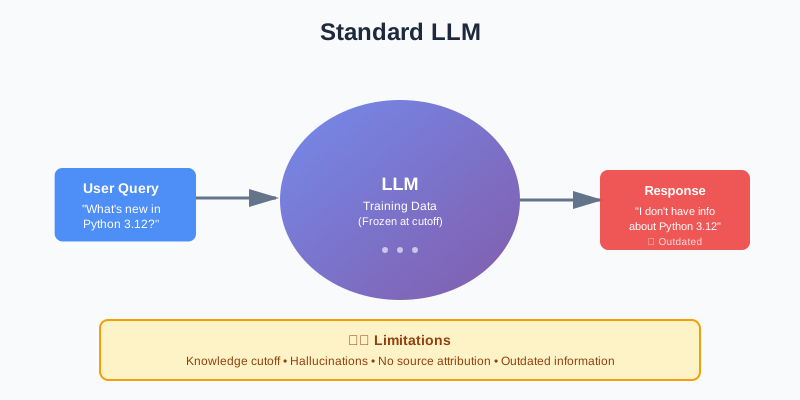
Standard LLM: Relies only on training data. Knowledge is frozen at training time. May hallucinate or provide outdated information.
-
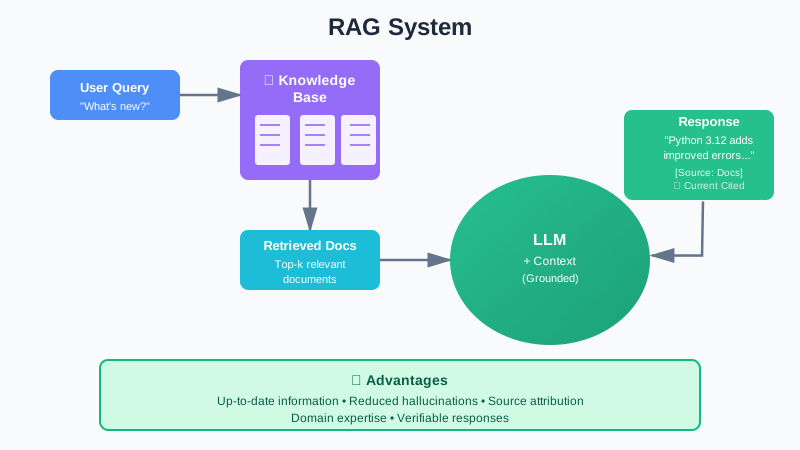
RAG System: Retrieves relevant documents from a knowledge base. Grounds responses in actual sources. Provides up-to-date, verifiable information.
Key Takeaways
Before moving to the next page, remember these key points:
- RAG = Retrieval + Generation: Combines information retrieval with LLM generation
- Solves LLM Limitations: Addresses knowledge cutoff, hallucinations, and lack of attribution
- Real-World Impact: Used across industries from customer support to medical diagnosis
- Grounded Responses: Answers are based on retrieved documents, not just training data
- Transparency: Can cite sources and show where information comes from
What’s Next?
In the next page, we’ll dive into the RAG Architecture and explore how each component works together to create this powerful system. You’ll see animated visualizations of the complete RAG pipeline.
Discussion
Loading comments...