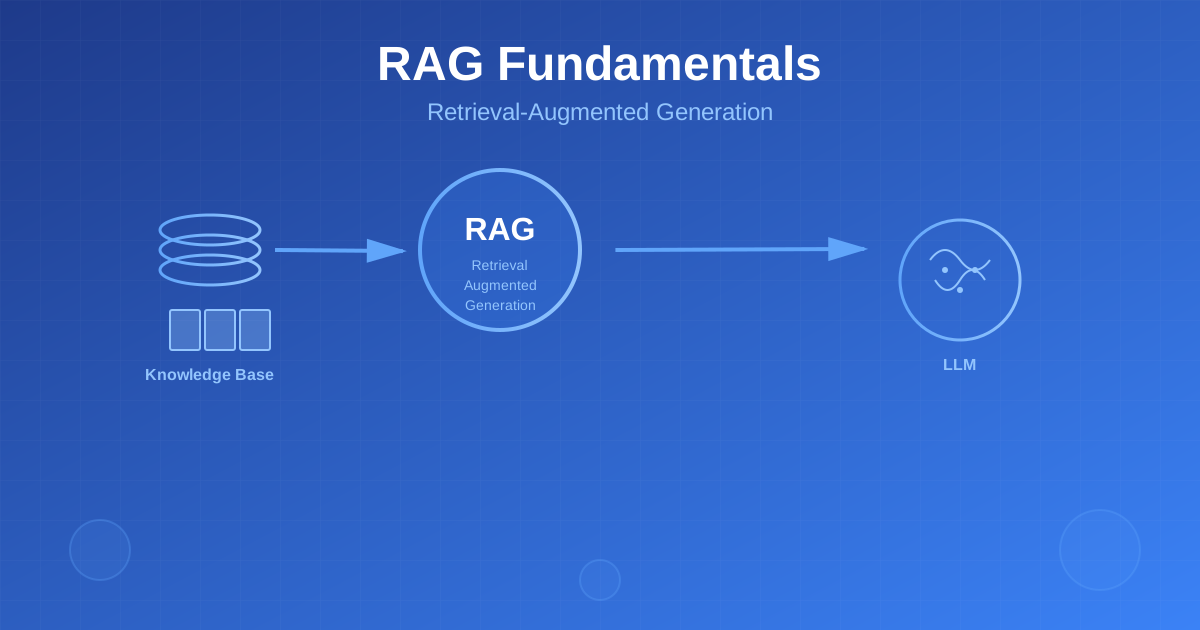
Understanding RAG: Retrieval-Augmented Generation
Welcome to RAG Fundamentals! 🚀
Retrieval-Augmented Generation (RAG) is transforming how we build AI applications. This interactive tutorial will teach you how RAG combines the power of information retrieval with large language models to create more accurate, up-to-date, and trustworthy AI systems.
What You’ll Learn
By the end of this tutorial, you’ll be able to:
- ✅ Explain RAG architecture and understand how each component works
- ✅ Identify when to use RAG vs. standard LLMs
- ✅ Build a mental model of the RAG pipeline
- ✅ Understand retrieval strategies and how they improve responses
- ✅ Apply RAG concepts to real-world problems
Tutorial Structure
This tutorial is divided into 5 interactive pages (approximately 25 minutes):
- Introduction (5 min) - What is RAG and why it matters
- Architecture (6 min) - Understanding RAG components with animated visualizations
- Retrieval Process (5 min) - How retrieval works with hands-on activity
- Generation Process (5 min) - LLM integration and comparison
- Practice & Summary (4 min) - Knowledge check and next steps
Interactive Features
Throughout this tutorial, you’ll experience:
- 🎬 Animated Concepts - Step-by-step visualizations of RAG processes
- 🎯 Drag-and-Drop Activities - Build RAG pipelines hands-on
- 📊 Animated Diagrams - Interactive system architecture
- ✅ Knowledge Checks - Test your understanding
Prerequisites
Before starting, you should have:
- Basic understanding of Large Language Models (LLMs)
- Familiarity with vector databases and embeddings
- Understanding of semantic search concepts
Don’t worry if you’re not an expert - we’ll explain concepts as we go!
Estimated Time
⏱️ 25 minutes to complete all 5 pages
You can take breaks between pages and resume anytime. Your progress will be tracked as you navigate through the tutorial.
What is RAG?
Quick Preview: Retrieval-Augmented Generation (RAG) enhances Large Language Models by combining them with external knowledge retrieval. Instead of relying solely on training data, RAG systems retrieve relevant information from a knowledge base to generate more accurate, up-to-date, and contextually relevant responses.
Why it matters: Traditional LLMs have knowledge cutoffs, can hallucinate, and lack domain-specific expertise. RAG solves these problems by grounding responses in retrieved documents.
Ready to dive in? Click the button above to start your RAG journey!
Discussion
Loading comments...