Understanding Quick Sort
Welcome to Quick Sort
Quick Sort is one of the most efficient sorting algorithms. It uses a divide-and-conquer approach and typically runs in O(n log n) time, making it a favorite for production code.
What You’ll Learn
By the end of this tutorial, you’ll be able to:
- ✅ Explain quick sort and the divide-and-conquer approach
- ✅ Understand partitioning and how it works
- ✅ Implement quick sort with optimizations
- ✅ Analyze performance and understand complexity
- ✅ Choose pivot strategies for best performance
Tutorial Structure
This tutorial is divided into 7 interactive pages (about 30 minutes):
- Introduction (4 min) - What is quick sort and why it’s fast
- How It Works (5 min) - Divide-and-conquer approach
- Partitioning (6 min) - The core of quick sort
- Visualization (4 min) - See it in action
- Implementation (5 min) - Code it yourself
- Complexity & Optimizations (4 min) - Performance analysis
- Practice & Quiz (2 min) - Test your knowledge
Interactive Features
Throughout this tutorial, you’ll use:
- 🎬 Animated Visualizations - Watch quick sort step-by-step
- 🎯 Interactive Sorters - Sort arrays yourself
- 📊 Animated Diagrams - See partitioning in action
- ✅ Knowledge Checks - Test your understanding
- 💻 Code Examples - Run and modify code
Prerequisites
Before starting, you should have:
- Basic understanding of arrays and recursion
- Familiarity with partitioning concepts
- Understanding of time complexity
Don’t worry if you’re not an expert - we’ll explain concepts as we go.
Estimated Time
⏱️ 30 minutes to complete all 7 pages
You can take breaks between pages and resume anytime. Your progress will be tracked as you navigate through the tutorial.
What is Quick Sort?
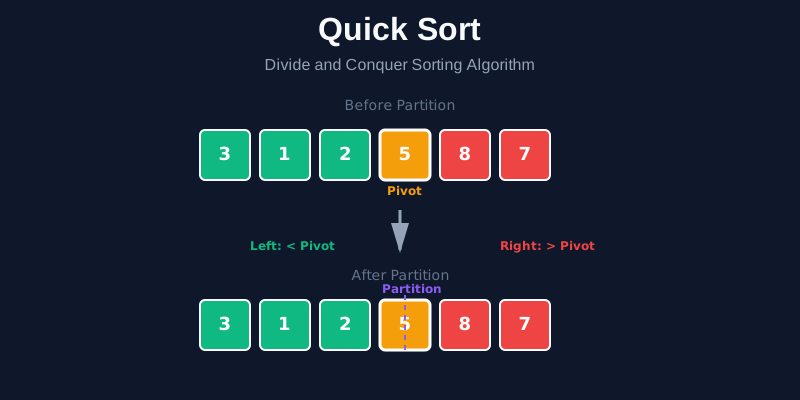
Quick Preview: Quick Sort is a divide-and-conquer algorithm that picks a pivot element and partitions the array around it. Elements smaller than the pivot go left, larger go right. Then it recursively sorts the sub-arrays.
Why it matters: Quick Sort is one of the fastest general-purpose sorting algorithms, with O(n log n) average time complexity. It’s used in many standard library implementations.
Ready to start? Click the button above to begin!
Discussion
Loading comments...