Understanding Insertion Sort
Welcome to Insertion Sort
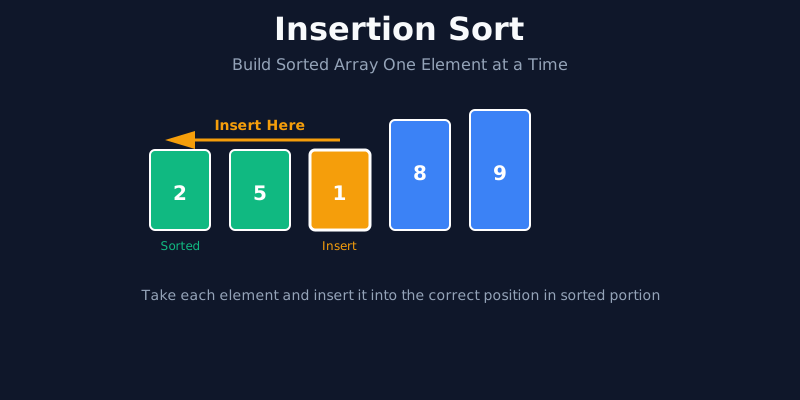
Insertion Sort is a simple sorting algorithm that builds the sorted array one element at a time. It’s similar to how you might sort playing cards in your hand.
What You’ll Learn
By the end of this tutorial, you’ll be able to:
- ✅ Explain insertion sort and how it works
- ✅ Implement insertion sort in code
- ✅ Analyze performance and understand complexity
- ✅ Identify when to use insertion sort
- ✅ Compare with other sorting algorithms
Tutorial Structure
This tutorial is divided into 7 interactive pages (about 25 minutes):
- Introduction (3 min) - What is insertion sort
- How It Works (4 min) - Step-by-step algorithm
- Visualization (4 min) - See it in action
- Implementation (5 min) - Code it yourself
- Complexity Analysis (4 min) - Time and space complexity
- Optimizations (3 min) - Making it better
- Practice & Quiz (2 min) - Test your knowledge
Interactive Features
Throughout this tutorial, you’ll use:
- 🎬 Animated Visualizations - Watch insertion sort step-by-step
- 🎯 Interactive Sorters - Sort arrays yourself
- 📊 Animated Diagrams - See how insertion works
- ✅ Knowledge Checks - Test your understanding
- 💻 Code Examples - Run and modify code
Prerequisites
Before starting, you should have:
- Basic understanding of arrays
- Familiarity with loops
- Understanding of time complexity concepts
Don’t worry if you’re not an expert - we’ll explain concepts as we go.
Estimated Time
⏱️ 25 minutes to complete all 7 pages
You can take breaks between pages and resume anytime. Your progress will be tracked as you navigate through the tutorial.
What is Insertion Sort?
Quick Preview: Insertion Sort works by building a sorted array one element at a time. It takes each element and inserts it into its correct position in the already-sorted portion of the array.
Why learn it: Insertion sort is simple, stable, and efficient for small datasets or nearly sorted arrays. It’s how many people naturally sort cards.
Ready to start? Click the button above to begin!
Discussion
Loading comments...