Understanding Binary Search Trees
Welcome to Binary Search Trees
Binary Search Trees (BSTs) are one of the most useful data structures in computer science. They let you store and find data quickly. This tutorial shows you how they work with interactive examples.
What You’ll Learn
By the end of this tutorial, you’ll be able to:
- ✅ Explain BST properties and why they matter
- ✅ Insert nodes into a BST correctly
- ✅ Search for values efficiently
- ✅ Delete nodes while maintaining BST properties
- ✅ Traverse trees using different methods
- ✅ Analyze performance of BST operations
Tutorial Structure
This tutorial is divided into 7 interactive pages (about 30 minutes):
- Introduction (4 min) - What are BSTs and why use them
- Structure & Properties (5 min) - Understanding BST rules
- Insertion (5 min) - Adding nodes to a BST
- Search (4 min) - Finding values efficiently
- Deletion (6 min) - Removing nodes correctly
- Traversal (4 min) - Visiting all nodes
- Practice & Quiz (2 min) - Test your knowledge
Interactive Features
Throughout this tutorial, you’ll use:
- 🎬 Animated Visualizations - Watch BST operations step-by-step
- 🎯 Interactive BST Builder - Build your own trees
- 📊 Animated Diagrams - See how algorithms work
- ✅ Knowledge Checks - Test your understanding
- 💻 Code Examples - Run and modify code
Prerequisites
Before starting, you should have:
- Basic understanding of trees and binary trees
- Familiarity with recursion
- Understanding of time complexity concepts
Don’t worry if you’re not an expert - we’ll explain concepts as we go.
Estimated Time
⏱️ 30 minutes to complete all 7 pages
You can take breaks between pages and resume anytime. Your progress will be tracked as you navigate through the tutorial.
What is a Binary Search Tree?
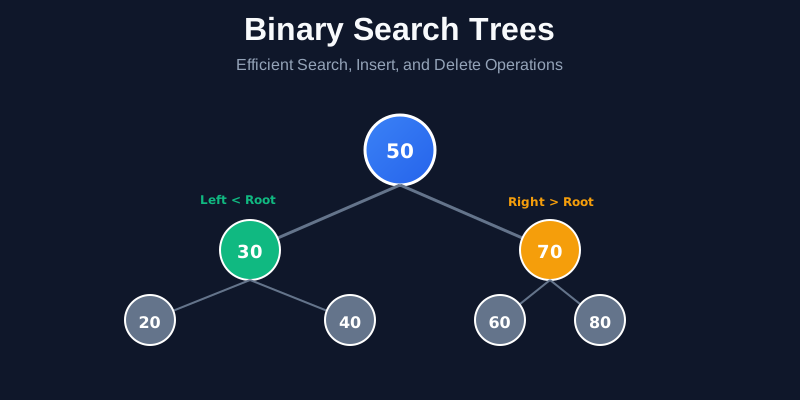
Quick Preview: A Binary Search Tree is a special type of binary tree where each node has a value, and all values in the left subtree are smaller than the node’s value, while all values in the right subtree are larger. This property makes searching very efficient.
Why it matters: BSTs let you search, insert, and delete values in O(log n) time on average, which is much faster than searching through an unsorted array.
Ready to start? Click the button above to begin!
Discussion
Loading comments...