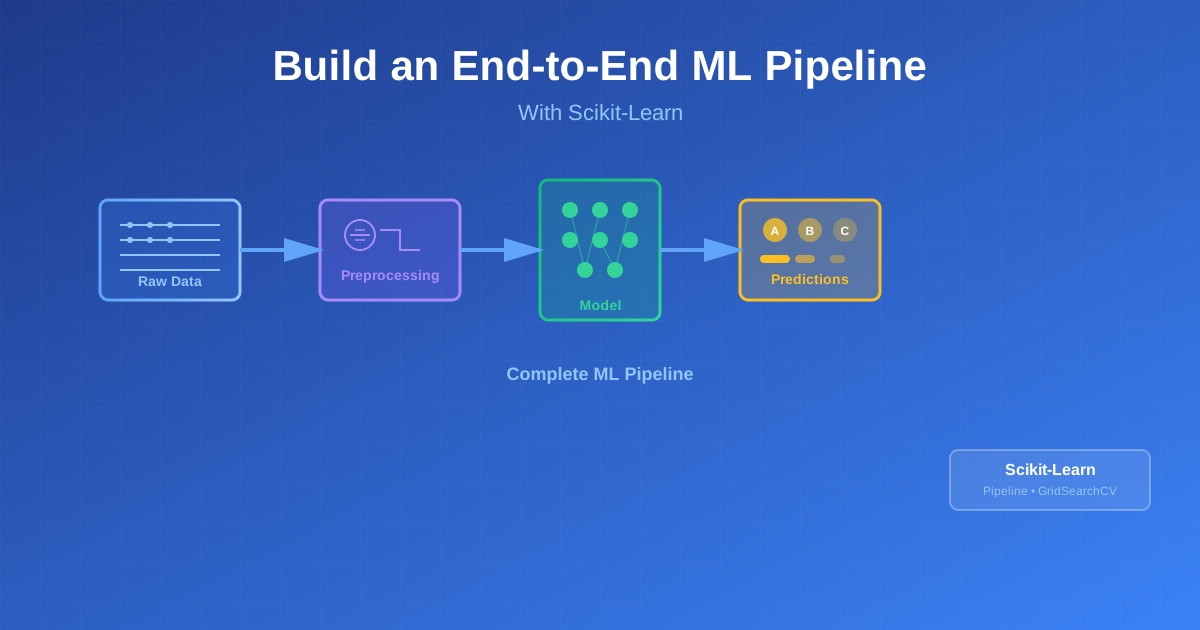
Build an End-to-End ML Pipeline with Scikit-Learn (Step by Step)
Welcome to Building ML Pipelines! 🚀
In this tutorial, you’ll build a complete machine learning pipeline using Scikit-Learn. We’ll start from a raw tabular dataset and end with a tuned model wrapped in a reusable Pipeline. Along the way, you’ll learn how to handle preprocessing, train/test splits, cross-validation, hyperparameter tuning, and evaluation in a clean and structured way.
What You’ll Build
We’ll build a classification model on a real-world style dataset using Scikit-Learn pipelines. You’ll use the Wine dataset to predict wine class based on chemical properties.
What Tools You’ll Use
- Python - The programming language
- Pandas - For data manipulation
- NumPy - For numerical operations
- Scikit-Learn - Pipeline, ColumnTransformer, GridSearchCV
Tutorial Structure
This tutorial is divided into 7 interactive pages (approximately 30 minutes):
- Setup and Dataset (5 min) - Install dependencies and explore the dataset
- Quick Baseline Model (4 min) - Build a simple model without pipelines
- Adding Preprocessing (5 min) - Use ColumnTransformer for feature preprocessing
- Building the Full Pipeline (5 min) - Combine preprocessing and model
- Cross-Validation (4 min) - Use cross-validation for better evaluation
- Hyperparameter Tuning (5 min) - Optimize model parameters with GridSearchCV
- Evaluation and Saving (2 min) - Evaluate the final model and save it for reuse
Interactive Features
Throughout this tutorial, you’ll experience:
- 🎬 Animated Concepts - Step-by-step visualizations of ML pipeline processes
- 📊 Animated Diagrams - Interactive system architecture
- 💻 Live Code Runner - Edit and run Python code directly in the browser
- 📑 Tabbed Panes - Compare different approaches side-by-side
- ✅ Knowledge Checks - Test your understanding
- 🎯 Interactive Activities - Hands-on practice with concepts
Prerequisites
Before starting, you should have:
- Comfortable with Python basics
- Used Pandas and NumPy at least once
- Knows what a classification model is, but may still be wiring things manually
- New to doing things “the Scikit-Learn way” with Pipeline, ColumnTransformer, and GridSearchCV
Don’t worry if you’re not an expert - we’ll explain concepts as we go!
Estimated Time
⏱️ 30 minutes to complete all 7 pages
You can take breaks between pages and resume anytime. Your progress will be tracked as you navigate through the tutorial.
What is a Machine Learning Pipeline?
Quick Preview: A machine learning pipeline is a way to chain together multiple steps of data processing and model training. Instead of manually calling fit_transform on each preprocessing step and then training the model, a pipeline automates this process and ensures consistency between training and prediction.
Why it matters: Pipelines make your code cleaner, prevent data leakage, and make it easier to deploy models to production. They’re the standard way to build ML systems in Scikit-Learn.
Ready to start building? Click the button above to begin your ML pipeline journey!
Discussion
Loading comments...