Designing Deterministic AI Workflows with Structured Generation and Schema-Constrained Outputs
Most production AI systems fail the same way. The model returns almost-correct JSON. Your parser chokes on a trailing comma. Or a field is missing. Or the enum value is “Medium” instead of “medium”. The workflow stops.
This happens because we treat LLMs like functions with deterministic outputs. They’re not. Every call is a new roll of the dice. You ask for structured JSON and sometimes you get it wrapped in markdown. Sometimes with extra commentary. Sometimes with a creative interpretation of your schema.
The shift from free-form generation to schema-constrained outputs isn’t about controlling the model. It’s about making AI systems that don’t fall apart when the model decides to be helpful in unexpected ways.
Why Free-Form AI Breaks Production Systems
You write a prompt. The model responds. You parse the response. It works in development. Then you deploy and get paged at 3am because the model returned {"status": "COMPLETED"} instead of {"status": "completed"}.
Here’s what breaks:
Inconsistent JSON: The model returns valid JSON 95% of the time. The other 5% you get trailing commas, unquoted keys, or creative use of single quotes.
Hallucinated fields: Your schema defines priority as 1-5. The model returns urgency: "critical" because it decided that made more sense.
Formatting errors: You need ISO timestamps. The model gives you “2026-07-14” one time and “July 14, 2026” the next.
Downstream failures: Every system after the LLM expects a specific shape. Missing fields cascade into KeyError exceptions. Wrong types cause silent failures that take hours to debug.
The real problem isn’t the model. It’s treating uncertain outputs like certain inputs.
What Structured Generation Actually Means
Structured generation is forcing the model to produce outputs that match your schema. Not asking nicely. Not hoping it follows instructions. Forcing.
There are different ways to do this:
JSON Schema: You define a schema. The model can only return JSON that validates against it. Providers like OpenAI and Anthropic support this natively now.
Typed outputs: Using libraries like Instructor or Pydantic to bind model outputs to typed Python objects. The validation happens automatically.
Function calling: The model selects a function and provides arguments. You validate the arguments before executing.
Structured decoding: Some models support constrained decoding where the tokenizer itself ensures valid JSON structure.
Schema validation: Post-generation validation that catches issues and triggers repair loops.
All of these share one thing: an explicit contract between your system and the model. The contract defines what’s required, what’s optional, and what’s allowed.
Designing AI-Friendly Schemas
Your schema is an interface. Design it like you’d design an API.
Start with required fields. What does your downstream system absolutely need? Make those required. Everything else is optional with sensible defaults.
from pydantic import BaseModel, Field
from typing import Literal

class TaskExtraction(BaseModel):
    title: str = Field(description="Task title, 10-100 characters")
    priority: Literal[1, 2, 3, 4, 5] = Field(description="1=lowest, 5=highest")
    category: Literal["bug", "feature", "docs", "refactor"]

    # Optional fields with defaults
    description: str | None = Field(None, description="Detailed description")
    estimated_hours: float | None = Field(None, ge=0.5, le=80.0)
    tags: list[str] = Field(default_factory=list, max_length=5)
Use enums for fixed sets. Don’t let the model choose from infinite possibilities. Literal["open", "in_progress", "done"] is better than str with validation later.
Constrain numbers. If priority is 1-5, enforce it with ge=1, le=5. If estimated hours can’t be negative or exceed 80, say so in the schema.
Nested objects need validation too. Each level should be explicit:
class Address(BaseModel):
    street: str
    city: str
    country: str = Field(pattern="^[A-Z]{2}$")  # ISO country codes

class Customer(BaseModel):
    name: str = Field(min_length=2, max_length=100)
    email: str = Field(pattern=r'^[\w\.-]+@[\w\.-]+\.\w+$')
    address: Address
Keep schemas small. One schema per task. Don’t create a mega-schema that extracts everything. Extract customer info in one call. Extract order details in another. Compose them if needed.
Version your schemas. When you change a field from optional to required, that’s a breaking change. Use explicit versions:
class TaskExtractionV2(BaseModel):
    schema_version: Literal["2.0"] = "2.0"
    # ... rest of schema
Validation Pipeline Architecture
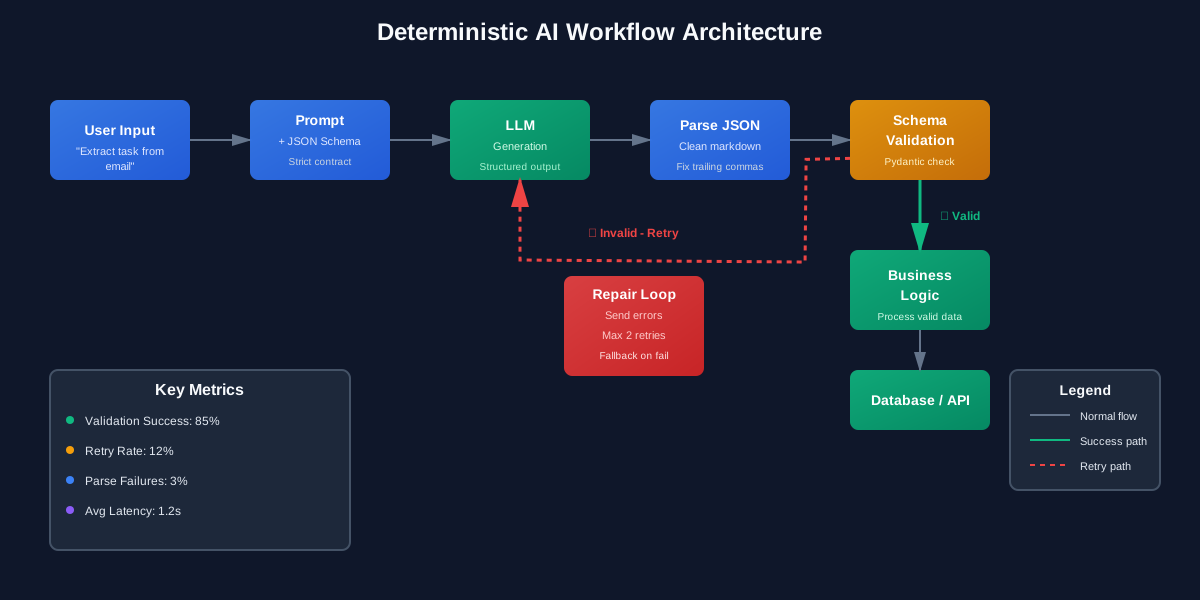
The pipeline is simple: prompt, generate, validate, decide.
User Input
    ↓
Prompt Construction
    ↓
LLM Generation
    ↓
Parse Output
    ↓
Schema Validation ──✗──→ Retry with Errors
    ↓ ✓                        ↓
Business Logic ←────────────────
    ↓
Database/API
Each step has one job. Parsing extracts JSON from model output. Validation checks the schema. Business logic processes valid data. There’s no mixing.
Here’s what it looks like in code:
def process_extraction(user_input: str, schema: type[BaseModel]):
    # Step 1: Build prompt
    prompt = build_prompt(user_input, schema)

    # Step 2: Generate
    response = llm.generate(prompt)

    # Step 3: Parse
    parsed = parse_json(response)
    if parsed is None:
        return handle_parse_failure()

    # Step 4: Validate
    try:
        validated = schema(**parsed)
    except ValidationError as e:
        return handle_validation_failure(e, user_input, schema)

    # Step 5: Business logic
    return process_business_logic(validated)
The parsing step handles common issues. Markdown code blocks. Extra text before or after JSON. Trailing commas. Unescaped quotes.
import re
import json

def parse_json(text: str) -> dict | None:
    # Remove markdown
    text = re.sub(r'```json\s*', '', text)
    text = re.sub(r'```\s*', '', text)

    # Extract first JSON object
    match = re.search(r'\{[^{}]*(?:\{[^{}]*\}[^{}]*)*\}', text)
    if not match:
        return None

    try:
        return json.loads(match.group(0))
    except json.JSONDecodeError:
        # Try fixing trailing commas
        fixed = re.sub(r',\s*}', '}', match.group(0))
        fixed = re.sub(r',\s*]', ']', fixed)
        try:
            return json.loads(fixed)
        except json.JSONDecodeError:
            return None
Validation catches schema violations. Pydantic gives you specific error messages:
from pydantic import ValidationError

def validate_with_details(data: dict, schema: type[BaseModel]):
    try:
        return schema(**data), None
    except ValidationError as e:
        errors = []
        for error in e.errors():
            field = ".".join(str(x) for x in error["loc"])
            msg = error["msg"]
            errors.append(f"{field}: {msg}")
        return None, errors
This pipeline makes debugging easier. You know where failures happen. Parse failures mean the model didn’t produce valid JSON. Validation failures mean the JSON doesn’t match your schema. Business logic failures are your code.
Retry Strategies That Work
When validation fails, you have options. Retry with the same prompt. Retry with error feedback. Partially regenerate just the invalid fields. Use a fallback model.
Validation retry is simplest. The model returns invalid output. You send the validation errors back. The model tries again.
def retry_with_errors(
    original_prompt: str,
    schema: type[BaseModel],
    validation_errors: list[str],
    max_retries: int = 2
) -> BaseModel | None:

    error_msg = "\n".join(validation_errors)
    repair_prompt = f"""Your previous output had these errors:
{error_msg}

Schema:
{schema.model_json_schema()}

Original request:
{original_prompt}

Return corrected JSON."""

    for attempt in range(max_retries):
        response = llm.generate(repair_prompt)
        parsed = parse_json(response)
        if parsed is None:
            continue

        validated, errors = validate_with_details(parsed, schema)
        if validated is not None:
            return validated

    return None
Repair prompts are specific. Show the exact validation errors. Show the schema. Ask for corrections only.
Don’t ask the model to regenerate everything. Show what broke:
Your previous output had these errors:
- priority: Input should be 1, 2, 3, 4, or 5
- email: Invalid email format

Please fix ONLY these fields. Keep everything else the same.
Partial regeneration works when most fields are valid. Extract the invalid fields. Regenerate just those. Merge with the original response.
def partial_regeneration(
    original_data: dict,
    schema: type[BaseModel],
    invalid_fields: list[str]
) -> dict:
    # Build prompt targeting specific fields
    field_prompts = []
    for field in invalid_fields:
        field_schema = schema.model_fields[field]
        field_prompts.append(
            f"{field}: {field_schema.description}"
        )

    prompt = f"""Generate valid values for these fields:
{chr(10).join(field_prompts)}

Return JSON with only these fields."""

    response = llm.generate(prompt)
    parsed = parse_json(response)

    # Merge with original
    return {**original_data, **parsed}
Fallback models are your last resort. The primary model fails. Switch to a more reliable (often smaller, cheaper) model with stricter prompts.
def extract_with_fallback(
    prompt: str,
    schema: type[BaseModel],
    primary_model: str = "gpt-4",
    fallback_model: str = "gpt-3.5-turbo"
) -> BaseModel:

    # Try primary
    result = try_extract(prompt, schema, primary_model, max_retries=2)
    if result is not None:
        return result

    # Fall back
    simpler_prompt = simplify_prompt(prompt)
    result = try_extract(simpler_prompt, schema, fallback_model, max_retries=1)
    if result is not None:
        return result

    # Use safe default
    return schema.model_validate({})
The key is limits. Retry once or twice. Not ten times. If it doesn’t work after 2-3 attempts, it won’t work. Move on.
Common Schema Design Mistakes
You’ll make these. Everyone does.
Deeply nested objects: Each level of nesting multiplies the failure rate. The model gets confused. Keep nesting to 2-3 levels max.
# Bad: 5 levels deep
class BadSchema(BaseModel):
    user: dict[str, dict[str, dict[str, dict[str, str]]]]

# Good: Flat with composition
class Address(BaseModel):
    street: str
    city: str

class User(BaseModel):
    name: str
    address: Address
Ambiguous field names: status, state, type, kind all mean roughly the same thing. The model picks randomly.
# Bad: Ambiguous
class Task(BaseModel):
    status: str  # "open"? "active"? "pending"?
    state: str   # How is this different from status?

# Good: Explicit
class Task(BaseModel):
    completion_status: Literal["not_started", "in_progress", "completed"]
    approval_state: Literal["pending", "approved", "rejected"]
Unlimited arrays: The model will fill them. You’ll get 100 tags when you needed 3.
# Bad: Unbounded
class Article(BaseModel):
    tags: list[str]  # Model returns 47 tags

# Good: Limited
class Article(BaseModel):
    tags: list[str] = Field(max_length=5)
Nullable confusion: Is None different from an empty string? Different from a missing field? Be explicit.
# Bad: Unclear intent
class User(BaseModel):
    phone: str | None = None  # None vs "" vs missing?

# Good: Clear intent
class User(BaseModel):
    phone: str | None = Field(
        None,
        description="Phone number if provided, None if user declined"
    )
Inconsistent enums: The model sees “high”, “HIGH”, “High”, and “priority_high” as equally valid.
# Bad: Inconsistent
priority: Literal["low", "MEDIUM", "High", "URGENT"]

# Good: Consistent
priority: Literal["low", "medium", "high", "urgent"]
These mistakes compound. Fix them in your schema, not in post-processing.
Observability You Actually Need
Track four metrics: validation success rate, retry rate, parse failure rate, schema drift.
Validation Success Rate: How often does the first generation pass validation?
validation_success_rate = successful_validations / total_attemptsTarget 80%+. If you’re below 70%, your schema is too strict or your prompts are unclear.
Retry Rate: How often do you need to retry?
retry_rate = retries / total_attemptsTarget <20%. High retry rate means wasted tokens and latency.
Parse Failure Rate: How often can’t you even extract JSON?
parse_failure_rate = parse_failures / total_attemptsTarget <5%. Parse failures usually mean prompt issues.
Schema Drift: How often do successful validations use different field combinations?
# Track which optional fields are populated
field_usage = {}
for validated_output in outputs:
    for field in validated_output.model_fields_set:
        field_usage[field] = field_usage.get(field, 0) + 1
If optional fields are never populated, make them required or remove them. If required fields are always empty strings, they should be optional.
Latency by path: How long does each path through the pipeline take?
import time

metrics = {
    "parse_time": [],
    "validate_time": [],
    "retry_time": [],
    "total_time": []
}

start = time.time()
parsed = parse_json(response)
metrics["parse_time"].append(time.time() - start)

start = time.time()
validated, errors = validate_with_details(parsed, schema)
metrics["validate_time"].append(time.time() - start)
Track P50, P95, P99 latency. Retries add 2-3x latency. Factor that into your SLOs.
Error patterns: What validation errors happen most?
error_counts = {}
for error in validation_errors:
    error_counts[error] = error_counts.get(error, 0) + 1

# Sort by frequency
sorted_errors = sorted(error_counts.items(), key=lambda x: x[1], reverse=True)
The top 3 error patterns tell you what to fix in prompts or schemas.
Log everything:
def log_extraction(
    prompt: str,
    response: str,
    validated: BaseModel | None,
    errors: list[str] | None,
    retries: int,
    latency: float,
    schema_version: str
):
    logger.info({
        "prompt_hash": hash(prompt),
        "response_hash": hash(response),
        "success": validated is not None,
        "errors": errors,
        "retries": retries,
        "latency_ms": latency * 1000,
        "schema_version": schema_version,
        "timestamp": datetime.utcnow().isoformat()
    })
These logs let you debug production issues. You can replay failed extractions. You can A/B test schema changes.
Production Checklist
Before you deploy:
Schema versioning: Every schema has an explicit version. Old and new schemas can coexist during migrations.
class TaskExtractionV1(BaseModel):
    version: Literal["1.0"] = "1.0"
    title: str
    priority: int

class TaskExtractionV2(BaseModel):
    version: Literal["2.0"] = "2.0"
    title: str
    priority: Literal[1, 2, 3, 4, 5]
    category: str  # New required field

def extract_task(input: str) -> BaseModel:
    # Try v2 first
    result = try_extract(input, TaskExtractionV2)
    if result is not None:
        return result

    # Fall back to v1
    return try_extract(input, TaskExtractionV1)
Automated testing: Test your schemas with valid and invalid inputs. Test your validation. Test your retry logic.
def test_validation():
    valid = {"title": "Fix bug", "priority": 3, "category": "bug"}
    assert TaskExtraction(**valid)

    invalid = {"title": "Fix bug", "priority": 6, "category": "other"}
    with pytest.raises(ValidationError):
        TaskExtraction(**invalid)

def test_retry_logic():
    def mock_llm_with_fix(prompt):
        if "errors" in prompt:
            return '{"priority": 3}'  # Fixed
        return '{"priority": "high"}'  # Invalid

    result = retry_with_errors("test", TaskExtraction, ["priority: must be 1-5"])
    assert result is not None
assert result.priority in [1, 2, 3, 4, 5]Monitoring: Set up alerts on validation failure rate, retry rate, and latency P95.
# Alert if validation failure rate > 30%
if validation_success_rate < 0.7:
    alert("High validation failure rate", rate=validation_success_rate)

# Alert if P95 latency > 5s
if p95_latency > 5.0:
    alert("High latency", p95=p95_latency)
Backward compatibility: When you change schemas, old code should still work. Use optional fields for new additions. Use separate schemas for breaking changes.
# Good: New optional field
class TaskV2(BaseModel):
    title: str
    priority: int
    assignee: str | None = None  # New, optional

# Bad: New required field
class TaskV2(BaseModel):
    title: str
    priority: int
    assignee: str  # Breaking change!
Audit logging: Log every extraction with enough context to reproduce issues.
audit_log = {
    "extraction_id": uuid.uuid4(),
    "user_id": user_id,
    "prompt": prompt,
    "response": response,
    "validated": bool(result),
    "schema_version": schema.version,
    "timestamp": datetime.utcnow(),
    "model": model_name
}
These logs are your debugging tool when something goes wrong in production.
Code Samples
The repository includes 10 complete examples:
- Pydantic Schema Definitions: Comprehensive schemas with validation rules, enums, and nested objects
- JSON Schema Generation: Converting Pydantic models to JSON Schema for LLM consumption
- Validation Middleware: Reusable validation wrapper with detailed error reporting
- Retry Logic: Exponential backoff with repair prompts and max attempts
- FastAPI Integration: REST endpoint with schema validation and error handling
- Typed Response Handler: Type-safe response processing with exhaustive error handling
- Unit Tests: Property-based testing and golden test cases
- Schema Evolution: Versioning and migration strategies for production schemas
- Observability Metrics: Prometheus-style metrics collection and export
- Complete Pipeline: End-to-end example tying everything together
Each example is self-contained and runnable. See the GitHub repository for setup instructions and detailed documentation.
Making It Work
Start small. Pick one LLM integration that breaks often. Add a schema. Add validation. Measure the difference.
You’ll see fewer runtime errors. Fewer silent failures. Fewer debugging sessions at 3am trying to figure out why the pipeline stopped.
The pattern scales. One schema becomes ten. Ten schemas become a library. That library becomes your interface to all LLM operations.
Schema-first design isn’t about controlling the model. It’s about making AI systems that survive contact with production. That’s the difference between a demo and a system you can depend on.
Discussion
Loading comments...