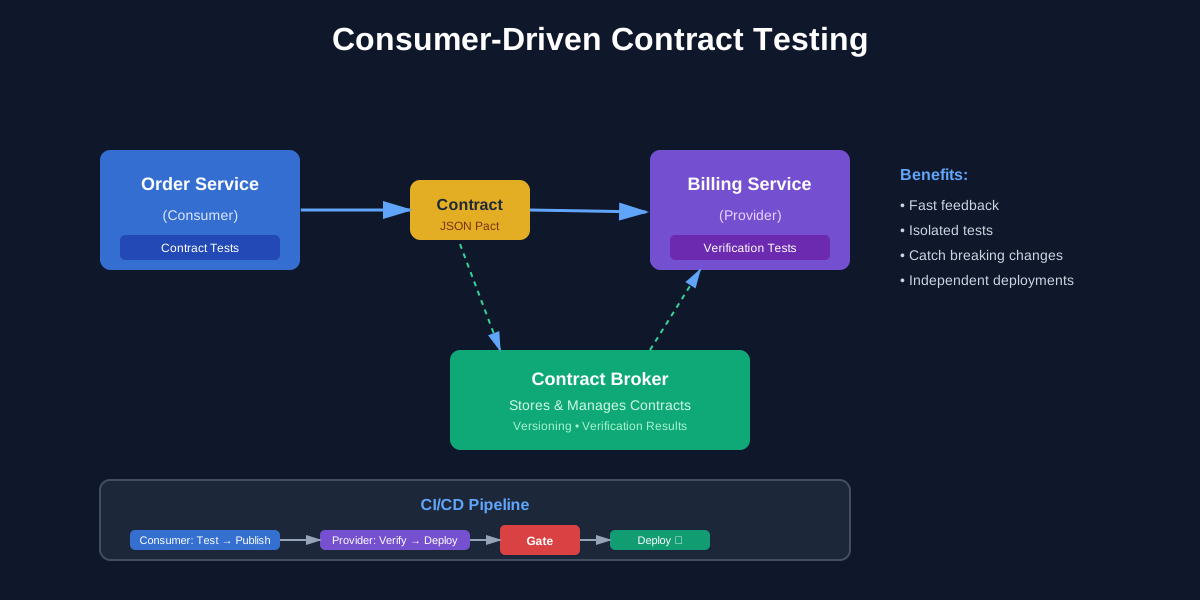
Consumer-Driven Contract Testing: Keeping Microservices Deployable Without Fragile End-to-End Tests
You deploy a small change to BillingService. A field name changes from amount to total. OrderService breaks in production. Customers can’t complete purchases.
This happens when services change without coordination. Integration tests catch some issues, but they’re slow and flaky. They run against real services or complex test environments. They break when unrelated services change. You can’t deploy independently.
Consumer-driven contract testing fixes this. Consumers define what they expect from providers. Providers verify they meet those expectations. Tests run fast. They’re isolated. They catch breaking changes before deployment.
This article shows how to adopt contract testing in practice.
The Pain: Why Integration Tests Aren’t Enough
Most teams start with integration tests. They test the full flow: OrderService calls BillingService, which calls PaymentGateway. Everything works together.
Then problems appear.
Story: One Small Change Breaks Everything
OrderService calls BillingService’s /payments endpoint. It expects a response with amount and currency. Everything works.
A developer refactors BillingService. They rename amount to total for clarity. The change looks safe. Unit tests pass. Integration tests pass. They deploy.
OrderService breaks. It still expects amount. The response has total instead. Orders fail. Revenue stops.
Integration tests didn’t catch this because they test against a shared test environment. That environment might be outdated. Or the test data doesn’t cover this field. Or the test passes but production breaks because environments differ.
Limitations of Full Integration / E2E Tests
Slow. Integration tests spin up multiple services. They wait for databases. They make real HTTP calls. A full suite takes minutes or hours. You can’t run them on every commit.
Flaky. Services depend on each other. One service is slow. The test times out. Or a service is down. The test fails. It’s not your code. It’s the environment.
Environment-heavy. You need databases, message queues, external services. Setting up test environments is complex. Keeping them in sync with production is harder.
Hard to pinpoint failures. A test fails. Which service broke? Which change caused it? You dig through logs. You check multiple services. Debugging takes hours.
You want fast feedback at service boundaries. You don’t need to test the entire system. You need to test the contract between two services. Is the API still compatible? That’s what contract testing does.
What Is Contract Testing?
Contract testing validates the “handshake” between consumer and provider services. It checks that requests and responses match expectations.
Think of it like this: Consumer says “When I send X, I expect Y back.” Provider says “I can handle X and return Y.” Contract tests verify both sides match.
How It Differs from Other Testing
Schema validation (OpenAPI): OpenAPI defines the API structure. It’s documentation. It doesn’t test behavior. Contract tests verify actual requests and responses work.
Unit tests: Unit tests check one service in isolation. They mock dependencies. Contract tests check the interface between services. They verify compatibility.
E2E tests: E2E tests run the full system. They’re slow and brittle. Contract tests run at service boundaries. They’re fast and isolated.
Consumer-Driven Contracts
In consumer-driven contract testing, consumers define what they need. Providers must satisfy those expectations.
Consumers define expected requests + responses. OrderService writes a test: “When I call POST /payments with this body, I expect this response.” The test generates a contract.
Providers must satisfy these expectations. BillingService runs verification tests. It checks: “Can I handle all the contracts from my consumers?” If not, deployment fails.
This flips the traditional model. Instead of providers dictating the API, consumers drive it. Providers adapt to what consumers actually need.
Where Contract Testing Fits in the Test Pyramid
The test pyramid shows how to balance test types:
        /\
       /  \  Few E2E tests
      /____\
     /      \  More integration/contract tests
    /________\
   /          \  Many unit tests
  /____________\
Unit tests: Fast. Isolated. Test business logic. You write many of these.
Contract tests: Fast. Isolated to service boundaries. Test API compatibility. You write these for each consumer-provider pair.
E2E tests: Slow. Full system. Test critical user journeys. You write a few of these.
Many teams now rely on contract tests instead of heavy E2E suites for microservices. Contract tests catch breaking changes. They run fast. They don’t require full environments.
E2E tests still matter. But you use them for critical paths. Contract tests handle the rest.
Designing Good Contracts
Contracts should be stable and clear. They should focus on what matters, not implementation details.
Keep Them Business-Level
Contracts should express business intent, not internal structure.
Bad: Contract includes internal IDs, database timestamps, implementation details.
{
  "paymentId": "internal-db-id-12345",
  "createdAt": "2025-12-06T10:30:45.123Z",
  "internalStatus": "PROCESSING"
}
Good: Contract includes only what consumers need.
{
  "paymentId": "pay_abc123",
  "status": "completed",
  "amount": 100.00,
  "currency": "USD"
}
Use Clear, Stable Fields
Field names should be obvious. Avoid abbreviations. Use consistent naming.
Bad: amt, curr, txn_id
Good: amount, currency, transactionId
Versioning Patterns
APIs change. Design for evolution.
Additive changes with defaults: Add new optional fields. Old consumers still work. New consumers can use new fields.
// Version 1
{
  "amount": 100.00,
  "currency": "USD"
}

// Version 2 (additive)
{
  "amount": 100.00,
  "currency": "USD",
  "fee": 2.50  // New optional field
}
Deprecate fields instead of removing: Mark fields as deprecated. Give consumers time to migrate. Remove later.
{
  "amount": 100.00,
  "currency": "USD",
  "deprecated_field": "value",  // Marked deprecated, will be removed in v3
  "new_field": "value"
}
Use explicit versioning when you must break compatibility: Sometimes you need breaking changes. Use versioned endpoints or headers.
POST /api/v1/payments  // Old version
POST /api/v2/payments  // New version with breaking changes
Example: Payment Request/Response
Here’s a well-designed payment contract:
Request:
{
  "orderId": "order_123",
  "amount": 100.00,
  "currency": "USD",
  "paymentMethod": {
    "type": "card",
    "last4": "4242"
  }
}
Response:
{
  "paymentId": "pay_abc123",
  "status": "completed",
  "amount": 100.00,
  "currency": "USD",
  "processedAt": "2025-12-06T10:30:00Z"
}
Optional fields for backward compatibility:
{
  "paymentId": "pay_abc123",
  "status": "completed",
  "amount": 100.00,
  "currency": "USD",
  "processedAt": "2025-12-06T10:30:00Z",
  "fee": 2.50,  // Optional, added in v2
  "refundable": true  // Optional, added in v2
}
Old consumers ignore optional fields. New consumers can use them.
Consumer-Driven Flow: Step by Step
Let’s walk through a complete example using OrderService (consumer) and BillingService (provider).
Consumer Tests (Order Service)
OrderService writes tests that define what it expects from BillingService.
import { Pact } from '@pact-foundation/pact';
import { Matchers } from '@pact-foundation/pact';

describe('OrderService -> BillingService', () => {
  const provider = new Pact({
    consumer: 'OrderService',
    provider: 'BillingService',
    port: 1234,
    log: './logs/pact.log',
    dir: './pacts',
  });

  beforeAll(() => provider.setup());
  afterAll(() => provider.finalize());
  afterEach(() => provider.verify());

  it('creates a payment for an order', async () => {
    const expectedPayment = {
      paymentId: Matchers.string('pay_abc123'),
      status: Matchers.string('completed'),
      amount: Matchers.decimal(100.00),
      currency: Matchers.string('USD'),
      processedAt: Matchers.iso8601DateTime('2025-12-06T10:30:00Z'),
    };

    await provider.addInteraction({
      state: 'order exists',
      uponReceiving: 'a request to create a payment',
      withRequest: {
        method: 'POST',
        path: '/payments',
        headers: {
          'Content-Type': 'application/json',
        },
        body: {
          orderId: 'order_123',
          amount: 100.00,
          currency: 'USD',
          paymentMethod: {
            type: 'card',
            last4: '4242',
          },
        },
      },
      willRespondWith: {
        status: 201,
        headers: {
          'Content-Type': 'application/json',
        },
        body: expectedPayment,
      },
    });

    // Run your actual service code
    const response = await orderService.createPayment({
      orderId: 'order_123',
      amount: 100.00,
      currency: 'USD',
      paymentMethod: {
        type: 'card',
        last4: '4242',
      },
    });

    expect(response.paymentId).toBe('pay_abc123');
    expect(response.status).toBe('completed');
  });
});
This test:
- Sets up a mock provider using Pact
- Defines the expected request (method, path, body, headers)
- Defines the expected response (status, body shape)
- Runs the actual OrderService code against the mock
- Generates a contract file (JSON) when the test passes
Generated Contract
The test produces a contract file:
{
  "consumer": {
    "name": "OrderService"
  },
  "provider": {
    "name": "BillingService"
  },
  "interactions": [
    {
      "description": "a request to create a payment",
      "providerState": "order exists",
      "request": {
        "method": "POST",
        "path": "/payments",
        "headers": {
          "Content-Type": "application/json"
        },
        "body": {
          "orderId": "order_123",
          "amount": 100.00,
          "currency": "USD",
          "paymentMethod": {
            "type": "card",
            "last4": "4242"
          }
        }
      },
      "response": {
        "status": 201,
        "headers": {
          "Content-Type": "application/json"
        },
        "body": {
          "paymentId": "pay_abc123",
          "status": "completed",
          "amount": 100.00,
          "currency": "USD",
          "processedAt": "2025-12-06T10:30:00Z"
        }
      }
    }
  ],
  "metadata": {
    "pactSpecification": {
      "version": "3.0.0"
    }
  }
}
Contract Broker / Registry
Contracts need a central place to live. This is the contract broker.
What it does:
- Stores contracts from all consumers
- Tracks which consumer versions use which contracts
- Provides APIs for providers to fetch contracts
- Shows verification results
Why it matters:
- Providers can see all consumers they need to satisfy
- Teams can see which contracts are verified
- You can track contract evolution over time
Popular options: Pact Broker (open source), PactFlow (managed service), or a simple file store for small teams.
Provider Verification (Billing Service)
BillingService verifies it can satisfy all consumer contracts.
import { Verifier } from '@pact-foundation/pact';
import { server } from './billing-service';

describe('BillingService Provider Verification', () => {
  it('verifies all contracts from OrderService', async () => {
    const verifier = new Verifier({
      providerBaseUrl: 'http://localhost:3000',
      pactBrokerUrl: 'https://pact-broker.example.com',
      provider: 'BillingService',
      consumerVersionTags: ['main'],
      publishVerificationResult: true,
      providerVersion: process.env.GIT_COMMIT || '1.0.0',
    });

    await verifier.verifyProvider();
  });
});
This test:
- Fetches contracts from the broker (or local files)
- Spins up the real BillingService (or a test instance)
- Replays each interaction from the contract
- Verifies actual responses match contract expectations
- Publishes results back to the broker
If verification fails, the test fails. Deployment is blocked.
Deployment Gating
The key: contract verification gates deployment.
Consumer pipeline:
- Run contract tests
- Generate contracts
- Publish contracts to broker
- Deploy consumer
Provider pipeline:
- Fetch latest contracts from broker
- Run provider verification
- If verification fails, block deployment
- If verification passes, deploy provider
This ensures providers never deploy breaking changes. Consumers never deploy code that expects changes providers haven’t made.
Implementation Walkthrough with Code
Let’s build a complete example using TypeScript and Pact.
Project Setup
{
  "name": "contract-testing-example",
  "version": "1.0.0",
  "scripts": {
    "test:consumer": "jest --testPathPattern=consumer",
    "test:provider": "jest --testPathPattern=provider",
    "publish:pacts": "pact-broker publish ./pacts --broker-base-url https://pact-broker.example.com"
  },
  "dependencies": {
    "@pact-foundation/pact": "^13.0.0",
    "express": "^4.18.2",
    "axios": "^1.6.0"
  },
  "devDependencies": {
    "@types/node": "^20.10.0",
    "@types/express": "^4.17.21",
    "typescript": "^5.3.3",
    "ts-node": "^10.9.2",
    "jest": "^29.7.0"
  }
}
Consumer Test
// consumer/order-service.test.ts
import { Pact } from '@pact-foundation/pact';
import { Matchers } from '@pact-foundation/pact';
import axios from 'axios';

describe('OrderService -> BillingService', () => {
  const provider = new Pact({
    consumer: 'OrderService',
    provider: 'BillingService',
    port: 1234,
    log: './logs/pact.log',
    dir: './pacts',
  });

  beforeAll(() => provider.setup());
  afterAll(() => provider.finalize());
  afterEach(() => provider.verify());

  describe('create payment', () => {
    it('creates a payment successfully', async () => {
      const paymentRequest = {
        orderId: 'order_123',
        amount: 100.00,
        currency: 'USD',
        paymentMethod: {
          type: 'card',
          last4: '4242',
        },
      };

      const expectedResponse = {
        paymentId: Matchers.string('pay_abc123'),
        status: Matchers.string('completed'),
        amount: Matchers.decimal(100.00),
        currency: Matchers.string('USD'),
        processedAt: Matchers.iso8601DateTime('2025-12-06T10:30:00Z'),
      };

      await provider.addInteraction({
        state: 'order exists and is valid',
        uponReceiving: 'a request to create a payment',
        withRequest: {
          method: 'POST',
          path: '/payments',
          headers: {
            'Content-Type': 'application/json',
          },
          body: paymentRequest,
        },
        willRespondWith: {
          status: 201,
          headers: {
            'Content-Type': 'application/json',
          },
          body: expectedResponse,
        },
      });

      // Actual service call
      const response = await axios.post(
        'http://localhost:1234/payments',
        paymentRequest
      );

      expect(response.status).toBe(201);
      expect(response.data.paymentId).toBe('pay_abc123');
      expect(response.data.status).toBe('completed');
    });

    it('handles payment failure', async () => {
      await provider.addInteraction({
        state: 'payment processing fails',
        uponReceiving: 'a request to create a payment that fails',
        withRequest: {
          method: 'POST',
          path: '/payments',
          headers: {
            'Content-Type': 'application/json',
          },
          body: {
            orderId: 'order_456',
            amount: 50.00,
            currency: 'USD',
            paymentMethod: {
              type: 'card',
              last4: '0000',
            },
          },
        },
        willRespondWith: {
          status: 400,
          headers: {
            'Content-Type': 'application/json',
          },
          body: {
            error: Matchers.string('Payment failed'),
            code: Matchers.string('INSUFFICIENT_FUNDS'),
          },
        },
      });

      try {
        await axios.post('http://localhost:1234/payments', {
          orderId: 'order_456',
          amount: 50.00,
          currency: 'USD',
          paymentMethod: {
            type: 'card',
            last4: '0000',
          },
        });
        fail('Should have thrown an error');
      } catch (error: any) {
        expect(error.response.status).toBe(400);
        expect(error.response.data.error).toBe('Payment failed');
      }
    });
  });
});
Provider Implementation
// provider/billing-service.ts
import express from 'express';

const app = express();
app.use(express.json());

interface PaymentRequest {
  orderId: string;
  amount: number;
  currency: string;
  paymentMethod: {
    type: string;
    last4: string;
  };
}

app.post('/payments', async (req, res) => {
  const payment: PaymentRequest = req.body;

  // Validate request
  if (!payment.orderId || !payment.amount || !payment.currency) {
    return res.status(400).json({
      error: 'Invalid request',
      code: 'INVALID_REQUEST',
    });
  }

  // Simulate payment processing
  if (payment.paymentMethod.last4 === '0000') {
    return res.status(400).json({
      error: 'Payment failed',
      code: 'INSUFFICIENT_FUNDS',
    });
  }

  // Success response
  res.status(201).json({
    paymentId: `pay_${Math.random().toString(36).substr(2, 9)}`,
    status: 'completed',
    amount: payment.amount,
    currency: payment.currency,
    processedAt: new Date().toISOString(),
  });
});

export default app;
Provider Verification Test
// provider/billing-service.verification.test.ts
import { Verifier } from '@pact-foundation/pact';
import server from './billing-service';

describe('BillingService Provider Verification', () => {
  let app: any;
  let serverInstance: any;

  beforeAll(() => {
    const PORT = 3000;
    serverInstance = server.listen(PORT, () => {
      console.log(`Provider service running on port ${PORT}`);
    });
    app = server;
  });

  afterAll((done) => {
    serverInstance.close(done);
  });

  it('verifies all contracts from OrderService', async () => {
    const verifier = new Verifier({
      providerBaseUrl: 'http://localhost:3000',
      pactBrokerUrl: process.env.PACT_BROKER_URL || 'https://pact-broker.example.com',
      provider: 'BillingService',
      consumerVersionTags: ['main'],
      publishVerificationResult: true,
      providerVersion: process.env.GIT_COMMIT || '1.0.0',
      logLevel: 'INFO',
    });

    const output = await verifier.verifyProvider();
    expect(output).toBeDefined();
  });
});
Integrating Contract Testing into Your Delivery Process
Adopting contract testing takes planning. Here’s how to introduce it gradually.
Start with One Critical Integration
Pick the integration that causes the most pain. Maybe it’s OrderService -> BillingService. Maybe it’s UserService -> AuthService.
Steps:
- Write consumer tests for that integration
- Generate contracts
- Set up provider verification
- Wire into CI/CD
- Monitor and iterate
Don’t try to contract test everything at once. Start small. Learn. Expand.
Mirror Key E2E Scenarios as Contracts
Look at your E2E tests. What scenarios do they cover? Convert those to contracts.
E2E test: “User can place an order and pay”
Contracts:
- OrderService -> BillingService: create payment
- OrderService -> InventoryService: reserve items
- OrderService -> NotificationService: send confirmation
Each contract is faster and more isolated than the E2E test.
Teaching Teams to Own Their Contracts
Consumers = responsible for clear expectations. Consumers write contract tests. They define what they need. They keep contracts up to date.
Providers = responsible for stable APIs and backward compatibility. Providers verify contracts. They don’t break existing contracts. They coordinate breaking changes.
Make this explicit in your team agreements. Document the process. Review contracts in code reviews.
Best Practices
Run contract tests on every commit. Both consumer and provider. Fast feedback. Catch issues early.
Use tags or labels for environments in broker. Tag contracts with main, staging, production. Providers verify against the right tags.
const verifier = new Verifier({
  providerBaseUrl: 'http://localhost:3000',
  pactBrokerUrl: 'https://pact-broker.example.com',
  provider: 'BillingService',
  consumerVersionTags: ['main'], // Verify contracts from main branch
  providerVersionTags: ['staging'], // Tag this verification for staging
});
Keep contracts in version control. Store generated contracts in your repo. Review them like code. Track changes over time.
Document contract evolution. When you add fields, document why. When you deprecate fields, document migration path.
Avoiding Common Traps
Contract testing has pitfalls. Here’s how to avoid them.
Contract Explosion
Problem: Every tiny variation becomes a separate contract. You have hundreds of contracts. Maintenance becomes impossible.
Solution: Group scenarios by use case. One contract per use case, not per variation.
// Bad: Separate contract for each field combination
it('creates payment with amount 100', ...);
it('creates payment with amount 200', ...);
it('creates payment with amount 300', ...);

// Good: One contract with flexible matchers
it('creates payment with any valid amount', async () => {
  await provider.addInteraction({
    // ...
    body: {
      amount: Matchers.decimal(), // Any decimal value
      // ...
    },
  });
});
Over-Mocking
Problem: Contracts use fake data that doesn’t reflect real behavior. Tests pass but production breaks.
Solution: Use realistic data. Test with actual service responses when possible. Validate contracts against production-like responses.
// Bad: Unrealistic test data
body: {
  paymentId: 'test-id',
  status: 'completed',
  amount: 999999.99, // Unrealistic
}

// Good: Realistic test data
body: {
  paymentId: Matchers.string('pay_abc123'), // Realistic format
  status: Matchers.string('completed'),
  amount: Matchers.decimal(100.00), // Realistic amount
}
Ignoring Error Cases
Problem: Contracts only test happy paths. Error cases break in production.
Solution: Include error responses in contracts. Test 400, 500, timeout scenarios.
it('handles payment failure', async () => {
  await provider.addInteraction({
    // ...
    willRespondWith: {
      status: 400,
      body: {
        error: Matchers.string(),
        code: Matchers.string('INSUFFICIENT_FUNDS'),
      },
    },
  });
});
Breaking Changes Without Coordination
Problem: Provider makes breaking change. All consumer contracts fail. Deployment blocked. Teams stuck.
Solution: Process for proposing breaking changes:
- Provider proposes change
- Notify all consumers
- Consumers update contracts (or agree to change)
- Provider deploys after all consumers ready
Or use versioning:
- Keep old endpoint working
- Add new endpoint with breaking changes
- Migrate consumers gradually
- Deprecate old endpoint
Pulling It All Together
Contract testing supports several goals:
Independent Deployments
Teams deploy without coordinating. Consumer deploys. Provider deploys. Contract tests ensure compatibility. No manual coordination needed.
Smaller, More Stable E2E Suites
E2E tests focus on critical paths. Contract tests handle service boundaries. Fewer E2E tests. More stable. Faster feedback.
Safer Refactors
You can refactor a service internally. As long as contracts pass, consumers work. Refactor with confidence.
Short Checklist for Adopting Contract Testing
Next sprint:
- Pick one critical integration
- Write consumer contract tests
- Set up contract broker (or file store)
- Write provider verification
- Add to CI/CD pipeline
- Monitor and iterate
Within a month:
- Contract test 3-5 key integrations
- Document process for team
- Review contracts in code reviews
- Reduce E2E test coverage where contracts cover it
Long term:
- Contract test all service boundaries
- Use contract tests as API documentation
- Track contract evolution over time
- Use contracts to guide API design
The Bottom Line
Contract testing lets teams deploy microservices independently. It catches breaking changes fast. It runs in CI/CD. It doesn’t require complex test environments.
Start with one integration. Write consumer tests. Set up provider verification. Wire into your pipeline. Learn from it. Expand gradually.
Your deployments will be safer. Your teams will move faster. Your production will break less.
The code examples in this article are available in the repository. Use them as a starting point. Adapt them to your needs. Build systems you can deploy with confidence.
Yusuf Elborey is a software architect who helps teams build reliable microservices. He writes about system design, testing strategies, and distributed systems patterns.
Discussion
Loading comments...