Reflexive AI Agents: Closing the Loop Between Perception and Self-Evaluation
An agent processes a task. It makes a decision. It acts. Then it moves on. It doesn’t look back. It doesn’t question whether the decision was right. It doesn’t learn from its mistakes in real-time.
This is how most AI agents work today. They react. They don’t reflect.
Reflexive agents change that. They evaluate their own reasoning after each step. They detect errors. They adjust their approach. They close the loop between perception and self-evaluation.
This article explains how reflexive agents work and how to build them.
Introduction
Most AI agents follow a simple pattern. They receive input. They process it. They produce output. They move to the next task. There’s no feedback loop. No self-evaluation. No adaptation based on their own performance.
This works for straightforward tasks. But real problems are messy. Decisions have consequences. Actions create new situations. Agents need to evaluate whether their reasoning was sound. They need to correct mistakes before they compound.
Reflexive agents add a self-reflection layer. After each action, the agent evaluates its reasoning. Did it use the right tools? Did it consider all relevant context? Was its logic sound? If not, it adapts. It adjusts its policy. It updates its approach.
This isn’t just about error correction. It’s about building agents that understand their own limitations. Agents that recognize when they’re uncertain. Agents that seek clarification instead of guessing. Agents that improve over time through self-evaluation.
Why Reflection Matters
Reflection matters because agents make mistakes. They use wrong tools. They miss important context. They reason incorrectly. Without reflection, these mistakes compound. The agent keeps making the same errors. It doesn’t learn.
With reflection, agents catch errors early. They identify patterns in their mistakes. They adjust their behavior. They become more reliable over time.
Reflection also enables alignment. Agents can evaluate whether their actions match their goals. They can detect when they’re drifting off course. They can self-correct before external intervention is needed.
Relationship to Meta-Cognition
Reflexive agents are related to meta-cognition. Meta-cognition is thinking about thinking. It’s the ability to evaluate your own cognitive processes. To know what you know. To recognize what you don’t know.
Humans use meta-cognition constantly. We ask ourselves: “Did I understand that correctly?” “Am I using the right approach?” “What am I missing?” This self-awareness improves our decision-making.
Reflexive agents bring meta-cognition to AI systems. They evaluate their reasoning processes. They assess their confidence. They identify gaps in their knowledge. This makes them more reliable and trustworthy.
The Shift After 2024
Before 2024, most agent systems were reactive. They followed predefined patterns. They didn’t adapt. They didn’t reflect.
After 2024, the focus shifted. Agents need autonomy. They need to operate in uncertain environments. They need to make decisions without constant human oversight. This requires self-evaluation. It requires reflection.
Reflexive agents are a step toward autonomous alignment. They can evaluate their own behavior. They can detect misalignment. They can self-correct. This reduces the need for external monitoring and intervention.
Architecture Overview
Standard ReAct agents follow a simple pattern: Reasoning + Action. They think. They act. They repeat. There’s no evaluation step. No reflection. No adaptation.
Reflexive agents add a third component: Reflection. The pattern becomes: Reasoning + Action + Reflection + Adaptation. After each action, the agent reflects. It evaluates its reasoning. It adapts its approach.
Standard ReAct Agents
A standard ReAct agent works like this:
- Perception: Receive input from the environment
- Reasoning: Think about what to do
- Action: Execute a tool or produce output
- Repeat: Move to the next step
There’s no evaluation. The agent doesn’t question its reasoning. It doesn’t check if the action was correct. It just moves forward.
This works for simple tasks. But it breaks down when:
- The agent makes a reasoning error
- The action doesn’t produce expected results
- The context changes mid-task
- The agent needs to correct a previous mistake
The Self-Reflection Layer
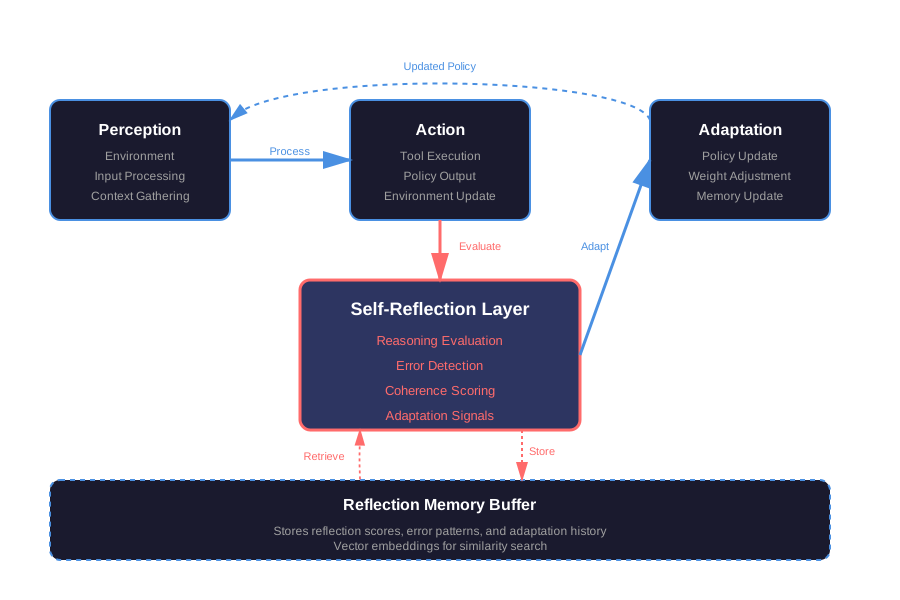
Reflexive agents add a Self-Reflection Layer between action and the next reasoning step. This layer:
- Evaluates reasoning: Was the logic sound? Were the right tools used?
- Detects errors: Did the action fail? Was the output unexpected?
- Scores coherence: Does the reasoning align with goals? Is there drift?
- Generates adaptation signals: What should change? How should the policy adjust?
The reflection layer uses an internal model to evaluate reasoning. This could be:
- A separate LLM call that critiques the reasoning
- A scoring function based on action outcomes
- A coherence check against stored goals and constraints
- A combination of these approaches
Key Differences
The main difference is the feedback loop. Standard agents are open-loop. They process input and produce output. There’s no feedback.
Reflexive agents are closed-loop. They process input, produce output, evaluate the output, and adjust their processing. The evaluation feeds back into the system.
This creates a self-improving system. Each cycle makes the agent slightly better. Errors are caught and corrected. Patterns are identified and learned.
The Reflexive Loop
The reflexive loop has four stages: Perception, Action, Reflection, and Adaptation. Each stage feeds into the next. The loop closes when adaptation feeds back into perception.
Perception → Action
Perception gathers information from the environment. This includes:
- Direct input from users or systems
- Context from memory or databases
- State from previous interactions
- Constraints and goals
The agent processes this information and decides on an action. It selects tools. It generates outputs. It executes.
This is the standard agent behavior. Nothing new here.
Action → Reflection
After action, reflection begins. The agent evaluates:
Reasoning Quality: Was the reasoning sound? Did it consider all relevant factors? Were there logical errors?
Tool Selection: Were the right tools used? Could better tools have been used? Were tools used correctly?
Outcome Assessment: Did the action produce expected results? Were there errors? Did the environment change as expected?
Coherence Check: Does the action align with goals? Is there drift from the original intent? Are constraints being violated?
The reflection layer produces scores and signals:
- Error score: How many errors were detected?
- Coherence score: How well does the action align with goals?
- Confidence score: How certain is the agent about its reasoning?
- Adaptation signals: What should change?
Reflection → Adaptation
Adaptation uses reflection signals to adjust the agent’s behavior. This can include:
Policy Updates: Adjust weights for different reasoning strategies. Favor approaches that score well. Reduce use of approaches that score poorly.
Tool Selection Changes: Update tool selection probabilities. Increase use of tools that work well. Decrease use of tools that fail.
Memory Updates: Store reflection results in memory. Remember what works. Remember what doesn’t. Use this for future decisions.
Reasoning Strategy Shifts: Change how the agent reasons. If reflection shows logical errors, use more structured reasoning. If it shows missing context, gather more information first.
Adaptation → Perception
The loop closes when adaptation feeds back into perception. Updated policies affect how the agent perceives and processes new input. Memory updates provide better context. Tool selection changes affect available actions.
This creates a continuous improvement cycle. Each iteration makes the agent slightly better at:
- Detecting errors
- Selecting tools
- Reasoning correctly
- Aligning with goals
Internal Memory Buffer
The reflexive loop needs memory. The agent must remember:
- Previous reflection scores
- Error patterns
- Successful adaptations
- Failed approaches
This memory is stored in a buffer. It’s indexed for fast retrieval. When reflecting, the agent can:
- Compare current reasoning to past patterns
- Identify recurring errors
- Recall successful strategies
- Detect drift over time
The memory buffer uses vector embeddings. Similar reasoning patterns cluster together. The agent can quickly find relevant past reflections.
Practical Implementation
Let’s build a reflexive agent. We’ll use Python 3.10+, LangChain, OpenAI, and FAISS for vector storage.
Basic Setup
First, set up the dependencies:
from langchain.agents import AgentExecutor, create_react_agent
from langchain.tools import Tool
from langchain_openai import ChatOpenAI, OpenAIEmbeddings
from langchain.prompts import ChatPromptTemplate
from langchain.memory import ConversationBufferMemory
import faiss
import numpy as np
from typing import Dict, List, Any, Optional
from dataclasses import dataclass
from datetime import datetime
Reflection Model
The reflection model evaluates reasoning. It takes the agent’s thought process and action, then produces scores and feedback.
@dataclass
class ReflectionResult:
    error_score: float  # 0.0 = no errors, 1.0 = many errors
    coherence_score: float  # 0.0 = low coherence, 1.0 = high coherence
    confidence_score: float  # 0.0 = low confidence, 1.0 = high confidence
    feedback: str  # Text feedback on reasoning
    adaptation_signals: List[str]  # Specific things to change

class ReflectionModel:
    def __init__(self, llm: ChatOpenAI):
        self.llm = llm
        self.reflection_prompt = ChatPromptTemplate.from_messages([
            ("system", """You are a reflection model that evaluates AI agent reasoning.
            Analyze the agent's thought process and action. Identify:
            1. Reasoning errors or logical flaws
            2. Tool selection issues
            3. Missing context or information
            4. Alignment with stated goals
            5. Confidence level in the reasoning

            Provide scores (0.0 to 1.0) and specific feedback."""),
            ("human", """Agent Reasoning:
            {reasoning}

            Action Taken:
            {action}

            Action Result:
            {result}

            Stated Goals:
            {goals}

            Evaluate this reasoning and provide scores and feedback.""")
        ])

    def reflect(self, reasoning: str, action: str, result: str, goals: str) -> ReflectionResult:
        response = self.llm.invoke(
            self.reflection_prompt.format_messages(
                reasoning=reasoning,
                action=action,
                result=result,
                goals=goals
            )
        )

        # Parse response to extract scores and feedback
        # In practice, you'd use structured output or parsing
        content = response.content

        # Extract scores (simplified - use proper parsing in production)
        error_score = self._extract_score(content, "error")
        coherence_score = self._extract_score(content, "coherence")
        confidence_score = self._extract_score(content, "confidence")

        feedback = self._extract_feedback(content)
        adaptation_signals = self._extract_adaptation_signals(content)

        return ReflectionResult(
            error_score=error_score,
            coherence_score=coherence_score,
            confidence_score=confidence_score,
            feedback=feedback,
            adaptation_signals=adaptation_signals
        )

    def _extract_score(self, content: str, score_type: str) -> float:
        # Simplified extraction - use proper parsing
        import re
        pattern = f"{score_type}[_\\s]*score[:\\s]*([0-9.]+)"
        match = re.search(pattern, content, re.IGNORECASE)
        return float(match.group(1)) if match else 0.5

    def _extract_feedback(self, content: str) -> str:
        # Extract feedback section
        if "feedback:" in content.lower():
            parts = content.split("feedback:", 1)
            return parts[1].strip() if len(parts) > 1 else content
        return content

    def _extract_adaptation_signals(self, content: str) -> List[str]:
        # Extract adaptation signals
        signals = []
        if "adaptation" in content.lower() or "should" in content.lower():
            # Parse signals (simplified)
            lines = content.split("\n")
            for line in lines:
                if "should" in line.lower() or "change" in line.lower():
                    signals.append(line.strip())
        return signals
Reflection Memory Buffer
The memory buffer stores reflection results for future reference. It uses FAISS for similarity search.
class ReflectionMemoryBuffer:
    def __init__(self, embedding_model: OpenAIEmbeddings, dimension: int = 1536):
        self.embedding_model = embedding_model
        self.dimension = dimension
        self.index = faiss.IndexFlatL2(dimension)
        self.reflections: List[Dict[str, Any]] = []

    def store(self, reasoning: str, reflection: ReflectionResult, context: Dict[str, Any]):
        # Create embedding from reasoning + reflection
        text = f"{reasoning}\n{reflection.feedback}"
        embedding = self.embedding_model.embed_query(text)
        embedding_array = np.array([embedding], dtype=np.float32)

        # Add to index
        self.index.add(embedding_array)

        # Store full reflection
        self.reflections.append({
            "reasoning": reasoning,
            "reflection": reflection,
            "context": context,
            "timestamp": datetime.now(),
            "embedding": embedding
        })

    def retrieve_similar(self, query: str, k: int = 5) -> List[Dict[str, Any]]:
        # Get embedding for query
        query_embedding = self.embedding_model.embed_query(query)
        query_array = np.array([query_embedding], dtype=np.float32)

        # Search for similar reflections
        distances, indices = self.index.search(query_array, k)

        # Return similar reflections
        results = []
        for idx in indices[0]:
            if idx < len(self.reflections):
                results.append(self.reflections[idx])

        return results

    def get_error_patterns(self) -> Dict[str, float]:
        # Analyze stored reflections to find error patterns
        error_patterns = {}
        for reflection_data in self.reflections:
            signals = reflection_data["reflection"].adaptation_signals
            for signal in signals:
                error_patterns[signal] = error_patterns.get(signal, 0) + 1

        # Normalize
        total = sum(error_patterns.values())
        if total > 0:
            error_patterns = {k: v/total for k, v in error_patterns.items()}

        return error_patterns
Reflexive Agent
The reflexive agent wraps a standard agent with reflection capabilities.
class ReflexiveAgent:
    def __init__(
        self,
        base_agent: AgentExecutor,
        reflection_model: ReflectionModel,
        memory_buffer: ReflectionMemoryBuffer,
        goals: str
    ):
        self.base_agent = base_agent
        self.reflection_model = reflection_model
        self.memory_buffer = memory_buffer
        self.goals = goals

        # Policy weights (simplified)
        self.tool_weights: Dict[str, float] = {}
        self.reasoning_strategy_weight = 1.0

    def run(self, input_text: str) -> Dict[str, Any]:
        # Get similar past reflections
        similar_reflections = self.memory_buffer.retrieve_similar(input_text, k=3)

        # Adjust policy based on past reflections
        self._adjust_policy(similar_reflections)

        # Run base agent
        reasoning_trace = []
        action_taken = None
        result = None

        try:
            # In practice, you'd capture the reasoning trace from the agent
            # This is simplified
            result = self.base_agent.invoke({"input": input_text})
            reasoning_trace.append(f"Processed: {input_text}")
            action_taken = str(result)
        except Exception as e:
            result = f"Error: {str(e)}"
            reasoning_trace.append(f"Error occurred: {str(e)}")

        # Reflect on the reasoning and action
        reasoning_text = "\n".join(reasoning_trace)
        reflection = self.reflection_model.reflect(
            reasoning=reasoning_text,
            action=str(action_taken),
            result=str(result),
            goals=self.goals
        )

        # Store reflection in memory
        self.memory_buffer.store(
            reasoning=reasoning_text,
            reflection=reflection,
            context={"input": input_text, "result": result}
        )

        # Adapt based on reflection
        self._adapt(reflection)

        return {
            "result": result,
            "reflection": reflection,
            "reasoning_trace": reasoning_trace
        }

    def _adjust_policy(self, similar_reflections: List[Dict[str, Any]]):
        # Adjust policy weights based on similar past reflections
        if not similar_reflections:
            return

        # Analyze what worked and what didn't
        for ref_data in similar_reflections:
            reflection = ref_data["reflection"]

            # If coherence was low, we might need different reasoning
            if reflection.coherence_score < 0.5:
                self.reasoning_strategy_weight *= 0.95

            # If error score was high, we need to be more careful
            if reflection.error_score > 0.7:
                # Adjust tool weights based on adaptation signals
                for signal in reflection.adaptation_signals:
                    if "tool" in signal.lower():
                        # Extract tool name and adjust weight
                        # Simplified - would need proper parsing
                        pass

    def _adapt(self, reflection: ReflectionResult):
        # Adapt based on current reflection

        # If error score is high, reduce confidence in current approach
        if reflection.error_score > 0.7:
            self.reasoning_strategy_weight *= 0.9

        # If coherence is low, we're drifting from goals
        if reflection.coherence_score < 0.5:
            # Reset or adjust strategy
            self.reasoning_strategy_weight = max(0.5, self.reasoning_strategy_weight * 0.95)

        # Update tool weights based on adaptation signals
        for signal in reflection.adaptation_signals:
            # Parse signal and update weights
            # This would be more sophisticated in practice
            pass
Complete Example
Here’s how to put it all together:
def create_reflexive_agent(goals: str = "Help users effectively"):
    # Initialize models
    llm = ChatOpenAI(model="gpt-4", temperature=0)
    embeddings = OpenAIEmbeddings()

    # Create base agent (simplified - you'd set up tools properly)
    tools = [
        Tool(
            name="search",
            func=lambda q: f"Search results for: {q}",
            description="Search for information"
        ),
        Tool(
            name="calculate",
            func=lambda x: str(eval(x)),
            description="Perform calculations"
        )
    ]

    # In practice, you'd create a proper ReAct agent here
    # This is simplified
    base_agent = None  # Would be AgentExecutor with tools

    # Create reflection components
    reflection_model = ReflectionModel(llm)
    memory_buffer = ReflectionMemoryBuffer(embeddings)

    # Create reflexive agent
    agent = ReflexiveAgent(
        base_agent=base_agent,
        reflection_model=reflection_model,
        memory_buffer=memory_buffer,
        goals=goals
    )

    return agent

# Usage
agent = create_reflexive_agent(goals="Answer questions accurately and helpfully")

result = agent.run("What is 2+2?")
print(f"Result: {result['result']}")
print(f"Reflection: {result['reflection'].feedback}")
print(f"Error Score: {result['reflection'].error_score}")
print(f"Coherence Score: {result['reflection'].coherence_score}")
Dynamic Plan Updates
Reflexive agents can update their plans based on reflection. If reflection shows the plan is flawed, the agent can revise it.
class PlanReflexiveAgent(ReflexiveAgent):
    def __init__(self, *args, **kwargs):
        super().__init__(*args, **kwargs)
        self.current_plan: Optional[List[str]] = None

    def run_with_planning(self, input_text: str) -> Dict[str, Any]:
        # Create initial plan
        if not self.current_plan:
            self.current_plan = self._create_plan(input_text)

        # Execute plan steps with reflection
        results = []
        for i, step in enumerate(self.current_plan):
            step_result = self.run(step)
            results.append(step_result)

            # Reflect on step
            reflection = step_result["reflection"]

            # If reflection shows plan is wrong, revise it
            if reflection.error_score > 0.6 or reflection.coherence_score < 0.5:
                self.current_plan = self._revise_plan(self.current_plan, i, reflection)
                # Re-execute from revised point
                break

        return {
            "results": results,
            "final_plan": self.current_plan
        }

    def _create_plan(self, input_text: str) -> List[str]:
        # Use LLM to create plan
        # Simplified
        return [f"Step 1: {input_text}", "Step 2: Process", "Step 3: Respond"]

    def _revise_plan(self, plan: List[str], step_index: int, reflection: ReflectionResult) -> List[str]:
        # Revise plan based on reflection
        # Use reflection feedback to create better plan
        # Simplified
        revised = plan[:step_index]
        revised.append(f"Revised step based on: {reflection.feedback}")
        revised.extend(plan[step_index+1:])
        return revised
Evaluation Metrics
How do you measure if reflection is working? You need metrics that capture improvement over time.
Error Correction Rate
Error correction rate measures how often the agent catches and fixes errors. Track:
- Errors detected: How many errors did reflection identify?
- Errors corrected: How many of those were actually fixed?
- Error correction rate: corrected / detected
A good reflexive agent should have a high error correction rate. If it detects errors but doesn’t fix them, reflection isn’t helping.
class ReflectionMetrics:
    def __init__(self):
        self.errors_detected = 0
        self.errors_corrected = 0
        self.total_reflections = 0

    def record_reflection(self, reflection: ReflectionResult, was_corrected: bool):
        self.total_reflections += 1
        if reflection.error_score > 0.5:
            self.errors_detected += 1
            if was_corrected:
                self.errors_corrected += 1

    def error_correction_rate(self) -> float:
        if self.errors_detected == 0:
            return 0.0
        return self.errors_corrected / self.errors_detected

    def error_detection_rate(self) -> float:
        if self.total_reflections == 0:
            return 0.0
        return self.errors_detected / self.total_reflections
Coherence Drift Reduction
Coherence drift happens when agents move away from their goals. Reflection should detect this and bring the agent back.
Measure:
- Baseline coherence: Average coherence without reflection
- Reflexive coherence: Average coherence with reflection
- Drift reduction: How much less drift occurs with reflection
def measure_coherence_drift(
    agent_without_reflection: AgentExecutor,
    reflexive_agent: ReflexiveAgent,
    test_cases: List[str]
) -> Dict[str, float]:
    baseline_scores = []
    reflexive_scores = []

    for test_case in test_cases:
        # Run without reflection
        result1 = agent_without_reflection.invoke({"input": test_case})
        # Measure coherence (would need a coherence metric)
        baseline_scores.append(0.5)  # Placeholder

        # Run with reflection
        result2 = reflexive_agent.run(test_case)
        reflexive_scores.append(result2["reflection"].coherence_score)

    baseline_avg = sum(baseline_scores) / len(baseline_scores)
    reflexive_avg = sum(reflexive_scores) / len(reflexive_scores)

    drift_reduction = reflexive_avg - baseline_avg

    return {
        "baseline_coherence": baseline_avg,
        "reflexive_coherence": reflexive_avg,
        "drift_reduction": drift_reduction
    }
Reflection Quality Metrics
Measure the quality of reflection itself:
- Reflection accuracy: Do reflection scores correlate with actual errors?
- Adaptation effectiveness: Do adaptations based on reflection actually help?
- Memory utilization: Is the agent using past reflections effectively?
def evaluate_reflection_quality(
    reflexive_agent: ReflexiveAgent,
    test_cases: List[Dict[str, Any]]  # input, expected_result, has_error
) -> Dict[str, float]:
    correct_detections = 0
    incorrect_detections = 0
    missed_errors = 0

    for test_case in test_cases:
        result = reflexive_agent.run(test_case["input"])
        reflection = result["reflection"]

        has_error = test_case["has_error"]
        detected_error = reflection.error_score > 0.5

        if has_error and detected_error:
            correct_detections += 1
        elif not has_error and detected_error:
            incorrect_detections += 1
        elif has_error and not detected_error:
            missed_errors += 1

    total = len(test_cases)
    accuracy = correct_detections / total if total > 0 else 0.0
    precision = correct_detections / (correct_detections + incorrect_detections) if (correct_detections + incorrect_detections) > 0 else 0.0
    recall = correct_detections / (correct_detections + missed_errors) if (correct_detections + missed_errors) > 0 else 0.0

    return {
        "accuracy": accuracy,
        "precision": precision,
        "recall": recall
    }
Long-term Improvement
Track improvement over time. A good reflexive agent should:
- Detect errors more accurately over time
- Correct errors more effectively
- Maintain higher coherence
- Require fewer external corrections
class LongTermMetrics:
    def __init__(self):
        self.metrics_over_time: List[Dict[str, float]] = []

    def record_episode(self, metrics: Dict[str, float]):
        self.metrics_over_time.append(metrics)

    def improvement_trend(self, metric_name: str) -> float:
        if len(self.metrics_over_time) < 2:
            return 0.0

        values = [m.get(metric_name, 0) for m in self.metrics_over_time]
        # Simple linear trend
        n = len(values)
        x = list(range(n))
        y = values

        # Calculate slope
        x_mean = sum(x) / n
        y_mean = sum(y) / n

        numerator = sum((x[i] - x_mean) * (y[i] - y_mean) for i in range(n))
        denominator = sum((x[i] - x_mean) ** 2 for i in range(n))

        slope = numerator / denominator if denominator > 0 else 0.0
        return slope
Future Directions
Reflexive agents are still early. There’s a lot to explore.
Multi-Agent Ecosystems
In multi-agent systems, reflection becomes more complex. Agents need to reflect on:
- Their own reasoning
- Other agents’ reasoning
- Collective decisions
- Group coherence
Agents can share reflection results. They can learn from each other’s mistakes. They can coordinate adaptations.
class MultiAgentReflection:
    def __init__(self, agents: List[ReflexiveAgent]):
        self.agents = agents
        self.shared_memory = ReflectionMemoryBuffer(...)

    def collective_reflection(self, interaction_history: List[Dict]):
        # Each agent reflects on their part
        individual_reflections = []
        for agent, interaction in zip(self.agents, interaction_history):
            reflection = agent.reflection_model.reflect(...)
            individual_reflections.append(reflection)

        # Collective reflection on group behavior
        collective_reflection = self._reflect_on_collective(
            individual_reflections,
            interaction_history
        )

        # Share insights
        for agent in self.agents:
            agent.memory_buffer.store(...)
            agent._adapt(collective_reflection)
Long-term Alignment Strategies
Reflexive agents can maintain alignment over time. They can:
- Detect when they’re drifting from goals
- Self-correct before external intervention
- Learn alignment constraints from feedback
- Maintain consistency across tasks
This reduces the need for constant monitoring. Agents become more autonomous while staying aligned.
Advanced Reflection Models
Current reflection models are simple. Future models could:
- Use specialized reflection LLMs trained on reasoning evaluation
- Incorporate external validation signals
- Learn reflection strategies over time
- Adapt reflection depth based on task complexity
Integration with Other Techniques
Reflexive agents can combine with:
- Reinforcement learning: Use reflection signals as rewards
- Meta-learning: Learn how to reflect more effectively
- Causal reasoning: Understand why errors occurred
- Uncertainty quantification: Know when to reflect more deeply
Conclusion
Reflexive agents close the loop between perception and self-evaluation. They don’t just act. They reflect. They adapt. They improve.
This isn’t just about error correction. It’s about building agents that understand themselves. Agents that recognize their limitations. Agents that seek help when needed. Agents that learn from their mistakes.
The implementation is straightforward. Add a reflection layer. Store results in memory. Use reflection to adapt. The hard part is making reflection accurate and useful. That’s where the research is heading.
As agents become more autonomous, reflection becomes essential. Agents need to evaluate themselves. They need to stay aligned. They need to improve over time. Reflexive agents provide a path forward.
Start simple. Add reflection to one agent. Measure if it helps. Iterate. The loop closes when you see improvement.
Discussion
Loading comments...