Memory Sharding for Scalable Agent Collectives
You have 50 agents analyzing customer interactions. Each one fetches context from a shared memory store. Each one stores new embeddings. Before long, search times slow down. Context gets mixed up. Relevance drops.
This is what happens with centralized memory in multi-agent systems. One vector database. All agents competing for access. Context collisions everywhere.
Memory sharding fixes this. Instead of one global memory store, you split memory into semantic partitions. Each shard handles a specific domain. Agents route queries to the right shard. Performance improves. Context stays clean.
Introduction
AI agents are moving from isolated chatbots to collaborative ecosystems. Multiple agents work together. They share context. They build on each other’s knowledge.
But shared memory becomes a bottleneck. When all agents use one memory store, problems emerge. Context collisions happen when agents overwrite each other’s embeddings. Slow retrieval happens when the vector index gets too large. Redundant embeddings waste space when similar knowledge gets stored multiple times.
Memory sharding solves these problems. It splits the global knowledge base into smaller, independent shards. Each shard handles a specific domain or agent cluster. A memory router directs queries to the right shard.
This article explains how memory sharding works and how to build it.
The Problem with Centralized Memory
Most agent architectures use a single memory component. A global FAISS store. A single Redis index. One Pinecone database.
This works fine with a few agents. But as the system grows, three problems emerge.
Contention
All agents query the same store at the same time. They compete for access. Concurrent reads and writes create bottlenecks. The memory store becomes a single point of failure.
With 10 agents, contention is manageable. With 50 agents, it’s a problem. With 100 agents, the system slows to a crawl.
Redundancy
Agents store similar embeddings across different domains. A finance agent stores “customer payment” embeddings. A support agent stores “payment issue” embeddings. They’re related, but stored separately. The same knowledge gets embedded multiple times.
This wastes space. It also makes retrieval harder. You have to search across redundant entries to find what you need.
Context Dilution
When all embeddings live in one index, retrieval gets noisy. A finance agent queries for “customer payment history” and gets results mixed with support tickets, engineering docs, and marketing content. The relevant results get buried in irrelevant ones.
Relevance scores drop. Agents spend more time filtering noise than finding useful context.
The result? Agents spend more time resolving noise than making decisions. Performance degrades. The system becomes harder to scale.
Concept: Memory Sharding
Memory sharding partitions the global knowledge base into smaller, independent semantic shards.
Each shard can:
- Host a specific domain (e.g., “finance”, “support”, “engineering”)
- Serve a subset of agents
- Operate on its own retrieval index optimized for that context
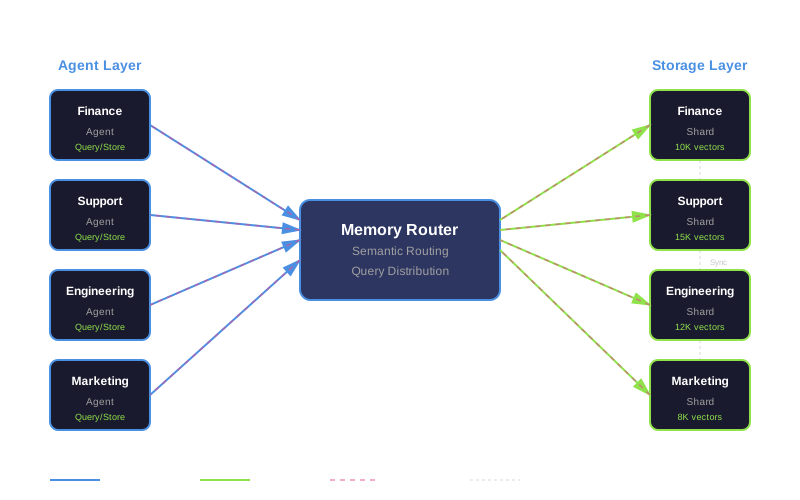
Agents no longer compete for one global memory. Instead, they interact with a Memory Router. The router directs embedding queries to the correct shard based on semantic similarity or agent assignment.
How Sharding Works
Sharding splits memory by domain or function. A finance shard stores financial embeddings. A support shard stores customer support context. An engineering shard stores technical documentation.
When an agent needs context, it sends a query to the Memory Router. The router analyzes the query and determines which shard to search. It might use:
- Semantic similarity to shard domains
- Agent assignment rules
- Query classification
- Historical routing patterns
The router sends the query to the appropriate shard. The shard searches its local index and returns results. The agent gets relevant context without noise from other domains.
Shard Independence
Each shard operates independently. It has its own vector index. It manages its own embeddings. It can scale separately from other shards.
This independence means:
- Shards can use different indexing strategies
- Shards can scale based on their own load
- Shard failures don’t take down the entire system
- Shards can be optimized for their specific domain
Synchronization
Shards don’t exist in isolation. They synchronize periodically via lightweight gossip updates. When one shard learns something relevant to another, it shares that knowledge.
This keeps shards connected without creating tight coupling. Each shard stays independent while benefiting from cross-domain knowledge.
Architecture Overview
The system has three key layers:
Agent Layer: Produces and consumes knowledge. Autonomous agents that generate embeddings and query for context.
Routing Layer: Directs memory queries. The Memory Router analyzes queries and routes them to the correct shard.
Storage Layer: Hosts distributed memory shards. Shard servers or vector stores that maintain domain-specific indexes.
Agent Layer
Agents generate embeddings from their work. They query for relevant context. They store new knowledge.
Agents don’t know about shards directly. They send queries to the Memory Router. The router handles shard selection and routing.
Routing Layer
The Memory Router is the brain of the system. It receives queries from agents. It determines which shard to search. It routes queries and aggregates results.
The router uses several strategies:
- Semantic routing: Analyzes query embeddings to find the best-matching shard
- Agent-based routing: Routes based on which agent is querying
- Hybrid routing: Combines semantic and agent-based approaches
- Load balancing: Distributes queries across shards to prevent overload
Storage Layer
Each shard is a separate storage system. It might be:
- A dedicated vector database instance
- A partition in a distributed vector store
- A separate index in a multi-tenant system
Shards maintain their own indexes. They optimize for their domain. They scale independently.
Implementation: Building a Memory Router
Let’s build a memory sharding system. We’ll create a Memory Router that directs queries to shards. We’ll implement shard management and query routing.
Basic Structure
from typing import Dict, List, Optional, Any
from dataclasses import dataclass
from enum import Enum
import numpy as np
from collections import defaultdict

class ShardDomain(Enum):
    """Domain categories for shards."""
    FINANCE = "finance"
    SUPPORT = "support"
    ENGINEERING = "engineering"
    MARKETING = "marketing"
    GENERAL = "general"

@dataclass
class MemoryShard:
    """Represents a memory shard."""
    shard_id: str
    domain: ShardDomain
    vector_index: Any  # Vector store (FAISS, Milvus, etc.)
    agent_ids: List[str]  # Agents assigned to this shard
    metadata: Dict[str, Any]

@dataclass
class Query:
    """A memory query from an agent."""
    agent_id: str
    query_embedding: np.ndarray
    query_text: str
    domain_hint: Optional[ShardDomain] = None
    max_results: int = 10

@dataclass
class QueryResult:
    """Result from a shard query."""
    shard_id: str
    results: List[Dict[str, Any]]
    relevance_score: float
Memory Router
The router directs queries to shards:
class MemoryRouter:
    """Routes memory queries to appropriate shards."""

    def __init__(self):
        self.shards: Dict[str, MemoryShard] = {}
        self.agent_to_shard: Dict[str, str] = {}  # agent_id -> shard_id
        self.domain_embeddings: Dict[ShardDomain, np.ndarray] = {}
        self.routing_history: List[Dict[str, Any]] = []

    def register_shard(self, shard: MemoryShard):
        """Register a new shard."""
        self.shards[shard.shard_id] = shard

        # Assign agents to shard
        for agent_id in shard.agent_ids:
            self.agent_to_shard[agent_id] = shard.shard_id

        # Initialize domain embedding (centroid of shard's content)
        self.domain_embeddings[shard.domain] = self._compute_domain_embedding(shard)

    def route_query(self, query: Query) -> List[QueryResult]:
        """Route a query to appropriate shards and return results."""
        # Determine which shards to search
        target_shards = self._select_shards(query)

        # Query each shard
        results = []
        for shard_id in target_shards:
            shard = self.shards[shard_id]
            shard_results = self._query_shard(shard, query)
            results.append(shard_results)

        # Record routing decision
        self.routing_history.append({
            "agent_id": query.agent_id,
            "query_text": query.query_text,
            "selected_shards": target_shards,
            "timestamp": time.time()
        })

        return results

    def _select_shards(self, query: Query) -> List[str]:
        """Select which shards to search for a query."""
        candidates = []

        # Strategy 1: Agent-based routing
        if query.agent_id in self.agent_to_shard:
            primary_shard = self.agent_to_shard[query.agent_id]
            candidates.append(primary_shard)

        # Strategy 2: Domain hint routing
        if query.domain_hint:
            domain_shards = [
                shard_id for shard_id, shard in self.shards.items()
                if shard.domain == query.domain_hint
            ]
            candidates.extend(domain_shards)

        # Strategy 3: Semantic routing
        if query.query_embedding is not None:
            semantic_shards = self._find_semantic_matches(query.query_embedding)
            candidates.extend(semantic_shards)

        # Remove duplicates and return
        unique_shards = list(set(candidates))

        # If no candidates, search all shards
        if not unique_shards:
            unique_shards = list(self.shards.keys())

        return unique_shards[:3]  # Limit to top 3 shards

    def _find_semantic_matches(self, query_embedding: np.ndarray) -> List[str]:
        """Find shards that semantically match the query."""
        matches = []

        for domain, domain_embedding in self.domain_embeddings.items():
            similarity = np.dot(query_embedding, domain_embedding) / (
                np.linalg.norm(query_embedding) * np.linalg.norm(domain_embedding)
            )

            if similarity > 0.7:  # Threshold for semantic match
                domain_shards = [
                    shard_id for shard_id, shard in self.shards.items()
                    if shard.domain == domain
                ]
                matches.extend(domain_shards)

        return matches

    def _query_shard(self, shard: MemoryShard, query: Query) -> QueryResult:
        """Query a specific shard."""
        # This would interact with the actual vector store
        # For now, we'll simulate it
        results = shard.vector_index.search(
            query.query_embedding,
            k=query.max_results
        )

        # Calculate relevance score (simplified)
        relevance = self._calculate_relevance(shard, query, results)

        return QueryResult(
            shard_id=shard.shard_id,
            results=results,
            relevance_score=relevance
        )

    def _calculate_relevance(self, shard: MemoryShard, query: Query, results: List[Dict]) -> float:
        """Calculate relevance score for shard results."""
        if not results:
            return 0.0

        # Simple relevance: average similarity scores
        similarities = [r.get("similarity", 0.0) for r in results]
        return sum(similarities) / len(similarities) if similarities else 0.0

    def _compute_domain_embedding(self, shard: MemoryShard) -> np.ndarray:
        """Compute a representative embedding for a shard's domain."""
        # In practice, this would sample embeddings from the shard
        # and compute a centroid or use a domain-specific model
        # For now, return a random embedding as placeholder
        return np.random.rand(384)  # Assuming 384-dim embeddings
Shard Management
Managing shards and their lifecycle:
class ShardManager:
    """Manages shard creation, scaling, and lifecycle."""

    def __init__(self, router: MemoryRouter):
        self.router = router
        self.shard_metrics: Dict[str, Dict[str, Any]] = {}

    def create_shard(self, domain: ShardDomain, agent_ids: List[str]) -> MemoryShard:
        """Create a new shard for a domain."""
        shard_id = f"shard_{domain.value}_{len(self.router.shards)}"

        # Initialize vector index (this would be FAISS, Milvus, etc.)
        vector_index = self._initialize_vector_index()

        shard = MemoryShard(
            shard_id=shard_id,
            domain=domain,
            vector_index=vector_index,
            agent_ids=agent_ids,
            metadata={}
        )

        self.router.register_shard(shard)
        self.shard_metrics[shard_id] = {
            "query_count": 0,
            "embedding_count": 0,
            "avg_latency": 0.0
        }

        return shard

    def _initialize_vector_index(self):
        """Initialize a vector index for a shard."""
        # This would create a FAISS index, Milvus collection, etc.
        # For now, return a placeholder
        return {"type": "vector_index", "dim": 384}

    def scale_shard(self, shard_id: str, scale_factor: float):
        """Scale a shard's resources."""
        shard = self.router.shards.get(shard_id)
        if not shard:
            return

        # In practice, this would resize the vector index,
        # adjust compute resources, etc.
        print(f"Scaling shard {shard_id} by factor {scale_factor}")

    def get_shard_health(self, shard_id: str) -> Dict[str, Any]:
        """Get health metrics for a shard."""
        metrics = self.shard_metrics.get(shard_id, {})
        shard = self.router.shards.get(shard_id)

        return {
            "shard_id": shard_id,
            "domain": shard.domain.value if shard else None,
            "query_count": metrics.get("query_count", 0),
            "embedding_count": metrics.get("embedding_count", 0),
            "avg_latency": metrics.get("avg_latency", 0.0),
            "agent_count": len(shard.agent_ids) if shard else 0
        }
Agent Integration
Agents interact with the router, not shards directly:
class ShardedMemoryAgent:
    """Agent that uses sharded memory."""

    def __init__(self, agent_id: str, router: MemoryRouter):
        self.agent_id = agent_id
        self.router = router
        self.embedding_model = None  # Would be initialized with actual model

    def store_memory(self, content: str, domain: Optional[ShardDomain] = None):
        """Store a memory in the appropriate shard."""
        # Generate embedding
        embedding = self._generate_embedding(content)

        # Determine target shard
        target_shard = self._select_storage_shard(domain)

        # Store in shard
        self._store_in_shard(target_shard, embedding, content)

    def retrieve_memory(self, query: str, domain_hint: Optional[ShardDomain] = None) -> List[Dict[str, Any]]:
        """Retrieve relevant memories."""
        # Generate query embedding
        query_embedding = self._generate_embedding(query)

        # Create query
        memory_query = Query(
            agent_id=self.agent_id,
            query_embedding=query_embedding,
            query_text=query,
            domain_hint=domain_hint
        )

        # Route query
        results = self.router.route_query(memory_query)

        # Aggregate and rank results
        aggregated = self._aggregate_results(results)

        return aggregated

    def _generate_embedding(self, text: str) -> np.ndarray:
        """Generate embedding for text."""
        # This would use an actual embedding model
        # For now, return random embedding
        return np.random.rand(384)

    def _select_storage_shard(self, domain: Optional[ShardDomain]) -> str:
        """Select which shard to store a memory in."""
        if domain:
            # Find shard for this domain
            domain_shards = [
                shard_id for shard_id, shard in self.router.shards.items()
                if shard.domain == domain
            ]
            if domain_shards:
                return domain_shards[0]

        # Default to agent's assigned shard
        return self.router.agent_to_shard.get(self.agent_id, list(self.router.shards.keys())[0])

    def _store_in_shard(self, shard_id: str, embedding: np.ndarray, content: str):
        """Store embedding in a shard."""
        shard = self.router.shards[shard_id]
        # This would actually store in the vector index
        print(f"Storing in shard {shard_id}: {content[:50]}...")

    def _aggregate_results(self, results: List[QueryResult]) -> List[Dict[str, Any]]:
        """Aggregate results from multiple shards."""
        all_results = []

        for result in results:
            for item in result.results:
                item["shard_id"] = result.shard_id
                item["shard_relevance"] = result.relevance_score
                all_results.append(item)

        # Sort by combined relevance
        all_results.sort(key=lambda x: x.get("similarity", 0) * x.get("shard_relevance", 1), reverse=True)

        return all_results[:10]  # Return top 10
Shard Synchronization
Shards need to share knowledge without tight coupling. Here’s a gossip-based synchronization approach:
class ShardSynchronizer:
    """Synchronizes knowledge across shards."""

    def __init__(self, router: MemoryRouter):
        self.router = router
        self.sync_interval = 300  # 5 minutes
        self.cross_shard_index: Dict[str, List[str]] = {}  # content_hash -> [shard_ids]

    def sync_shards(self):
        """Periodically synchronize shards."""
        # Find embeddings that should be shared
        shared_embeddings = self._identify_shared_content()

        # Propagate to relevant shards
        for embedding_hash, target_shards in shared_embeddings.items():
            self._propagate_embedding(embedding_hash, target_shards)

    def _identify_shared_content(self) -> Dict[str, List[str]]:
        """Identify content that should be shared across shards."""
        # In practice, this would analyze embeddings for cross-domain relevance
        # For now, return empty dict
        return {}

    def _propagate_embedding(self, embedding_hash: str, target_shards: List[str]):
        """Propagate an embedding to target shards."""
        for shard_id in target_shards:
            # Copy embedding to shard
            print(f"Propagating {embedding_hash} to {shard_id}")
Performance Benefits
Memory sharding improves performance in several ways:
Reduced Contention
With sharding, agents don’t all hit the same store. Finance agents query the finance shard. Support agents query the support shard. Contention drops because load is distributed.
Faster Retrieval
Smaller indexes are faster to search. A shard with 10,000 embeddings searches faster than a global index with 500,000 embeddings. Query latency decreases.
Better Relevance
Domain-specific indexes return more relevant results. A finance query searches only financial context. No noise from other domains. Relevance scores improve.
Independent Scaling
Each shard scales based on its own load. The finance shard can scale up during tax season. The support shard can scale during product launches. Other shards aren’t affected.
Best Practices
Shard Sizing
Shards should be large enough to be efficient, but small enough to stay fast. Aim for 10,000 to 100,000 embeddings per shard. Monitor query latency and adjust.
Domain Boundaries
Define clear domain boundaries. Overlapping domains create confusion. Each shard should have a distinct purpose.
Router Intelligence
The router needs good routing logic. Start with simple agent-based routing. Add semantic routing as you learn query patterns. Monitor routing decisions and adjust.
Synchronization Strategy
Don’t over-synchronize. Too much cross-shard sharing defeats the purpose of sharding. Sync only when content is clearly relevant to multiple domains.
Conclusion
Memory sharding solves the scalability problem in multi-agent systems. Instead of one bottleneck, you get distributed, domain-specific memory stores. Agents get faster, more relevant results. The system scales better.
The key is good routing. The Memory Router needs to send queries to the right shards. Start simple. Use agent-based routing first. Add semantic routing as you learn patterns. Monitor performance and adjust.
If you’re building multi-agent systems with shared memory, consider sharding. It’s not just about performance. It’s about keeping context clean and relevant. Agents work better when they’re not drowning in noise.
Discussion
Loading comments...