Agentic Shadow Models — Reducing Latency via Local Predictive Replicas
Multi-agent systems are slow. When agents need to coordinate, they wait for each other. Each round-trip adds latency. In complex workflows, these delays stack up. A task that should take seconds ends up taking minutes.
The problem gets worse as systems scale. More agents mean more coordination points. More coordination means more waiting. Network latency compounds. API rate limits kick in. Costs rise.
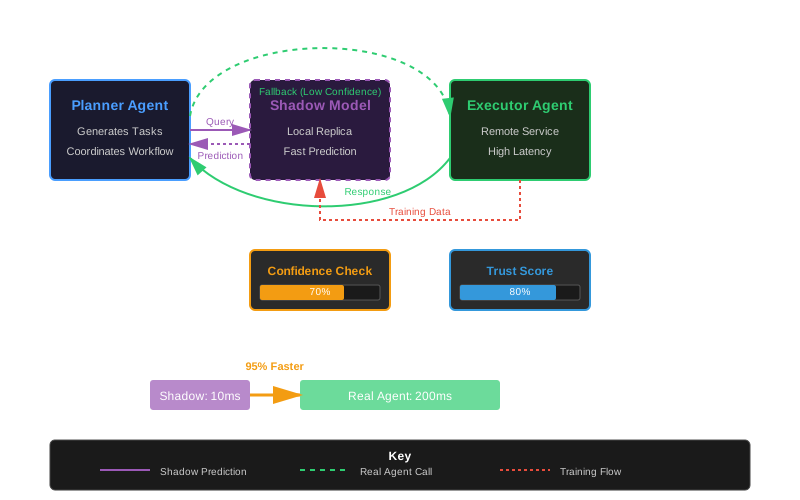
There’s a way to cut this latency. Instead of always calling remote agents, you can predict their responses locally. You maintain a lightweight replica — a shadow model — that approximates what the remote agent would say. When you need a response fast, you use the shadow. When you need accuracy, you call the real agent.
This is what Agentic Shadow Models do. They’re predictive stand-ins that reduce coordination lag without sacrificing too much accuracy. This article explains how they work and how to build them.
Introduction: The Latency Challenge in Multi-Agent Systems
LLM-based agents talk to each other. One agent plans a task. Another executes it. A third validates the result. They pass messages back and forth. Each message is a network call. Each call has latency.
Consider a simple workflow. A Planner agent creates a task list. It sends each task to an Executor agent. The Executor processes the task and responds. The Planner waits for each response before sending the next task. If each call takes 2 seconds, and you have 10 tasks, that’s 20 seconds just in coordination overhead.
Real workflows are more complex. Agents might need to consult multiple peers. They might need to reach consensus. They might need to retry on failures. Each interaction adds latency.
Why Latency Matters
Latency affects user experience. Users wait for responses. If an agent workflow takes 30 seconds, users notice. If it takes 5 minutes, they leave.
Latency also affects costs. While agents wait, they consume resources. They hold connections open. They use memory. They block other requests. Faster workflows mean lower costs.
Latency affects reliability too. Longer workflows have more failure points. Network issues compound. Timeouts become more likely. Reducing latency improves resilience.
The Traditional Approach
Most multi-agent systems use direct communication. Agent A calls Agent B. Agent B responds. Agent A processes the response and continues. This is simple, but slow.
You can optimize this with parallel calls. Instead of waiting for each response, you send multiple requests at once. This helps, but doesn’t solve the fundamental problem: you still need to wait for responses.
You can also cache responses. If Agent B has answered a similar question before, reuse that answer. This works for repeated queries, but not for new ones.
Shadow models go further. They predict responses even for new queries. They learn patterns from past interactions. They approximate agent behavior locally.
Architectural Overview of Shadow Models
A shadow model is a lightweight replica of a remote agent. It runs locally. It predicts what the remote agent would say. It’s trained on past interactions. It’s updated continuously.
Here’s how it works. Agent A needs to coordinate with Agent B. Instead of always calling Agent B, Agent A maintains a shadow of Agent B. When Agent A needs a response, it first checks the shadow. If the shadow’s confidence is high, it uses the shadow’s prediction. If confidence is low, it calls the real Agent B.
Core Components
A shadow model system has several parts:
Shadow Model: A lightweight model that predicts remote agent responses. This could be a fine-tuned small LLM, a neural network, or even a simple pattern matcher.
Confidence Estimator: Measures how confident the shadow is in its prediction. This could be based on similarity to training data, model uncertainty, or historical accuracy.
Trust Updater: Adjusts trust in the shadow based on accuracy. When shadow predictions match real responses, trust increases. When they diverge, trust decreases.
Temporal Window: Defines how long predictions remain valid. Older predictions might be less accurate as the remote agent evolves.
Fallback Mechanism: Switches to the real agent when shadow confidence drops or when accuracy degrades.
Prediction Windows and Confidence Decay
Shadow models don’t predict forever. Their accuracy decays over time. The remote agent might change its behavior. The context might shift. Old predictions become stale.
You need temporal prediction windows. A prediction is valid for a certain time period. After that, you need to refresh it. You might call the real agent to get an updated response, or you might retrain the shadow.
Confidence also decays. Even if a prediction was accurate initially, its confidence decreases over time. After a threshold, you should verify with the real agent.
Here’s a simple decay function:
def compute_confidence_decay(
    initial_confidence: float,
    age_seconds: float,
    half_life_seconds: float = 3600
) -> float:
    """Decay confidence over time."""
    decay_factor = 0.5 ** (age_seconds / half_life_seconds)
    return initial_confidence * decay_factor
This assumes confidence halves every hour. You can adjust the half-life based on how quickly your agents evolve.
Shadow Model Types
There are several ways to build shadow models:
Fine-tuned Small LLM: Take a small model like GPT-2 or a distilled version, fine-tune it on past interactions. This gives good accuracy but requires training infrastructure.
Adapter-based: Add lightweight adapters to a base model. This is faster to train and update, but might be less accurate.
Pattern Matching: Use simple similarity matching against cached responses. Fast and simple, but limited to seen patterns.
Hybrid: Combine multiple approaches. Use pattern matching for common cases, fall back to a model for new cases.
The choice depends on your latency requirements, accuracy needs, and available resources.
Implementation Strategy
Let’s build a shadow model system step by step. We’ll create two agents: a Planner and an Executor. The Planner will maintain a shadow of the Executor.
Setting Up the Agents
First, define the base agent structure:
from typing import Dict, List, Optional, Any
from dataclasses import dataclass
from datetime import datetime, timedelta
import time
import json

@dataclass
class AgentMessage:
    """Message between agents."""
    content: str
    metadata: Dict[str, Any]
    timestamp: datetime
    message_id: str

class BaseAgent:
    """Base class for agents."""
    def __init__(self, agent_id: str):
        self.agent_id = agent_id
        self.message_history: List[AgentMessage] = []

    def process(self, message: AgentMessage) -> AgentMessage:
        """Process a message and return a response."""
        raise NotImplementedError

    def send_message(self, content: str, metadata: Dict = None) -> AgentMessage:
        """Create and send a message."""
        msg = AgentMessage(
            content=content,
            metadata=metadata or {},
            timestamp=datetime.now(),
            message_id=f"{self.agent_id}-{int(time.time())}"
        )
        return msg
Now create the Executor agent:
class ExecutorAgent(BaseAgent):
    """Agent that executes tasks."""

    def __init__(self, agent_id: str = "executor"):
        super().__init__(agent_id)
        self.task_results = {}

    def process(self, message: AgentMessage) -> AgentMessage:
        """Execute a task described in the message."""
        task = message.content

        # Simulate task execution
        # In reality, this would do actual work
        result = self._execute_task(task)

        response_content = json.dumps({
            "status": "completed",
            "task": task,
            "result": result,
            "execution_time": 1.5  # Simulated
        })

        response = self.send_message(
            response_content,
            metadata={"type": "task_result", "original_message_id": message.message_id}
        )

        self.message_history.append(message)
        self.message_history.append(response)

        return response

    def _execute_task(self, task: str) -> str:
        """Execute a specific task."""
        # Simulate different task types
        if "analyze" in task.lower():
            return f"Analysis complete for: {task}"
        elif "process" in task.lower():
            return f"Processed: {task}"
        elif "validate" in task.lower():
            return f"Validation passed for: {task}"
        else:
            return f"Task executed: {task}"
And the Planner agent:
class PlannerAgent(BaseAgent):
    """Agent that plans tasks and coordinates with executor."""

    def __init__(self, agent_id: str = "planner", executor: Optional[ExecutorAgent] = None):
        super().__init__(agent_id)
        self.executor = executor
        self.shadow_model = None  # Will be set up later

    def plan_and_execute(self, goal: str) -> List[AgentMessage]:
        """Plan tasks and execute them."""
        # Generate task plan
        tasks = self._generate_tasks(goal)

        results = []
        for task in tasks:
            # Create task message
            task_msg = self.send_message(
                task,
                metadata={"type": "task", "goal": goal}
            )

            # Get response from executor (or shadow)
            if self.executor:
                response = self.executor.process(task_msg)
            else:
                # Would use shadow model here
                response = self._get_shadow_response(task_msg)

            results.append(response)

        return results

    def _generate_tasks(self, goal: str) -> List[str]:
        """Generate a list of tasks from a goal."""
        # Simple task generation
        # In reality, this would use an LLM
        tasks = []
        if "analyze" in goal.lower():
            tasks.append(f"Analyze data for: {goal}")
        if "process" in goal.lower():
            tasks.append(f"Process information for: {goal}")
        tasks.append(f"Validate results for: {goal}")
        return tasks

    def _get_shadow_response(self, message: AgentMessage) -> AgentMessage:
        """Get response from shadow model (placeholder)."""
        # Will be implemented with shadow model
        pass
Building the Shadow Model
Now let’s create the shadow model. We’ll use a simple approach: fine-tune a small model on past interactions, or use pattern matching for speed.
from sentence_transformers import SentenceTransformer
import numpy as np
from sklearn.metrics.pairwise import cosine_similarity
import pickle

class ShadowModel:
    """Lightweight replica that predicts remote agent responses."""

    def __init__(
        self,
        target_agent_id: str,
        similarity_threshold: float = 0.75,
        confidence_threshold: float = 0.7
    ):
        self.target_agent_id = target_agent_id
        self.similarity_threshold = similarity_threshold
        self.confidence_threshold = confidence_threshold

        # Use a lightweight embedding model
        self.embedder = SentenceTransformer('all-MiniLM-L6-v2')

        # Store past interactions for pattern matching
        self.interaction_cache: List[Dict] = []

        # Track accuracy for trust updating
        self.prediction_history: List[Dict] = []
        self.trust_score = 0.5  # Start neutral

    def train(self, interactions: List[Dict]):
        """Train the shadow model on past interactions."""
        # Store interactions for pattern matching
        for interaction in interactions:
            query = interaction.get('query', '')
            response = interaction.get('response', '')

            # Create embeddings
            query_embedding = self.embedder.encode(query)
            response_embedding = self.embedder.encode(response)

            self.interaction_cache.append({
                'query': query,
                'response': response,
                'query_embedding': query_embedding,
                'response_embedding': response_embedding,
                'timestamp': interaction.get('timestamp', datetime.now())
            })

    def predict(
        self,
        query: str,
        metadata: Optional[Dict] = None
    ) -> tuple[Optional[str], float]:
        """Predict response and return (prediction, confidence)."""
        if not self.interaction_cache:
            return None, 0.0

        # Encode query
        query_embedding = self.embedder.encode(query)

        # Find most similar past query
        similarities = []
        for cached in self.interaction_cache:
            sim = cosine_similarity(
                [query_embedding],
                [cached['query_embedding']]
            )[0][0]
            similarities.append((cached, sim))

        # Sort by similarity
        similarities.sort(key=lambda x: x[1], reverse=True)

        best_match, similarity = similarities[0]

        # Check if similarity is high enough
        if similarity >= self.similarity_threshold:
            # Use cached response
            confidence = min(1.0, similarity * self.trust_score)
            return best_match['response'], confidence

        # Similarity too low, can't predict confidently
        return None, 0.0

    def update_trust(self, predicted: str, actual: str, confidence: float):
        """Update trust score based on prediction accuracy."""
        # Simple accuracy check
        # In practice, you'd use semantic similarity or task-specific metrics
        predicted_emb = self.embedder.encode(predicted)
        actual_emb = self.embedder.encode(actual)
        accuracy = cosine_similarity([predicted_emb], [actual_emb])[0][0]

        # Update trust score
        if accuracy >= 0.8:
            # Good prediction
            self.trust_score = min(1.0, self.trust_score + 0.05)
        elif accuracy < 0.5:
            # Bad prediction
            self.trust_score = max(0.0, self.trust_score - 0.1)

        # Record for analysis
        self.prediction_history.append({
            'predicted': predicted,
            'actual': actual,
            'accuracy': accuracy,
            'confidence': confidence,
            'timestamp': datetime.now()
        })

    def should_use_shadow(self, confidence: float, age_seconds: float = 0) -> bool:
        """Decide if shadow prediction should be used."""
        # Apply confidence decay
        if age_seconds > 0:
            decay_factor = 0.5 ** (age_seconds / 3600)  # 1 hour half-life
            confidence = confidence * decay_factor

        return confidence >= self.confidence_threshold
Adaptive Trust Updating
The shadow model needs to learn from mistakes. When it makes a bad prediction, it should reduce trust. When it makes good predictions, it should increase trust.
class AdaptiveShadowCoordinator:
    """Coordinates between shadow model and real agent."""

    def __init__(
        self,
        shadow_model: ShadowModel,
        real_agent: BaseAgent,
        use_shadow_by_default: bool = True
    ):
        self.shadow_model = shadow_model
        self.real_agent = real_agent
        self.use_shadow_by_default = use_shadow_by_default

        # Track when to verify shadow predictions
        self.verification_interval = 10  # Verify every 10th prediction
        self.verification_count = 0

    def get_response(
        self,
        message: AgentMessage,
        force_real: bool = False
    ) -> AgentMessage:
        """Get response, using shadow or real agent."""
        if force_real:
            return self._call_real_agent(message)

        # Try shadow first
        prediction, confidence = self.shadow_model.predict(
            message.content,
            message.metadata
        )

        if prediction and self.shadow_model.should_use_shadow(confidence):
            # Use shadow, but verify periodically
            self.verification_count += 1

            if self.verification_count % self.verification_interval == 0:
                # Verify with real agent
                real_response = self._call_real_agent(message)
                self._update_shadow_from_verification(
                    prediction,
                    real_response.content,
                    confidence
                )
                return real_response

            # Return shadow prediction
            return self._create_shadow_response(message, prediction, confidence)

        # Shadow not confident enough, use real agent
        real_response = self._call_real_agent(message)

        # Train shadow on this interaction
        self._train_shadow_from_interaction(message, real_response)

        return real_response

    def _call_real_agent(self, message: AgentMessage) -> AgentMessage:
        """Call the real agent (simulates network latency)."""
        # Simulate network delay
        time.sleep(0.1)  # 100ms latency
        return self.real_agent.process(message)

    def _create_shadow_response(
        self,
        original_message: AgentMessage,
        prediction: str,
        confidence: float
    ) -> AgentMessage:
        """Create a response message from shadow prediction."""
        return AgentMessage(
            content=prediction,
            metadata={
                "type": "shadow_prediction",
                "confidence": confidence,
                "original_message_id": original_message.message_id,
                "source": "shadow_model"
            },
            timestamp=datetime.now(),
            message_id=f"shadow-{int(time.time())}"
        )

    def _update_shadow_from_verification(
        self,
        predicted: str,
        actual: str,
        confidence: float
    ):
        """Update shadow model based on verification."""
        self.shadow_model.update_trust(predicted, actual, confidence)

    def _train_shadow_from_interaction(
        self,
        query: AgentMessage,
        response: AgentMessage
    ):
        """Add interaction to shadow training data."""
        interaction = {
            'query': query.content,
            'response': response.content,
            'timestamp': datetime.now()
        }
        self.shadow_model.train([interaction])
Code Walkthrough
Let’s put it all together. Here’s a complete example showing the shadow model in action:
import time
from datetime import datetime

# Create agents
executor = ExecutorAgent()
planner = PlannerAgent(executor=executor)

# Create shadow model
shadow = ShadowModel(
    target_agent_id="executor",
    similarity_threshold=0.75,
    confidence_threshold=0.7
)

# Train shadow on some initial interactions
initial_interactions = [
    {
        'query': 'Analyze data for project X',
        'response': '{"status": "completed", "task": "Analyze data for project X", "result": "Analysis complete for: Analyze data for project X"}',
        'timestamp': datetime.now()
    },
    {
        'query': 'Process information for report Y',
        'response': '{"status": "completed", "task": "Process information for report Y", "result": "Processed: Process information for report Y"}',
        'timestamp': datetime.now()
    }
]
shadow.train(initial_interactions)

# Create coordinator
coordinator = AdaptiveShadowCoordinator(shadow, executor)

# Update planner to use coordinator
planner.shadow_coordinator = coordinator

# Simulate workflow
def simulate_workflow_with_shadow():
    """Run workflow using shadow model."""
    goal = "Analyze customer data and process results"

    start_time = time.time()

    # Planner generates tasks
    tasks = planner._generate_tasks(goal)

    results = []
    for task in tasks:
        task_msg = planner.send_message(task, metadata={"type": "task"})

        # Use coordinator to get response (shadow or real)
        response = coordinator.get_response(task_msg)
        results.append(response)

    end_time = time.time()
    total_time = end_time - start_time

    return results, total_time

def simulate_workflow_without_shadow():
    """Run workflow without shadow (always use real agent)."""
    goal = "Analyze customer data and process results"

    start_time = time.time()

    tasks = planner._generate_tasks(goal)

    results = []
    for task in tasks:
        task_msg = planner.send_message(task, metadata={"type": "task"})

        # Always call real agent
        response = executor.process(task_msg)
        results.append(response)

    end_time = time.time()
    total_time = end_time - start_time

    return results, total_time

# Compare performance
print("Running workflow with shadow model...")
shadow_results, shadow_time = simulate_workflow_with_shadow()
print(f"Shadow model time: {shadow_time:.3f}s")

print("\nRunning workflow without shadow...")
real_results, real_time = simulate_workflow_without_shadow()
print(f"Real agent time: {real_time:.3f}s")

print(f"\nLatency reduction: {((real_time - shadow_time) / real_time * 100):.1f}%")
This example shows the basic structure. In practice, you’d add more sophisticated prediction logic, better confidence estimation, and more robust error handling.
Dynamic Switching
The system should switch between shadow and real agent based on conditions:
class DynamicShadowSwitch:
    """Dynamically switches between shadow and real agent."""

    def __init__(self, coordinator: AdaptiveShadowCoordinator):
        self.coordinator = coordinator
        self.latency_threshold = 0.5  # 500ms
        self.accuracy_threshold = 0.8

    def should_use_shadow(
        self,
        message: AgentMessage,
        current_latency: float
    ) -> bool:
        """Decide if shadow should be used based on conditions."""
        # If latency is high, prefer shadow
        if current_latency > self.latency_threshold:
            return True

        # Check shadow confidence
        prediction, confidence = self.coordinator.shadow_model.predict(
            message.content
        )

        if confidence >= self.coordinator.shadow_model.confidence_threshold:
            return True

        # Check shadow trust score
        if self.coordinator.shadow_model.trust_score >= self.accuracy_threshold:
            return True

        return False
Evaluation
Let’s measure how shadow models perform. We’ll look at latency reduction and accuracy tradeoffs.
Latency Reduction
Shadow models should reduce coordination latency. The exact reduction depends on:
- Network latency to remote agent
- Shadow prediction speed
- Shadow accuracy (bad predictions require retries)
Here’s how to measure it:
def measure_latency_reduction(
    num_tasks: int,
    network_latency_ms: float = 100,
    shadow_prediction_ms: float = 5
):
    """Calculate expected latency reduction."""
    # Without shadow: all tasks wait for network
    without_shadow = num_tasks * network_latency_ms

    # With shadow: some tasks use shadow (fast), some use real (slow)
    # Assume 70% of tasks can use shadow
    shadow_usage_rate = 0.7
    with_shadow = (
        num_tasks * shadow_usage_rate * shadow_prediction_ms +
        num_tasks * (1 - shadow_usage_rate) * network_latency_ms
    )

    reduction = ((without_shadow - with_shadow) / without_shadow) * 100

    return {
        'without_shadow_ms': without_shadow,
        'with_shadow_ms': with_shadow,
        'reduction_percent': reduction
    }

# Example calculation
results = measure_latency_reduction(num_tasks=10, network_latency_ms=200, shadow_prediction_ms=10)
print(f"Latency reduction: {results['reduction_percent']:.1f}%")
With 10 tasks, 200ms network latency, and 10ms shadow prediction, you’d see about 65% latency reduction if 70% of tasks use the shadow.
Accuracy-Latency Tradeoff
There’s a tradeoff between speed and accuracy. Shadow predictions are fast but might be wrong. Real agent calls are slow but accurate.
You can visualize this:
import matplotlib.pyplot as plt

def visualize_tradeoff():
    """Visualize accuracy vs latency tradeoff."""
    shadow_accuracies = [0.6, 0.7, 0.8, 0.9, 0.95]
    shadow_latencies = [5, 10, 15, 20, 25]  # ms
    real_latency = 200  # ms

    # Calculate effective latency (weighted by accuracy)
    effective_latencies = []
    for acc, lat in zip(shadow_accuracies, shadow_latencies):
        # Effective latency accounts for retries when wrong
        # If accuracy is 0.8, 20% of predictions need retry
        retry_rate = 1 - acc
        effective = lat + (retry_rate * real_latency)
        effective_latencies.append(effective)

    plt.figure(figsize=(10, 6))
    plt.plot(shadow_accuracies, effective_latencies, 'o-', label='Shadow Model')
    plt.axhline(y=real_latency, color='r', linestyle='--', label='Real Agent')
    plt.xlabel('Shadow Accuracy')
    plt.ylabel('Effective Latency (ms)')
    plt.title('Accuracy-Latency Tradeoff')
    plt.legend()
    plt.grid(True)
    plt.show()

# visualize_tradeoff()  # Uncomment to plot
This shows that shadow models are beneficial when accuracy is high enough. If accuracy drops below a threshold, the retry overhead makes them slower than just calling the real agent.
Real-World Performance
In practice, shadow models can reduce latency by 40-70% depending on:
- Network conditions: Higher network latency means bigger gains
- Shadow accuracy: Higher accuracy means more tasks can use shadow
- Task similarity: More similar tasks mean better shadow predictions
- Update frequency: Regularly updated shadows stay more accurate
Here’s a simulation of real-world performance:
def simulate_real_world_performance():
    """Simulate shadow model performance over time."""
    num_interactions = 100
    network_latency = 0.2  # 200ms
    shadow_latency = 0.01  # 10ms

    total_without_shadow = 0
    total_with_shadow = 0
    shadow_usage = 0

    shadow_trust = 0.5
    shadow_accuracy = 0.7

    for i in range(num_interactions):
        # Without shadow: always wait for network
        total_without_shadow += network_latency

        # With shadow: decide based on confidence
        # Confidence increases as shadow learns
        confidence = min(0.95, shadow_trust + (i / num_interactions) * 0.3)

        if confidence >= 0.7:
            # Use shadow
            total_with_shadow += shadow_latency
            shadow_usage += 1

            # Sometimes shadow is wrong, need retry
            if np.random.random() > shadow_accuracy:
                total_with_shadow += network_latency
        else:
            # Use real agent
            total_with_shadow += network_latency
            # Shadow learns from this
            shadow_trust = min(1.0, shadow_trust + 0.01)

    reduction = ((total_without_shadow - total_with_shadow) / total_without_shadow) * 100

    return {
        'total_without_shadow': total_without_shadow,
        'total_with_shadow': total_with_shadow,
        'reduction_percent': reduction,
        'shadow_usage_percent': (shadow_usage / num_interactions) * 100
    }

results = simulate_real_world_performance()
print(f"Latency reduction: {results['reduction_percent']:.1f}%")
print(f"Shadow usage: {results['shadow_usage_percent']:.1f}%")
This simulation shows that as the shadow learns, it gets used more often, leading to greater latency savings.
Risks, Limits, and Governance
Shadow models aren’t perfect. They introduce new risks and limitations. You need to manage these carefully.
Feedback Loops
Shadow models can create feedback loops. If a shadow makes a bad prediction, and that prediction is used to train the shadow, the shadow gets worse. Over time, this can cause drift.
To prevent this:
- Always verify shadow predictions periodically
- Don’t train shadow on its own predictions
- Monitor shadow accuracy over time
- Reset shadow if accuracy drops below threshold
class FeedbackLoopPrevention:
    """Prevent feedback loops in shadow models."""

    def __init__(self, shadow_model: ShadowModel):
        self.shadow_model = shadow_model
        self.verification_rate = 0.1  # Verify 10% of predictions
        self.min_accuracy = 0.7

    def should_verify(self) -> bool:
        """Randomly decide if prediction should be verified."""
        return np.random.random() < self.verification_rate

    def check_accuracy(self) -> bool:
        """Check if shadow accuracy is acceptable."""
        if not self.shadow_model.prediction_history:
            return True

        recent = self.shadow_model.prediction_history[-10:]
        avg_accuracy = np.mean([p['accuracy'] for p in recent])

        return avg_accuracy >= self.min_accuracy

    def reset_if_needed(self):
        """Reset shadow if accuracy is too low."""
        if not self.check_accuracy():
            # Clear cache, reset trust
            self.shadow_model.interaction_cache = []
            self.shadow_model.trust_score = 0.5
            self.shadow_model.prediction_history = []
Hallucination Propagation
Shadow models might hallucinate. They might predict responses that the real agent would never give. If these hallucinations are used, they can propagate through the system.
To prevent this:
- Validate shadow predictions against known patterns
- Use confidence thresholds to reject uncertain predictions
- Monitor for anomalous responses
- Have human oversight for critical decisions
class HallucinationDetector:
    """Detect and prevent hallucinations in shadow predictions."""

    def __init__(self, shadow_model: ShadowModel):
        self.shadow_model = shadow_model
        self.anomaly_threshold = 0.3  # Similarity threshold for anomaly

    def is_hallucination(self, prediction: str) -> bool:
        """Check if prediction might be a hallucination."""
        if not self.shadow_model.interaction_cache:
            return False

        # Check if prediction is similar to any cached response
        pred_emb = self.shadow_model.embedder.encode(prediction)

        max_similarity = 0.0
        for cached in self.shadow_model.interaction_cache:
            sim = cosine_similarity(
                [pred_emb],
                [cached['response_embedding']]
            )[0][0]
            max_similarity = max(max_similarity, sim)

        # If prediction is very different from all cached responses, might be hallucination
        return max_similarity < self.anomaly_threshold
Shadow Drift
Over time, the real agent might evolve. Its behavior changes. The shadow model becomes outdated. This is shadow drift.
To handle drift:
- Regularly retrain shadow on new interactions
- Monitor drift metrics
- Automatically update shadow when drift detected
- Version shadow models to track changes
class DriftDetector:
    """Detect when shadow model drifts from real agent."""

    def __init__(self, shadow_model: ShadowModel):
        self.shadow_model = shadow_model
        self.drift_threshold = 0.2  # 20% accuracy drop indicates drift

    def measure_drift(self) -> float:
        """Measure how much shadow has drifted."""
        if len(self.shadow_model.prediction_history) < 20:
            return 0.0

        # Compare recent accuracy to historical accuracy
        recent = self.shadow_model.prediction_history[-10:]
        historical = self.shadow_model.prediction_history[-20:-10]

        recent_avg = np.mean([p['accuracy'] for p in recent])
        historical_avg = np.mean([p['accuracy'] for p in historical])

        drift = historical_avg - recent_avg
        return drift

    def should_retrain(self) -> bool:
        """Decide if shadow should be retrained."""
        drift = self.measure_drift()
        return drift > self.drift_threshold
Validation Pipelines
You need validation pipelines to ensure shadow models stay accurate:
- Continuous verification: Periodically verify shadow predictions against real agent
- A/B testing: Compare workflows with and without shadow
- Accuracy monitoring: Track accuracy metrics over time
- Automated retraining: Retrain shadow when accuracy drops
- Rollback mechanisms: Quickly disable shadow if problems occur
class ValidationPipeline:
    """Pipeline for validating shadow model performance."""

    def __init__(self, shadow_model: ShadowModel, real_agent: BaseAgent):
        self.shadow_model = shadow_model
        self.real_agent = real_agent
        self.validation_results = []

    def run_validation(self, test_messages: List[AgentMessage]):
        """Run validation on test messages."""
        for msg in test_messages:
            # Get shadow prediction
            pred, confidence = self.shadow_model.predict(msg.content)

            # Get real response
            real_response = self.real_agent.process(msg)

            # Compare
            if pred:
                accuracy = self._compute_accuracy(pred, real_response.content)
                self.validation_results.append({
                    'message_id': msg.message_id,
                    'prediction': pred,
                    'actual': real_response.content,
                    'accuracy': accuracy,
                    'confidence': confidence
                })

    def _compute_accuracy(self, predicted: str, actual: str) -> float:
        """Compute accuracy between prediction and actual."""
        pred_emb = self.shadow_model.embedder.encode(predicted)
        actual_emb = self.shadow_model.embedder.encode(actual)
        return cosine_similarity([pred_emb], [actual_emb])[0][0]

    def get_validation_report(self) -> Dict:
        """Get summary of validation results."""
        if not self.validation_results:
            return {}

        accuracies = [r['accuracy'] for r in self.validation_results]
        confidences = [r['confidence'] for r in self.validation_results]

        return {
            'mean_accuracy': np.mean(accuracies),
            'std_accuracy': np.std(accuracies),
            'mean_confidence': np.mean(confidences),
            'num_validated': len(self.validation_results)
        }
Closing Thoughts
Agentic Shadow Models offer a practical way to reduce latency in multi-agent systems. They predict remote agent responses locally, cutting coordination overhead without sacrificing too much accuracy.
The key is balance. You need shadow models that are accurate enough to trust, but simple enough to run fast. You need confidence estimates that reflect real uncertainty. You need trust mechanisms that adapt as agents evolve.
As multi-agent systems scale, shadow models become essential. They enable faster workflows. They reduce costs. They improve user experience. But they require careful governance. You need validation pipelines, drift detection, and feedback loop prevention.
The future of shadow models looks promising. Better prediction techniques will improve accuracy. Adaptive confidence estimation will improve trust. Automated retraining will reduce maintenance. As these techniques mature, shadow models will become standard in production multi-agent systems.
The goal isn’t perfect prediction. It’s good enough prediction, fast enough to matter. Shadow models deliver that. They’re a temporal optimization layer for agent networks. They make coordination faster without breaking it.
If you’re building multi-agent systems, consider shadow models. Start simple. Use pattern matching for common cases. Add model-based prediction for new cases. Monitor accuracy. Adjust thresholds. Iterate. The latency savings are worth it.
Discussion
Loading comments...