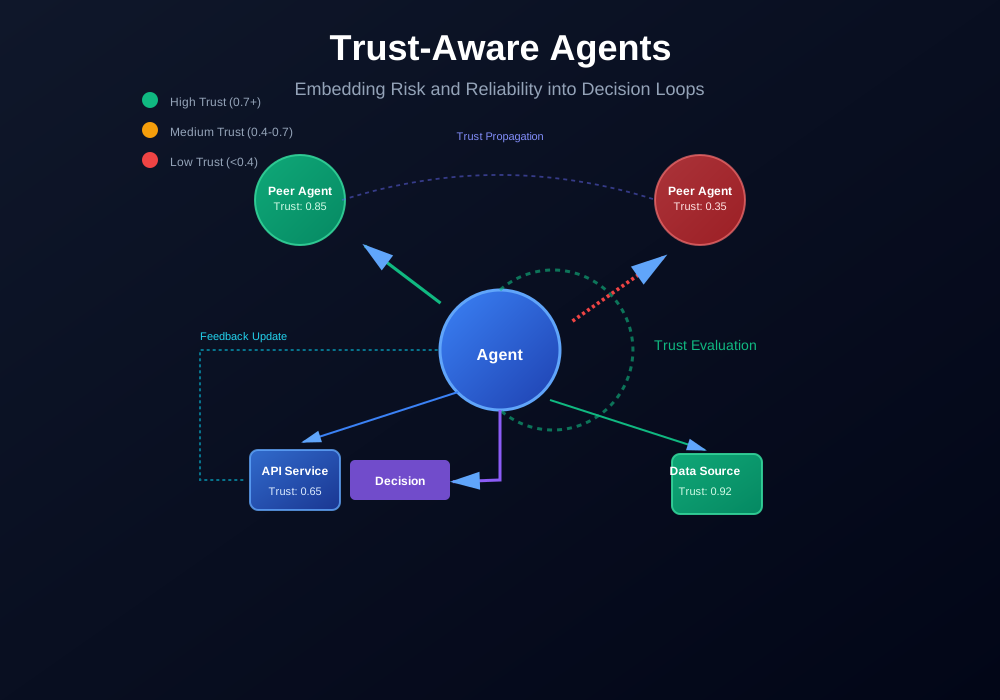
Trust-Aware Agents: Embedding Risk and Reliability into Decision Loops
Agents are making more decisions on their own. They delegate tasks to other agents. They call APIs. They use tools. They process data from various sources.
But here’s the problem: not all sources are equally reliable. Some APIs fail often. Some agents make mistakes. Some data sources are outdated. If an agent treats everything the same, it makes bad decisions.
Trust-aware agents fix this. They evaluate reliability before making decisions. They score trust for data sources, peer agents, and tools. They use those scores to decide what to do, when to verify, and when to reject.
This article explains how trust-aware systems work and how to build them.
Introduction: Why Trust Matters
Most agents work in a simple way. They get a request, they pick a tool or agent, they execute, and they return a result. They don’t question reliability. They don’t verify. They just execute.
This works when everything is perfect. But in real systems, things fail. APIs go down. Agents make errors. Data gets stale. Without trust awareness, agents can’t handle these problems well.
Consider a multi-agent system where one agent delegates a task to another. The delegating agent doesn’t know if the other agent is reliable. It just sends the task and hopes for the best. If the other agent fails or returns bad results, the whole system suffers.
Or consider an agent that uses multiple APIs. Some APIs are fast and reliable. Others are slow or fail often. Without trust awareness, the agent treats them all the same. It might keep using a failing API when better alternatives exist.
Trust-aware agents solve these problems by maintaining trust scores. They track how reliable each source is. They update scores based on outcomes. They use scores to make decisions.
A trust score is a number that represents reliability. High scores mean reliable. Low scores mean unreliable. Agents use these scores to decide what to do.
For example, if an agent has two APIs that can do the same thing, it picks the one with the higher trust score. If a peer agent has a low trust score, the agent might verify results or use a fallback. If a data source has a low trust score, the agent might look for alternatives.
Trust scores aren’t static. They change based on experience. If an API keeps failing, its trust score goes down. If it works well, the score goes up. This creates a feedback loop that improves decision-making over time.
The key insight is that trust is contextual. An agent might trust a peer for one type of task but not another. A data source might be reliable for recent data but unreliable for historical data. Trust-aware systems capture this context.
This is why trust awareness matters. It lets agents make better decisions in uncertain environments. It helps them adapt to failures. It improves overall system reliability.
Modeling Trust in Agent Systems
Trust isn’t a single number. It’s a combination of factors: credibility, accuracy, recency, and context. A good trust model captures all of these.
Components of Trust
Credibility: How much do you believe this source? This is about reputation and past performance. An agent that has consistently delivered good results has high credibility. One that has failed often has low credibility.
Accuracy: How correct are the results? This measures correctness of outputs. An API that returns accurate data has high accuracy. One that returns incorrect data has low accuracy.
Recency: How fresh is the information? This matters for data sources. A data source that updates frequently has high recency. One that’s outdated has low recency.
Context: How relevant is this source for this specific task? A peer agent might be great at one task but poor at another. Context captures this.
These components combine into a trust score. The exact combination depends on your needs. Some systems weight credibility heavily. Others focus on accuracy. The key is to capture what matters for your use case.
Trust Scoring Models
There are several ways to compute trust scores. Each has trade-offs.
Weighted Average: Simple and fast. You compute scores for each component, weight them, and average them.
def compute_trust_score_weighted(credibility: float, accuracy: float,
                                recency: float, context: float,
                                weights: dict) -> float:
    """Compute trust score using weighted average."""
    score = (
        weights['credibility'] * credibility +
        weights['accuracy'] * accuracy +
        weights['recency'] * recency +
        weights['context'] * context
    )
    return max(0.0, min(1.0, score))  # Clamp to [0, 1]
This works well when you have clear component scores and know the weights. But it doesn’t capture interactions between components.
Bayesian Models: More sophisticated. They update trust based on outcomes using probability theory.
class BayesianTrustModel:
    def __init__(self, alpha: float = 1.0, beta: float = 1.0):
        # Beta distribution parameters
        # alpha = successful interactions
        # beta = failed interactions
        self.alpha = alpha
        self.beta = beta

    def update(self, success: bool):
        """Update trust based on outcome."""
        if success:
            self.alpha += 1
        else:
            self.beta += 1

    def get_trust_score(self) -> float:
        """Get expected trust value (mean of beta distribution)."""
        total = self.alpha + self.beta
        if total == 0:
            return 0.5  # Neutral if no data
        return self.alpha / total

    def get_confidence(self) -> float:
        """Get confidence in trust score (inverse of variance)."""
        total = self.alpha + self.beta
        if total == 0:
            return 0.0
        # Higher total = more confidence
        return 1.0 / (1.0 + total)
Bayesian models are good when you have binary outcomes (success/failure). They naturally handle uncertainty and update smoothly.
Graph Propagation: For multi-agent systems. Trust propagates through agent networks.
import numpy as np
from typing import Dict, List, Set

class TrustGraph:
    def __init__(self):
        self.agents: Set[str] = set()
        self.trust_edges: Dict[str, Dict[str, float]] = {}
        # trust_edges[agent_a][agent_b] = trust score from A to B

    def add_agent(self, agent_id: str):
        """Add an agent to the graph."""
        self.agents.add(agent_id)
        if agent_id not in self.trust_edges:
            self.trust_edges[agent_id] = {}

    def set_direct_trust(self, from_agent: str, to_agent: str, trust: float):
        """Set direct trust between two agents."""
        self.add_agent(from_agent)
        self.add_agent(to_agent)
        self.trust_edges[from_agent][to_agent] = max(0.0, min(1.0, trust))

    def propagate_trust(self, from_agent: str, to_agent: str,
                       max_hops: int = 3) -> float:
        """Compute trust through graph propagation."""
        if from_agent == to_agent:
            return 1.0

        # Direct trust
        if to_agent in self.trust_edges.get(from_agent, {}):
            return self.trust_edges[from_agent][to_agent]

        # Propagate through intermediate agents
        if max_hops <= 0:
            return 0.0

        best_trust = 0.0
        for intermediate in self.agents:
            if intermediate == from_agent or intermediate == to_agent:
                continue

            # Trust from source to intermediate
            trust_to_intermediate = self.propagate_trust(
                from_agent, intermediate, max_hops - 1
            )
            if trust_to_intermediate == 0:
                continue

            # Trust from intermediate to target
            trust_from_intermediate = self.propagate_trust(
                intermediate, to_agent, max_hops - 1
            )
            if trust_from_intermediate == 0:
                continue

            # Combined trust (multiplicative, with decay)
            combined = trust_to_intermediate * trust_from_intermediate * 0.9  # 10% decay per hop
            best_trust = max(best_trust, combined)

        return best_trust
Graph propagation is useful when agents don’t have direct experience with each other. They can infer trust through mutual connections.
Example: Scoring Peer Agents
Here’s how you might score trust for peer agents:
from dataclasses import dataclass
from datetime import datetime, timedelta
from typing import Optional
import time

@dataclass
class AgentTrustMetrics:
    agent_id: str
    total_interactions: int = 0
    successful_interactions: int = 0
    failed_interactions: int = 0
    avg_response_time_ms: float = 0.0
    last_interaction_time: Optional[datetime] = None
    context_scores: Dict[str, float] = None  # Trust per context/task type

    def __post_init__(self):
        if self.context_scores is None:
            self.context_scores = {}

    def record_interaction(self, success: bool, response_time_ms: float,
                          context: str = "default"):
        """Record an interaction outcome."""
        self.total_interactions += 1
        if success:
            self.successful_interactions += 1
        else:
            self.failed_interactions += 1

        # Update average response time
        if self.total_interactions == 1:
            self.avg_response_time_ms = response_time_ms
        else:
            # Exponential moving average
            alpha = 0.3
            self.avg_response_time_ms = (
                alpha * response_time_ms +
                (1 - alpha) * self.avg_response_time_ms
            )

        self.last_interaction_time = datetime.now()

        # Update context-specific score
        if context not in self.context_scores:
            self.context_scores[context] = 0.5  # Neutral

        # Update context score (simplified)
        if success:
            self.context_scores[context] = min(1.0,
                self.context_scores[context] + 0.1)
        else:
            self.context_scores[context] = max(0.0,
                self.context_scores[context] - 0.2)

    def get_overall_trust(self) -> float:
        """Get overall trust score."""
        if self.total_interactions == 0:
            return 0.5  # Neutral

        success_rate = self.successful_interactions / self.total_interactions

        # Penalize for recency (if no interaction in 24 hours, decay)
        recency_factor = 1.0
        if self.last_interaction_time:
            hours_since = (datetime.now() - self.last_interaction_time).total_seconds() / 3600
            if hours_since > 24:
                recency_factor = max(0.5, 1.0 - (hours_since - 24) / 168)  # Decay over week

        return success_rate * recency_factor

    def get_context_trust(self, context: str) -> float:
        """Get trust score for a specific context."""
        if context in self.context_scores:
            return self.context_scores[context]
        return self.get_overall_trust()
This captures success rate, recency, and context-specific trust. You can extend it to include more factors.
Example: Scoring APIs
For APIs, you might track different metrics:
@dataclass
class APITrustMetrics:
    api_id: str
    endpoint: str
    total_calls: int = 0
    successful_calls: int = 0
    failed_calls: int = 0
    avg_latency_ms: float = 0.0
    error_rate: float = 0.0
    rate_limit_hits: int = 0
    last_success_time: Optional[datetime] = None
    last_failure_time: Optional[datetime] = None

    def record_call(self, success: bool, latency_ms: float,
                   error_type: Optional[str] = None):
        """Record an API call."""
        self.total_calls += 1
        if success:
            self.successful_calls += 1
            self.last_success_time = datetime.now()
        else:
            self.failed_calls += 1
            self.last_failure_time = datetime.now()
            if error_type == "rate_limit":
                self.rate_limit_hits += 1

        # Update latency
        if self.total_calls == 1:
            self.avg_latency_ms = latency_ms
        else:
            alpha = 0.2
            self.avg_latency_ms = (
                alpha * latency_ms +
                (1 - alpha) * self.avg_latency_ms
            )

        # Update error rate
        self.error_rate = self.failed_calls / self.total_calls

    def get_trust_score(self) -> float:
        """Compute trust score for this API."""
        if self.total_calls == 0:
            return 0.5

        # Base score from success rate
        success_rate = self.successful_calls / self.total_calls

        # Penalize for high error rate
        error_penalty = self.error_rate * 0.3

        # Penalize for rate limit hits
        rate_limit_penalty = min(0.2, self.rate_limit_hits / max(1, self.total_calls))

        # Reward for low latency (normalized)
        latency_bonus = 0.0
        if self.avg_latency_ms < 1000:  # Under 1 second
            latency_bonus = 0.1 * (1.0 - self.avg_latency_ms / 1000)

        score = success_rate - error_penalty - rate_limit_penalty + latency_bonus
        return max(0.0, min(1.0, score))
This captures API-specific concerns like latency and rate limits. You can adjust the weights based on what matters for your use case.
Integrating Trust into Cognitive Loops
Trust scores are useless if agents don’t use them. You need to integrate trust evaluation into the agent’s decision-making process.
The Cognitive Loop
Most agents follow a cognitive loop: perceive, reason, act. Trust evaluation fits into each stage.
Perception: When the agent receives information, it evaluates the trustworthiness of the source. High trust means the agent accepts the information. Low trust means it might verify or reject.
Reasoning: When the agent reasons about what to do, it considers trust scores. It might prefer actions that use high-trust sources. It might add verification steps for low-trust sources.
Action: When the agent executes actions, it monitors outcomes and updates trust scores. Success increases trust. Failure decreases trust.
Here’s how this looks in code:
from enum import Enum
from typing import Dict, Any, Optional, List

class ActionOutcome(Enum):
    SUCCESS = "success"
    FAILURE = "failure"
    PARTIAL = "partial"

class TrustAwareAgent:
    def __init__(self, agent_id: str):
        self.agent_id = agent_id
        self.trust_registry: Dict[str, AgentTrustMetrics] = {}
        self.api_trust: Dict[str, APITrustMetrics] = {}
        self.data_source_trust: Dict[str, float] = {}
        self.decision_threshold = 0.6  # Minimum trust to proceed

    def perceive(self, source_id: str, data: Any, source_type: str = "agent") -> Optional[Any]:
        """Perceive information from a source, with trust evaluation."""
        trust_score = self.get_trust_score(source_id, source_type)

        if trust_score < self.decision_threshold:
            # Low trust: verify or reject
            if self.should_verify(trust_score):
                return self.verify_data(source_id, data, source_type)
            else:
                return None  # Reject

        # High trust: accept
        return data

    def reason(self, goal: str, available_actions: List[Dict]) -> Optional[Dict]:
        """Reason about which action to take, considering trust."""
        # Score each action based on trust of required sources
        scored_actions = []
        for action in available_actions:
            required_sources = action.get("required_sources", [])
            min_trust = min([
                self.get_trust_score(source_id, source_type)
                for source_id, source_type in required_sources
            ], default=1.0)

            # Combine trust with action utility
            utility = action.get("utility", 0.5)
            combined_score = 0.7 * min_trust + 0.3 * utility

            scored_actions.append({
                "action": action,
                "trust_score": min_trust,
                "combined_score": combined_score
            })

        # Filter out actions below threshold
        valid_actions = [
            sa for sa in scored_actions
            if sa["trust_score"] >= self.decision_threshold
        ]

        if not valid_actions:
            return None  # No trustworthy actions available

        # Pick best action
        best = max(valid_actions, key=lambda x: x["combined_score"])
        return best["action"]

    def act(self, action: Dict, sources: Dict[str, Any]) -> ActionOutcome:
        """Execute an action and update trust based on outcome."""
        start_time = time.time()
        success = False

        try:
            # Execute action (simplified)
            result = self.execute_action(action, sources)
            success = result.get("success", False)
            latency_ms = (time.time() - start_time) * 1000

            # Update trust for each source used
            for source_id, source_data in sources.items():
                source_type = source_data.get("type", "agent")
                self.update_trust(source_id, source_type, success, latency_ms)

            return ActionOutcome.SUCCESS if success else ActionOutcome.FAILURE

        except Exception as e:
            latency_ms = (time.time() - start_time) * 1000
            # Update trust for sources (all failed)
            for source_id, source_data in sources.items():
                source_type = source_data.get("type", "agent")
                self.update_trust(source_id, source_type, False, latency_ms)

            return ActionOutcome.FAILURE

    def get_trust_score(self, source_id: str, source_type: str) -> float:
        """Get trust score for a source."""
        if source_type == "agent":
            if source_id in self.trust_registry:
                return self.trust_registry[source_id].get_overall_trust()
        elif source_type == "api":
            if source_id in self.api_trust:
                return self.api_trust[source_id].get_trust_score()
        elif source_type == "data_source":
            return self.data_source_trust.get(source_id, 0.5)

        return 0.5  # Default neutral trust

    def update_trust(self, source_id: str, source_type: str,
                    success: bool, latency_ms: float, context: str = "default"):
        """Update trust score based on outcome."""
        if source_type == "agent":
            if source_id not in self.trust_registry:
                self.trust_registry[source_id] = AgentTrustMetrics(source_id)
            self.trust_registry[source_id].record_interaction(
                success, latency_ms, context
            )
        elif source_type == "api":
            if source_id not in self.api_trust:
                self.api_trust[source_id] = APITrustMetrics(source_id, source_id)
            self.api_trust[source_id].record_call(success, latency_ms)

    def should_verify(self, trust_score: float) -> bool:
        """Decide if data should be verified based on trust."""
        # Verify if trust is low but not zero
        return 0.2 < trust_score < self.decision_threshold

    def verify_data(self, source_id: str, data: Any, source_type: str) -> Optional[Any]:
        """Verify data from a low-trust source (e.g., cross-check with other sources)."""
        # Simplified: just return data for now
        # Real implementation would cross-check with other sources
        return data

    def execute_action(self, action: Dict, sources: Dict[str, Any]) -> Dict:
        """Execute an action (simplified)."""
        # Real implementation would actually execute the action
        return {"success": True}
This shows how trust evaluation fits into the cognitive loop. The agent evaluates trust at each stage and uses it to make decisions.
Decision-Throttling
When trust scores are low, agents should throttle decisions. They might wait for more information. They might use fallbacks. They might ask for human input.
class DecisionThrottler:
    def __init__(self, min_trust: float = 0.6, max_wait_seconds: int = 30):
        self.min_trust = min_trust
        self.max_wait = max_wait_seconds
        self.pending_decisions: List[Dict] = []

    def should_proceed(self, trust_score: float, urgency: float = 0.5) -> bool:
        """Decide if we should proceed or wait."""
        if trust_score >= self.min_trust:
            return True

        # Low trust: wait if not urgent
        if urgency < 0.3:
            return False

        # Urgent but low trust: proceed with caution
        return trust_score >= self.min_trust * 0.7

    def add_fallback(self, decision: Dict, fallback: Dict):
        """Add a fallback option for a decision."""
        decision["fallback"] = fallback

    def execute_with_fallback(self, primary_action: Dict,
                             fallback_action: Dict,
                             trust_score: float) -> Dict:
        """Execute primary action, fallback to secondary if trust is low."""
        if trust_score >= self.min_trust:
            return self.execute(primary_action)
        else:
            return self.execute(fallback_action)

    def execute(self, action: Dict) -> Dict:
        """Execute an action (simplified)."""
        return {"success": True, "action": action}
Throttling prevents agents from making bad decisions when trust is low. It gives them time to gather more information or use safer alternatives.
Fallback Mechanisms
Fallbacks are important when primary sources have low trust. Agents should have backup options.
class FallbackManager:
    def __init__(self):
        self.fallbacks: Dict[str, List[Dict]] = {}
        # fallbacks[source_id] = list of alternative sources

    def register_fallback(self, source_id: str, fallback_source: Dict):
        """Register a fallback for a source."""
        if source_id not in self.fallbacks:
            self.fallbacks[source_id] = []
        self.fallbacks[source_id].append(fallback_source)

    def get_fallback(self, source_id: str, trust_score: float) -> Optional[Dict]:
        """Get best fallback if primary source trust is low."""
        if trust_score >= 0.6:
            return None  # No fallback needed

        if source_id not in self.fallbacks:
            return None

        # Return first available fallback
        # Real implementation would score fallbacks too
        fallbacks = self.fallbacks[source_id]
        return fallbacks[0] if fallbacks else None
Fallbacks provide safety nets. When primary sources fail or have low trust, agents can use alternatives.
Example: Lowering Tool Invocation Confidence
Here’s a concrete example of how trust affects tool invocation:
class TrustAwareToolInvoker:
    def __init__(self, agent: TrustAwareAgent):
        self.agent = agent
        self.tool_trust: Dict[str, float] = {}

    def invoke_tool(self, tool_id: str, params: Dict,
                   required_confidence: float = 0.8) -> Dict:
        """Invoke a tool with trust-aware confidence checking."""
        trust_score = self.tool_trust.get(tool_id, 0.5)

        # If trust is below required confidence, don't invoke
        if trust_score < required_confidence:
            return {
                "success": False,
                "error": f"Tool {tool_id} trust score {trust_score:.2f} below required {required_confidence}",
                "trust_score": trust_score
            }

        # Invoke tool
        try:
            result = self.execute_tool(tool_id, params)

            # Verify result if trust is moderate
            if trust_score < 0.9:
                verified = self.verify_result(tool_id, result, params)
                if not verified:
                    # Verification failed: lower trust and return error
                    self.tool_trust[tool_id] = trust_score * 0.8
                    return {
                        "success": False,
                        "error": "Result verification failed",
                        "trust_score": self.tool_trust[tool_id]
                    }

            # Success: increase trust slightly
            self.tool_trust[tool_id] = min(1.0, trust_score + 0.05)

            return {
                "success": True,
                "result": result,
                "trust_score": self.tool_trust[tool_id]
            }

        except Exception as e:
            # Failure: decrease trust
            self.tool_trust[tool_id] = max(0.0, trust_score - 0.1)
            return {
                "success": False,
                "error": str(e),
                "trust_score": self.tool_trust[tool_id]
            }

    def execute_tool(self, tool_id: str, params: Dict) -> Any:
        """Execute a tool (simplified)."""
        # Real implementation would actually invoke the tool
        return {"output": "tool_result"}

    def verify_result(self, tool_id: str, result: Any, params: Dict) -> bool:
        """Verify a tool result (e.g., by calling another tool or checking constraints)."""
        # Simplified: just return True
        # Real implementation would perform actual verification
        return True
This shows how trust affects tool invocation. Low trust means higher confidence requirements or verification steps. High trust means direct execution.
Implementation Example
Let’s build a complete trust evaluator system. This will include trust scoring, graph propagation, and integration with agent decision logic.
Trust Evaluator Implementation
from dataclasses import dataclass, field
from datetime import datetime, timedelta
from typing import Dict, List, Optional, Set, Tuple
import time
import json

@dataclass
class TrustRecord:
    """Record of a trust interaction."""
    source_id: str
    target_id: str
    outcome: bool  # True for success, False for failure
    context: str
    timestamp: datetime
    metadata: Dict[str, Any] = field(default_factory=dict)

class TrustEvaluator:
    """Evaluates and manages trust scores for various sources."""

    def __init__(self, decay_factor: float = 0.95, min_interactions: int = 3):
        self.decay_factor = decay_factor  # How much trust decays over time
        self.min_interactions = min_interactions  # Min interactions before trusting
        self.records: List[TrustRecord] = []
        self.direct_trust: Dict[Tuple[str, str], float] = {}
        # direct_trust[(source, target)] = trust score
        self.context_trust: Dict[Tuple[str, str, str], float] = {}
        # context_trust[(source, target, context)] = trust score

    def record_interaction(self, source_id: str, target_id: str,
                          outcome: bool, context: str = "default",
                          metadata: Optional[Dict] = None):
        """Record an interaction and update trust."""
        record = TrustRecord(
            source_id=source_id,
            target_id=target_id,
            outcome=outcome,
            context=context,
            timestamp=datetime.now(),
            metadata=metadata or {}
        )
        self.records.append(record)

        # Update direct trust
        key = (source_id, target_id)
        current_trust = self.direct_trust.get(key, 0.5)

        # Update based on outcome
        if outcome:
            # Success: increase trust
            new_trust = min(1.0, current_trust + 0.1)
        else:
            # Failure: decrease trust
            new_trust = max(0.0, current_trust - 0.2)

        self.direct_trust[key] = new_trust

        # Update context-specific trust
        context_key = (source_id, target_id, context)
        context_current = self.context_trust.get(context_key, 0.5)
        if outcome:
            context_new = min(1.0, context_current + 0.1)
        else:
            context_new = max(0.0, context_current - 0.2)
        self.context_trust[context_key] = context_new

    def get_trust(self, source_id: str, target_id: str,
                 context: Optional[str] = None) -> float:
        """Get trust score from source to target."""
        # Check context-specific trust first
        if context:
            context_key = (source_id, target_id, context)
            if context_key in self.context_trust:
                return self.context_trust[context_key]

        # Fall back to direct trust
        key = (source_id, target_id)
        return self.direct_trust.get(key, 0.5)  # Default neutral

    def get_trust_with_decay(self, source_id: str, target_id: str,
                            context: Optional[str] = None) -> float:
        """Get trust score with temporal decay."""
        base_trust = self.get_trust(source_id, target_id, context)

        # Find most recent interaction
        recent_records = [
            r for r in self.records
            if r.source_id == source_id and r.target_id == target_id
        ]

        if not recent_records:
            return base_trust * 0.5  # No recent interactions: decay heavily

        most_recent = max(recent_records, key=lambda r: r.timestamp)
        hours_since = (datetime.now() - most_recent.timestamp).total_seconds() / 3600

        # Decay: lose 5% per day
        decay = self.decay_factor ** (hours_since / 24)
        return base_trust * decay

    def get_interaction_count(self, source_id: str, target_id: str) -> int:
        """Get number of interactions between source and target."""
        return len([
            r for r in self.records
            if r.source_id == source_id and r.target_id == target_id
        ])

    def is_trustworthy(self, source_id: str, target_id: str,
                      min_trust: float = 0.6,
                      context: Optional[str] = None) -> bool:
        """Check if target is trustworthy from source's perspective."""
        trust = self.get_trust_with_decay(source_id, target_id, context)
        interactions = self.get_interaction_count(source_id, target_id)

        # Need minimum interactions and minimum trust
        return interactions >= self.min_interactions and trust >= min_trust
Trust Propagation with Weighted Graph
Now let’s add graph-based trust propagation:
import networkx as nx
from collections import defaultdict

class TrustGraphPropagator:
    """Propagates trust through a graph of agents."""

    def __init__(self, evaluator: TrustEvaluator):
        self.evaluator = evaluator
        self.graph = nx.DiGraph()  # Directed graph: edge weight = trust score

    def build_graph(self):
        """Build graph from trust records."""
        self.graph.clear()

        # Add nodes (all unique agents)
        agents = set()
        for record in self.evaluator.records:
            agents.add(record.source_id)
            agents.add(record.target_id)

        for agent in agents:
            self.graph.add_node(agent)

        # Add edges with trust weights
        for (source, target), trust in self.evaluator.direct_trust.items():
            self.graph.add_edge(source, target, weight=trust)

    def propagate_trust(self, source_id: str, target_id: str,
                       max_hops: int = 3) -> float:
        """Compute trust through graph propagation."""
        if source_id == target_id:
            return 1.0

        # Direct trust
        if self.graph.has_edge(source_id, target_id):
            return self.graph[source_id][target_id]['weight']

        # Find paths
        try:
            paths = list(nx.all_simple_paths(
                self.graph, source_id, target_id, cutoff=max_hops
            ))
        except nx.NetworkXNoPath:
            return 0.0  # No path found

        if not paths:
            return 0.0

        # Compute trust for each path (multiplicative with decay)
        path_trusts = []
        for path in paths:
            path_trust = 1.0
            for i in range(len(path) - 1):
                edge_trust = self.graph[path[i]][path[i+1]]['weight']
                path_trust *= edge_trust

            # Decay: 10% per hop
            decay = 0.9 ** (len(path) - 1)
            path_trust *= decay
            path_trusts.append(path_trust)

        # Return maximum path trust (most trustworthy path)
        return max(path_trusts) if path_trusts else 0.0

    def get_trust_network(self, agent_id: str, max_hops: int = 2) -> Dict:
        """Get trust network around an agent."""
        self.build_graph()

        network = {
            "agent": agent_id,
            "direct_trust": {},
            "indirect_trust": {}
        }

        # Direct connections
        if agent_id in self.graph:
            for neighbor in self.graph.successors(agent_id):
                trust = self.graph[agent_id][neighbor]['weight']
                network["direct_trust"][neighbor] = trust

        # Indirect connections (2 hops)
        for node in self.graph.nodes():
            if node == agent_id:
                continue
            if node not in network["direct_trust"]:
                trust = self.propagate_trust(agent_id, node, max_hops=2)
                if trust > 0:
                    network["indirect_trust"][node] = trust

        return network
Integration with Agent Decision Logic
Finally, let’s integrate trust into an agent’s decision-making:
class TrustAwareDecisionEngine:
    """Decision engine that uses trust scores."""

    def __init__(self, evaluator: TrustEvaluator,
                 propagator: TrustGraphPropagator):
        self.evaluator = evaluator
        self.propagator = propagator
        self.decision_threshold = 0.6
        self.verification_threshold = 0.4

    def evaluate_action(self, action: Dict, agent_id: str) -> Dict:
        """Evaluate whether an action should be taken based on trust."""
        required_sources = action.get("required_sources", [])
        context = action.get("context", "default")

        # Compute minimum trust across all required sources
        min_trust = 1.0
        trust_scores = {}

        for source in required_sources:
            source_id = source.get("id")
            source_type = source.get("type", "agent")

            # Get trust (direct or propagated)
            if source_type == "agent":
                trust = self.propagator.propagate_trust(
                    agent_id, source_id, max_hops=3
                )
            else:
                # For APIs/data sources, use direct trust
                trust = self.evaluator.get_trust(agent_id, source_id, context)

            trust_scores[source_id] = trust
            min_trust = min(min_trust, trust)

        # Decision logic
        decision = {
            "action": action,
            "min_trust": min_trust,
            "trust_scores": trust_scores,
            "recommendation": None,
            "reason": None
        }

        if min_trust >= self.decision_threshold:
            decision["recommendation"] = "proceed"
            decision["reason"] = "All sources meet trust threshold"
        elif min_trust >= self.verification_threshold:
            decision["recommendation"] = "proceed_with_verification"
            decision["reason"] = "Trust is moderate; verification recommended"
        else:
            decision["recommendation"] = "reject"
            decision["reason"] = "Trust too low; action rejected"

        return decision

    def select_best_action(self, actions: List[Dict], agent_id: str) -> Optional[Dict]:
        """Select best action from candidates based on trust and utility."""
        evaluated = []

        for action in actions:
            evaluation = self.evaluate_action(action, agent_id)
            utility = action.get("utility", 0.5)

            # Combine trust and utility
            if evaluation["recommendation"] == "reject":
                continue  # Skip rejected actions

            # Score: 70% trust, 30% utility
            score = 0.7 * evaluation["min_trust"] + 0.3 * utility

            evaluated.append({
                "action": action,
                "evaluation": evaluation,
                "score": score
            })

        if not evaluated:
            return None

        # Return best action
        best = max(evaluated, key=lambda x: x["score"])
        return best["action"]

    def execute_with_trust_tracking(self, action: Dict, agent_id: str,
                                    sources: Dict[str, Any]) -> Dict:
        """Execute action and update trust based on outcome."""
        # Execute action
        start_time = time.time()
        try:
            result = self._execute_action(action, sources)
            success = result.get("success", False)
            latency_ms = (time.time() - start_time) * 1000

            # Update trust for each source
            context = action.get("context", "default")
            for source_id, source_data in sources.items():
                self.evaluator.record_interaction(
                    source_id=agent_id,
                    target_id=source_id,
                    outcome=success,
                    context=context,
                    metadata={"latency_ms": latency_ms}
                )

            return {
                "success": True,
                "result": result,
                "trust_updated": True
            }

        except Exception as e:
            latency_ms = (time.time() - start_time) * 1000
            # Update trust (failure)
            context = action.get("context", "default")
            for source_id in sources.keys():
                self.evaluator.record_interaction(
                    source_id=agent_id,
                    target_id=source_id,
                    outcome=False,
                    context=context,
                    metadata={"error": str(e), "latency_ms": latency_ms}
                )

            return {
                "success": False,
                "error": str(e),
                "trust_updated": True
            }

    def _execute_action(self, action: Dict, sources: Dict[str, Any]) -> Dict:
        """Execute an action (simplified)."""
        # Real implementation would actually execute
        return {"success": True, "output": "action_result"}
Complete Example Usage
Here’s how you’d use this system:
# Create components
evaluator = TrustEvaluator()
propagator = TrustGraphPropagator(evaluator)
decision_engine = TrustAwareDecisionEngine(evaluator, propagator)

# Simulate some interactions to build trust
evaluator.record_interaction("agent_a", "agent_b", True, "task_1")
evaluator.record_interaction("agent_a", "agent_b", True, "task_1")
evaluator.record_interaction("agent_a", "agent_b", False, "task_1")
evaluator.record_interaction("agent_b", "agent_c", True, "task_2")
evaluator.record_interaction("agent_b", "agent_c", True, "task_2")

# Build graph
propagator.build_graph()

# Check trust
trust_ab = evaluator.get_trust("agent_a", "agent_b")
print(f"Trust from A to B: {trust_ab:.2f}")

# Propagated trust (A -> B -> C)
trust_ac = propagator.propagate_trust("agent_a", "agent_c")
print(f"Propagated trust from A to C: {trust_ac:.2f}")

# Evaluate an action
action = {
    "id": "action_1",
    "required_sources": [
        {"id": "agent_b", "type": "agent"},
        {"id": "api_1", "type": "api"}
    ],
    "context": "task_1",
    "utility": 0.8
}

evaluation = decision_engine.evaluate_action(action, "agent_a")
print(f"Action recommendation: {evaluation['recommendation']}")
print(f"Reason: {evaluation['reason']}")

# Execute with trust tracking
sources = {
    "agent_b": {"type": "agent", "data": "some_data"},
    "api_1": {"type": "api", "data": "api_data"}
}

result = decision_engine.execute_with_trust_tracking(action, "agent_a", sources)
print(f"Execution success: {result['success']}")
This gives you a complete trust-aware system. Agents can evaluate trust, propagate it through networks, and use it to make decisions.
Visualization and Logging
Trust scores are only useful if you can see them. You need dashboards, logs, and visualizations to understand how trust evolves.
Displaying Trust Scores
Here’s a simple way to visualize trust scores:
import matplotlib.pyplot as plt
from datetime import datetime, timedelta
from collections import defaultdict

class TrustVisualizer:
    def __init__(self, evaluator: TrustEvaluator):
        self.evaluator = evaluator

    def plot_trust_over_time(self, source_id: str, target_id: str,
                            days: int = 7, save_path: Optional[str] = None):
        """Plot trust score over time."""
        # Get records for this pair
        records = [
            r for r in self.evaluator.records
            if r.source_id == source_id and r.target_id == target_id
        ]

        if not records:
            print("No records found")
            return

        # Sort by timestamp
        records.sort(key=lambda r: r.timestamp)

        # Compute trust at each point
        times = []
        trust_scores = []
        current_trust = 0.5

        for record in records:
            if record.outcome:
                current_trust = min(1.0, current_trust + 0.1)
            else:
                current_trust = max(0.0, current_trust - 0.2)

            times.append(record.timestamp)
            trust_scores.append(current_trust)

        # Plot
        plt.figure(figsize=(10, 6))
        plt.plot(times, trust_scores, marker='o')
        plt.xlabel('Time')
        plt.ylabel('Trust Score')
        plt.title(f'Trust: {source_id} -> {target_id}')
        plt.grid(True)
        plt.ylim(0, 1)

        if save_path:
            plt.savefig(save_path)
        else:
            plt.show()

    def plot_trust_network(self, agent_id: str, save_path: Optional[str] = None):
        """Plot trust network around an agent."""
        propagator = TrustGraphPropagator(self.evaluator)
        network = propagator.get_trust_network(agent_id)

        # Build graph for visualization
        import networkx as nx
        G = nx.DiGraph()

        # Add edges
        for target, trust in network["direct_trust"].items():
            G.add_edge(agent_id, target, weight=trust, type="direct")

        for target, trust in network["indirect_trust"].items():
            G.add_edge(agent_id, target, weight=trust, type="indirect")

        # Plot
        plt.figure(figsize=(12, 8))
        pos = nx.spring_layout(G)

        # Draw nodes
        nx.draw_networkx_nodes(G, pos, node_color='lightblue',
                              node_size=1000, alpha=0.9)

        # Draw edges with thickness based on trust
        direct_edges = [(u, v) for u, v, d in G.edges(data=True)
                       if d.get('type') == 'direct']
        indirect_edges = [(u, v) for u, v, d in G.edges(data=True)
                         if d.get('type') == 'indirect']

        nx.draw_networkx_edges(G, pos, edgelist=direct_edges,
                              width=[G[u][v]['weight'] * 5 for u, v in direct_edges],
                              edge_color='green', alpha=0.6, arrows=True)

        nx.draw_networkx_edges(G, pos, edgelist=indirect_edges,
                              width=[G[u][v]['weight'] * 3 for u, v in indirect_edges],
                              edge_color='orange', alpha=0.4, arrows=True, style='dashed')

        # Draw labels
        nx.draw_networkx_labels(G, pos, font_size=10)

        # Edge labels (trust scores)
        edge_labels = {(u, v): f"{G[u][v]['weight']:.2f}"
                      for u, v in G.edges()}
        nx.draw_networkx_edge_labels(G, pos, edge_labels, font_size=8)

        plt.title(f'Trust Network: {agent_id}')
        plt.axis('off')

        if save_path:
            plt.savefig(save_path)
        else:
            plt.show()
Handling Dynamic Decay and Refresh
Trust scores decay over time. You need to handle this dynamically:
class TrustDecayManager:
    def __init__(self, evaluator: TrustEvaluator,
                 decay_rate: float = 0.05,  # 5% per day
                 refresh_interval_hours: int = 24):
        self.evaluator = evaluator
        self.decay_rate = decay_rate
        self.refresh_interval = timedelta(hours=refresh_interval_hours)
        self.last_refresh: Dict[Tuple[str, str], datetime] = {}

    def apply_decay(self):
        """Apply temporal decay to all trust scores."""
        now = datetime.now()

        for (source, target), trust in list(self.evaluator.direct_trust.items()):
            # Find last interaction
            recent_records = [
                r for r in self.evaluator.records
                if r.source_id == source and r.target_id == target
            ]

            if not recent_records:
                # No interactions: decay to neutral
                self.evaluator.direct_trust[(source, target)] = 0.5
                continue

            last_interaction = max(recent_records, key=lambda r: r.timestamp)
            hours_since = (now - last_interaction.timestamp).total_seconds() / 3600
            days_since = hours_since / 24

            # Apply decay
            decay_factor = (1 - self.decay_rate) ** days_since
            new_trust = trust * decay_factor

            # Don't decay below 0.3 (some baseline trust)
            self.evaluator.direct_trust[(source, target)] = max(0.3, new_trust)

    def should_refresh(self, source_id: str, target_id: str) -> bool:
        """Check if trust score should be refreshed."""
        key = (source_id, target_id)
        last_refresh_time = self.last_refresh.get(key)

        if last_refresh_time is None:
            return True

        return (datetime.now() - last_refresh_time) >= self.refresh_interval

    def refresh_trust(self, source_id: str, target_id: str):
        """Refresh trust score by recalculating from recent interactions."""
        # Get recent interactions (last 30 days)
        cutoff = datetime.now() - timedelta(days=30)
        recent_records = [
            r for r in self.evaluator.records
            if r.source_id == source_id and r.target_id == target_id
            and r.timestamp >= cutoff
        ]

        if not recent_records:
            return

        # Recalculate trust from recent interactions
        successes = sum(1 for r in recent_records if r.outcome)
        total = len(recent_records)
        new_trust = successes / total if total > 0 else 0.5

        self.evaluator.direct_trust[(source_id, target_id)] = new_trust
        self.last_refresh[(source_id, target_id)] = datetime.now()
This handles decay and refresh automatically. Trust scores stay current without manual intervention.
Telemetry Dashboard
For production systems, you want a telemetry dashboard. Here’s a simple JSON-based approach:
class TrustTelemetry:
    def __init__(self, evaluator: TrustEvaluator):
        self.evaluator = evaluator
        self.metrics: List[Dict] = []

    def export_metrics(self) -> Dict:
        """Export current trust metrics for dashboard."""
        return {
            "timestamp": datetime.now().isoformat(),
            "total_interactions": len(self.evaluator.records),
            "trust_scores": {
                f"{source}->{target}": trust
                for (source, target), trust in self.evaluator.direct_trust.items()
            },
            "recent_interactions": [
                {
                    "source": r.source_id,
                    "target": r.target_id,
                    "outcome": r.outcome,
                    "context": r.context,
                    "timestamp": r.timestamp.isoformat()
                }
                for r in self.evaluator.records[-100:]  # Last 100
            ]
        }

    def get_trust_summary(self) -> Dict:
        """Get summary statistics."""
        if not self.evaluator.direct_trust:
            return {"message": "No trust data"}

        trust_values = list(self.evaluator.direct_trust.values())

        return {
            "total_trust_relationships": len(trust_values),
            "avg_trust": sum(trust_values) / len(trust_values),
            "min_trust": min(trust_values),
            "max_trust": max(trust_values),
            "high_trust_count": sum(1 for t in trust_values if t >= 0.7),
            "low_trust_count": sum(1 for t in trust_values if t < 0.4)
        }
You can expose this via an API or write it to a file for dashboard consumption.
Future Trends
Trust-aware systems are still evolving. Several trends will shape their future.
Agent Negotiation
In multi-agent systems, agents will negotiate based on trust. An agent with high trust can demand better terms. One with low trust might need to offer incentives.
Trust becomes a form of social capital. Agents build reputation through reliable behavior. That reputation affects their ability to collaborate.
This creates interesting dynamics. Agents might invest in building trust with key partners. They might avoid interactions that could damage trust. They might form trust-based coalitions.
Federated Learning
Trust is crucial for federated learning systems. Multiple agents contribute model updates. You need to trust that updates are legitimate and useful.
Trust scores can weight contributions. High-trust agents get more influence. Low-trust agents get less. This prevents malicious or low-quality updates from corrupting the model.
Trust can also guide agent selection. You might only include high-trust agents in a federated learning round. This improves model quality and security.
AI Governance Frameworks
As AI systems become more autonomous, governance becomes critical. Trust-aware systems provide a foundation for governance.
You can set policies based on trust. For example, low-trust agents might have restricted permissions. High-trust agents might get more autonomy.
Trust scores provide audit trails. You can see which agents are reliable and which aren’t. This helps with accountability and compliance.
Regulatory frameworks might require trust tracking. Systems might need to demonstrate that they evaluate reliability before making decisions. Trust-aware architectures support this.
Cross-Domain Trust
Today, trust is usually domain-specific. An agent might trust a peer for one type of task but not another. Future systems might transfer trust across domains.
For example, if an agent is reliable at data processing, that might indicate reliability at other tasks too. Cross-domain trust transfer could accelerate trust building.
This requires understanding what makes trust transferable. Is it general competence? Is it specific skills? Research will answer these questions.
Trust as a Service
We might see trust evaluation as a service. Centralized trust registries could track reliability across many systems. Agents could query these registries instead of building trust from scratch.
This would accelerate trust building. New agents could start with reputation from previous systems. They wouldn’t need to build trust from zero.
Privacy is a challenge here. Trust registries need to balance transparency with privacy. Agents might not want to share all trust information publicly.
Conclusion
Trust-aware agents make better decisions. They evaluate reliability before acting. They adapt based on experience. They handle uncertainty better than blind systems.
The key components are trust scoring, propagation, and integration into decision loops. Trust scores capture reliability. Propagation extends trust through networks. Integration makes trust actionable.
Implementation isn’t trivial. You need to track interactions, compute scores, handle decay, and visualize results. But the building blocks are straightforward. Trust records, scoring models, graph propagation, decision engines.
As multi-agent systems grow, trust awareness becomes essential. Agents need to evaluate peers, APIs, and data sources. They need to make decisions under uncertainty. Trust-aware architectures support this.
The future will bring more sophisticated trust models. Cross-domain transfer, negotiation, federated learning integration. But the core idea remains: evaluate reliability, use it in decisions, update based on outcomes.
Trust-aware systems are the foundation for reliable multi-agent ecosystems. They enable agents to work together effectively even when individual components are unreliable. That’s why they matter.
Discussion
Loading comments...