Behavior Fusion: Integrating Multi-Intent Reasoning in AI Agents
Most AI agents work like assembly lines. They do one thing at a time. Planning happens separately from retrieval. Dialogue runs in isolation. Each part works fine, but they don’t talk to each other.
That’s a problem when you need agents that can handle multiple goals at once. A research agent might need to plan its search, retrieve information, and fact-check results simultaneously. A customer service agent needs to understand context while planning responses and validating information.
Traditional intent routing creates silos. Each intent gets its own path through your system. They don’t share context well. They can’t adapt when priorities shift.
Behavior fusion changes that. Instead of routing intents to separate paths, you blend them together. Multiple reasoning processes work in parallel, sharing context and adjusting their influence based on what’s needed.
This article shows you how to build agents that can reason about multiple things at once. It’s not about choosing between planning and retrieval. It’s about doing both, together.
The Problem with Single-Intent Pipelines
Let’s look at a typical agent setup. You have a planner, a retriever, and a dialogue manager. They work in sequence.
# Traditional approach
def traditional_agent(user_query):
    # Step 1: Plan
    plan = planner.plan(user_query)

    # Step 2: Retrieve
    context = retriever.retrieve(plan.search_terms)

    # Step 3: Generate
    response = dialogue_manager.generate(context, user_query)

    return response
This works, but it’s rigid. The planner can’t see what the retriever found. The dialogue manager doesn’t know about planning constraints. If the retrieval fails, everything breaks.
Now imagine a research agent that needs to:
- Plan its search strategy
- Retrieve relevant papers
- Fact-check claims
- Adjust its approach based on what it finds
In a traditional system, this becomes a chain of dependencies. If fact-checking finds issues, you have to go back and re-plan. That’s inefficient.
What is Behavior Fusion?
Behavior fusion means blending multiple reasoning processes into a single unified context. Instead of separate pipelines, you have one system where different “behaviors” can influence each other.
Think of it like how your brain works. When you’re solving a problem, you don’t turn off planning to do retrieval. Both processes run at the same time, influencing each other.
Intent Blending
Intent blending is about combining different goals. A research agent might need to:
- Understand the user’s question (dialogue intent)
- Find relevant information (retrieval intent)
- Verify facts (critic intent)
- Plan next steps (planning intent)
Instead of routing each intent separately, you blend them. Each intent gets a weight that determines how much it influences the final decision.
Context Multiplexing
Context multiplexing means sharing information across reasoning paths. When the planner makes a decision, the retriever can see it immediately. When the retriever finds something, the planner can adjust.
This is different from passing data between stages. In fusion, all processes work with the same shared context. They can read and write to it simultaneously.
Cognitive Architectures
Behavior fusion draws inspiration from cognitive architectures like SOAR and ACT-R. These systems model how humans think by combining multiple cognitive processes.
SOAR (State, Operator, And Result) uses a unified state space where different reasoning processes can work together. ACT-R (Adaptive Control of Thought - Rational) combines declarative and procedural knowledge.
We’re applying similar ideas to AI agents. Instead of separate modules, we have unified reasoning spaces.
How Behavior Fusion Works
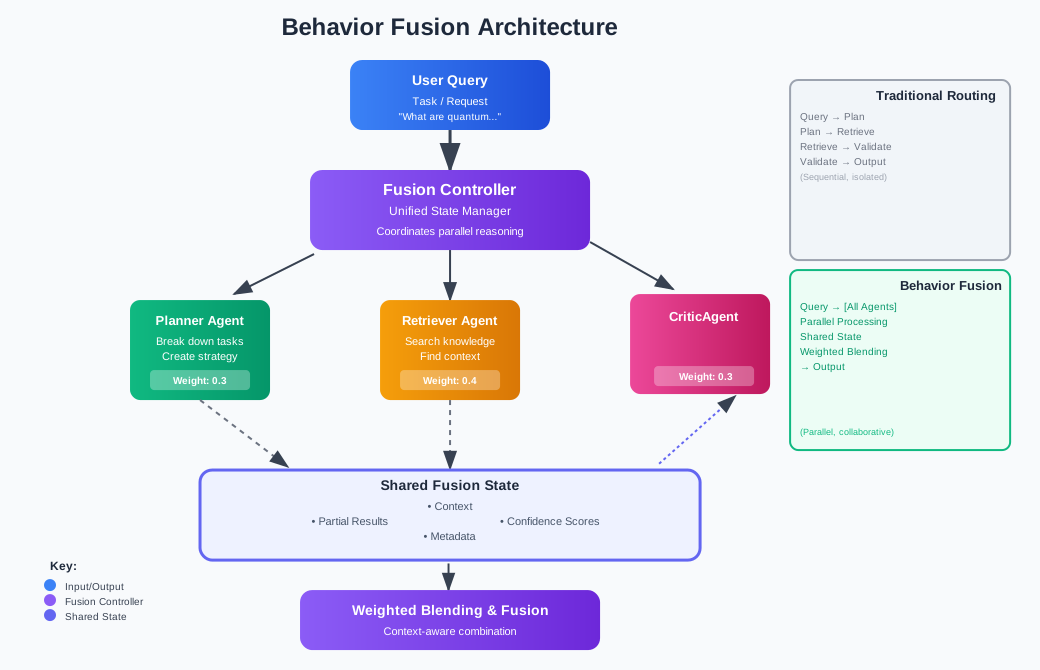
Here’s a visual representation of the behavior fusion architecture:
┌─────────────────────────────────────────────────────────────────┐
│                    User Query / Task                            │
└────────────────────────┬────────────────────────────────────────┘
                         │
                         ▼
        ┌─────────────────────────────────────┐
        │      Fusion Controller              │
        │  (Unified State Manager)            │
        └─────────────────────────────────────┘
                         │
        ┌────────────────┼────────────────┐
        │                │                │
        ▼                ▼                ▼
┌──────────────┐ ┌──────────────┐ ┌──────────────┐
│   Planner    │ │  Retriever   │ │    Critic    │
│   Agent      │ │   Agent      │ │    Agent     │
│              │ │              │ │              │
│ Weight: 0.3  │ │ Weight: 0.4  │ │ Weight: 0.3  │
└──────┬───────┘ └──────┬───────┘ └──────┬───────┘
       │                │                │
       │  ┌─────────────┴─────────────┐  │
       │  │   Shared Fusion State     │  │
       │  │  - Context                │  │
       │  │  - Partial Results        │  │
       │  │  - Confidence Scores      │  │
       │  │  - Metadata               │  │
       │  └─────────────┬─────────────┘  │
       │                │                │
       └────────────────┼────────────────┘
                        │
                        ▼
        ┌─────────────────────────────────────┐
        │   Weighted Blending & Fusion        │
        │   (Context-aware combination)       │
        └─────────────────────────────────────┘
                        │
                        ▼
        ┌─────────────────────────────────────┐
        │      Final Fused Output              │
        └─────────────────────────────────────┘

Traditional Routing (Sequential):
Query → Plan → Retrieve → Validate → Output
        (each step waits for previous)

Behavior Fusion (Parallel):
Query → [Plan + Retrieve + Validate] → Output
        (all steps work simultaneously, share state)
The key difference is that in behavior fusion, all agents work in parallel on a shared state. They can see each other’s progress and adjust in real-time. Traditional routing processes things sequentially, so each step is isolated.
Architecture Pattern
Behavior fusion differs from intent switching or routing in important ways.
Intent Switching vs. Fusion
Intent switching means choosing one intent at a time. You might switch from planning to retrieval, but they don’t overlap.
Fusion means multiple intents are active at the same time. They influence each other continuously.
The Fusion Pattern
Here’s how it works:
- Unified State: All reasoning processes share a common state object
- Parallel Processing: Multiple agents work on the same state simultaneously
- Weighted Influence: Each agent’s output gets a weight that determines its impact
- Continuous Update: The state updates in real-time as agents work
- Adaptive Weights: Weights can change based on context or task phase
State Management
The unified state is the key. It holds:
- Current context
- Partial results from each agent
- Confidence scores
- Metadata about reasoning paths
All agents read from and write to this state. They can see what others are doing and adjust accordingly.
Implementation Example
Let’s build a BehaviorFusionAgent that combines planning, retrieval, and fact-checking.
The Fusion Controller
First, we need a controller that manages the fusion process:
from typing import Dict, List, Any, Optional
from dataclasses import dataclass, field
from datetime import datetime
from langchain.agents import AgentExecutor, create_openai_functions_agent
from langchain_openai import ChatOpenAI
from langchain.prompts import ChatPromptTemplate, MessagesPlaceholder
from langchain.tools import Tool
from langchain_community.vectorstores import FAISS
from langchain_openai import OpenAIEmbeddings
import asyncio
from concurrent.futures import ThreadPoolExecutor

@dataclass
class FusionState:
    """Unified state shared by all reasoning agents"""
    user_query: str
    context: Dict[str, Any] = field(default_factory=dict)
    partial_results: Dict[str, Any] = field(default_factory=dict)
    confidence_scores: Dict[str, float] = field(default_factory=dict)
    metadata: Dict[str, Any] = field(default_factory=dict)
    timestamp: datetime = field(default_factory=datetime.now)

@dataclass
class FusionWeights:
    """Controls how much each agent influences the final output"""
    planner: float = 0.3
    retriever: float = 0.4
    critic: float = 0.3

    def normalize(self):
        """Ensure weights sum to 1.0"""
        total = self.planner + self.retriever + self.critic
        if total > 0:
            self.planner /= total
            self.retriever /= total
            self.critic /= total

class BehaviorFusionAgent:
    """
    An agent that fuses multiple reasoning behaviors into a unified context.
    Combines planning, retrieval, and fact-checking in parallel.
    """

    def __init__(
        self,
        llm: ChatOpenAI,
        vectorstore: FAISS,
        fusion_weights: Optional[FusionWeights] = None,
        max_iterations: int = 5
    ):
        self.llm = llm
        self.vectorstore = vectorstore
        self.fusion_weights = fusion_weights or FusionWeights()
        self.fusion_weights.normalize()
        self.max_iterations = max_iterations

        # Initialize specialized agents
        self.planner_agent = self._create_planner_agent()
        self.retriever_agent = self._create_retriever_agent()
        self.critic_agent = self._create_critic_agent()

    def _create_planner_agent(self) -> AgentExecutor:
        """Creates a specialized planning agent"""
        planner_prompt = ChatPromptTemplate.from_messages([
            ("system", """You are a planning agent. Your job is to break down tasks into steps.
            You have access to the current fusion state and can see what other agents are doing.
            Consider the user query and available context when planning."""),
            MessagesPlaceholder(variable_name="chat_history"),
            ("human", "{input}"),
            MessagesPlaceholder(variable_name="agent_scratchpad"),
        ])

        planner_tools = [
            Tool(
                name="read_state",
                func=lambda x: f"State: {x}",
                description="Read the current fusion state"
            ),
            Tool(
                name="update_plan",
                func=lambda x: f"Plan updated: {x}",
                description="Update the plan in the fusion state"
            )
        ]

        agent = create_openai_functions_agent(
            self.llm,
            planner_tools,
            planner_prompt
        )

        return AgentExecutor(agent=agent, tools=planner_tools, verbose=True)

    def _create_retriever_agent(self) -> AgentExecutor:
        """Creates a specialized retrieval agent"""
        retriever_prompt = ChatPromptTemplate.from_messages([
            ("system", """You are a retrieval agent. Your job is to find relevant information.
            You can search the knowledge base and retrieve documents.
            Consider the user query and planning context when retrieving."""),
            MessagesPlaceholder(variable_name="chat_history"),
            ("human", "{input}"),
            MessagesPlaceholder(variable_name="agent_scratchpad"),
        ])

        retriever_tools = [
            Tool(
                name="search_knowledge_base",
                func=self._search_kb,
                description="Search the knowledge base for relevant information"
            ),
            Tool(
                name="update_context",
                func=lambda x: f"Context updated: {x}",
                description="Update the retrieval context in fusion state"
            )
        ]

        agent = create_openai_functions_agent(
            self.llm,
            retriever_tools,
            retriever_prompt
        )

        return AgentExecutor(agent=agent, tools=retriever_tools, verbose=True)

    def _create_critic_agent(self) -> AgentExecutor:
        """Creates a specialized fact-checking/critical agent"""
        critic_prompt = ChatPromptTemplate.from_messages([
            ("system", """You are a critic agent. Your job is to fact-check and validate information.
            You review outputs from other agents and check for accuracy, consistency, and completeness.
            Consider the user query and retrieved context when critiquing."""),
            MessagesPlaceholder(variable_name="chat_history"),
            ("human", "{input}"),
            MessagesPlaceholder(variable_name="agent_scratchpad"),
        ])

        critic_tools = [
            Tool(
                name="validate_fact",
                func=self._validate_fact,
                description="Validate a fact against the knowledge base"
            ),
            Tool(
                name="update_confidence",
                func=lambda x: f"Confidence updated: {x}",
                description="Update confidence scores in fusion state"
            )
        ]

        agent = create_openai_functions_agent(
            self.llm,
            critic_tools,
            critic_prompt
        )

        return AgentExecutor(agent=agent, tools=critic_tools, verbose=True)

    def _search_kb(self, query: str) -> str:
        """Search the knowledge base"""
        docs = self.vectorstore.similarity_search(query, k=3)
        return "\n\n".join([doc.page_content for doc in docs])

    def _validate_fact(self, claim: str) -> str:
        """Validate a fact against the knowledge base"""
        # Simple validation: check if claim is in knowledge base
        docs = self.vectorstore.similarity_search(claim, k=1)
        if docs:
            return f"Claim validated: {docs[0].page_content[:100]}"
        return "Claim not found in knowledge base"

    async def _run_agent_async(
        self,
        agent: AgentExecutor,
        state: FusionState,
        agent_name: str
    ) -> Dict[str, Any]:
        """Run an agent asynchronously"""
        try:
            # Create input that includes current state
            input_text = f"""
            User Query: {state.user_query}
            Current State: {state.context}
            Partial Results: {state.partial_results}
            """

            result = await asyncio.to_thread(
                agent.invoke,
                {"input": input_text, "chat_history": []}
            )

            return {
                "agent": agent_name,
                "result": result.get("output", ""),
                "success": True,
                "timestamp": datetime.now()
            }
        except Exception as e:
            return {
                "agent": agent_name,
                "result": str(e),
                "success": False,
                "timestamp": datetime.now()
            }

    async def fuse_behaviors(
        self,
        user_query: str,
        adaptive_weights: bool = True
    ) -> Dict[str, Any]:
        """
        Main fusion method that runs all agents in parallel and blends their outputs.
        """
        # Initialize fusion state
        state = FusionState(user_query=user_query)

        # Run multiple fusion iterations
        for iteration in range(self.max_iterations):
            # Run all agents in parallel
            tasks = [
                self._run_agent_async(self.planner_agent, state, "planner"),
                self._run_agent_async(self.retriever_agent, state, "retriever"),
                self._run_agent_async(self.critic_agent, state, "critic")
            ]

            results = await asyncio.gather(*tasks)

            # Update state with results
            for result in results:
                agent_name = result["agent"]
                state.partial_results[agent_name] = result["result"]

                # Update confidence based on success
                if result["success"]:
                    state.confidence_scores[agent_name] = (
                        state.confidence_scores.get(agent_name, 0.5) + 0.1
                    )
                else:
                    state.confidence_scores[agent_name] = (
                        state.confidence_scores.get(agent_name, 0.5) - 0.1
                    )

            # Adaptive weight adjustment
            if adaptive_weights:
                self._adjust_weights(results, state)

            # Update context with blended information
            state.context = self._blend_contexts(results, state)

            # Check for convergence
            if self._check_convergence(state):
                break

        # Generate final output by blending all results
        final_output = self._generate_fused_output(state, results)

        return {
            "output": final_output,
            "state": state,
            "iterations": iteration + 1,
            "fusion_weights": {
                "planner": self.fusion_weights.planner,
                "retriever": self.fusion_weights.retriever,
                "critic": self.fusion_weights.critic
            }
        }

    def _adjust_weights(self, results: List[Dict], state: FusionState):
        """Adjust fusion weights based on agent performance"""
        # Increase weights for agents with high confidence
        total_confidence = sum(state.confidence_scores.values())

        if total_confidence > 0:
            # Adjust weights proportionally to confidence
            self.fusion_weights.planner = (
                state.confidence_scores.get("planner", 0.5) / total_confidence
            )
            self.fusion_weights.retriever = (
                state.confidence_scores.get("retriever", 0.5) / total_confidence
            )
            self.fusion_weights.critic = (
                state.confidence_scores.get("critic", 0.5) / total_confidence
            )

            self.fusion_weights.normalize()

    def _blend_contexts(
        self,
        results: List[Dict],
        state: FusionState
    ) -> Dict[str, Any]:
        """Blend contexts from all agents"""
        blended = {}

        # Weighted combination of all agent outputs
        for result in results:
            agent_name = result["agent"]
            weight = getattr(self.fusion_weights, agent_name, 0.33)

            if agent_name == "planner":
                blended["plan"] = result["result"]
            elif agent_name == "retriever":
                blended["retrieved_info"] = result["result"]
            elif agent_name == "critic":
                blended["validation"] = result["result"]

        return blended

    def _check_convergence(self, state: FusionState) -> bool:
        """Check if the fusion process has converged"""
        # Simple convergence check: all agents have results
        return len(state.partial_results) >= 3

    def _generate_fused_output(
        self,
        state: FusionState,
        results: List[Dict]
    ) -> str:
        """Generate final output by blending all agent results"""
        # Create a prompt that combines all results
        fusion_prompt = f"""
        Based on the following fused reasoning, generate a comprehensive response:

        User Query: {state.user_query}

        Planning Results (weight: {self.fusion_weights.planner:.2f}):
        {state.partial_results.get('planner', 'N/A')}

        Retrieval Results (weight: {self.fusion_weights.retriever:.2f}):
        {state.partial_results.get('retriever', 'N/A')}

        Validation Results (weight: {self.fusion_weights.critic:.2f}):
        {state.partial_results.get('critic', 'N/A')}

        Generate a response that synthesizes all these perspectives.
        """

        response = self.llm.invoke(fusion_prompt)
        return response.content

# Example usage
async def main():
    from langchain_openai import ChatOpenAI, OpenAIEmbeddings
    from langchain_community.vectorstores import FAISS
    from langchain_community.document_loaders import TextLoader

    # Initialize LLM
    llm = ChatOpenAI(temperature=0, model="gpt-4")
    embeddings = OpenAIEmbeddings()

    # Create a simple vectorstore (in practice, load your documents)
    # For demo purposes, we'll create an empty one
    vectorstore = FAISS.from_texts(
        ["Sample knowledge base content"],
        embeddings
    )

    # Create fusion agent
    agent = BehaviorFusionAgent(
        llm=llm,
        vectorstore=vectorstore,
        fusion_weights=FusionWeights(planner=0.3, retriever=0.4, critic=0.3)
    )

    # Run fusion
    result = await agent.fuse_behaviors(
        "What are the latest developments in quantum computing?"
    )

    print("Fused Output:", result["output"])
    print("Iterations:", result["iterations"])
    print("Final Weights:", result["fusion_weights"])

if __name__ == "__main__":
    asyncio.run(main())
Fusion Weights Explained
Fusion weights control how much each agent influences the final output. They can be:
- Static: Fixed weights that don’t change
- Adaptive: Weights that adjust based on performance
- Context-aware: Weights that change based on task phase
In the example above, weights are adaptive. If the retriever finds great information, its weight increases. If the critic finds issues, its weight increases to emphasize validation.
Task Example: Planning + Retrieval + Fact-Checking
Let’s see how this works with a concrete task:
# Research task: "What are the implications of quantum computing for cryptography?"

# Phase 1: All agents work in parallel
# Planner: "Break down into: current crypto methods, quantum capabilities, timeline"
# Retriever: "Find papers on quantum computing and cryptography"
# Critic: "Verify claims about quantum supremacy"

# Phase 2: Agents see each other's work
# Planner adjusts: "Focus on post-quantum cryptography since retriever found relevant papers"
# Retriever adjusts: "Search for post-quantum algorithms based on planner's focus"
# Critic adjusts: "Validate post-quantum claims with higher priority"

# Phase 3: Fusion produces final answer
# Combines: planned structure + retrieved facts + validated claims
Each agent influences the others. The planner sees what the retriever found and adjusts. The critic sees what needs validation and prioritizes. Everything happens in parallel, not in sequence.
Challenges and Trade-offs
Behavior fusion isn’t free. There are trade-offs to consider.
Stability vs. Adaptivity
Static weights are stable. You know exactly how each agent contributes. But they’re rigid. They can’t adapt when the task changes.
Adaptive weights are flexible. They adjust to the situation. But they can be unpredictable. You might get different results for the same input.
The solution is bounded adaptivity. Let weights adjust, but within limits. Don’t let any agent’s weight drop below 0.1 or go above 0.7, for example.
Debugging Fused Decision Paths
When multiple agents work in parallel, debugging gets harder. You can’t just trace a single path. You need to understand how all paths interact.
Good logging helps. Log:
- Agent outputs at each iteration
- Weight adjustments
- State changes
- Confidence scores
Visualization helps too. Show how weights change over time. Display the fusion state at each step. Make the process transparent.
Performance Optimization
Running multiple agents in parallel is expensive. You’re calling the LLM multiple times per iteration. That adds up.
Here are some optimization strategies:
- Early termination: Stop if confidence is high enough
- Caching: Cache agent outputs for similar queries
- Selective execution: Only run agents that are relevant
- Batch processing: Process multiple queries together
def optimize_fusion(agent: BehaviorFusionAgent, state: FusionState):
    """Optimization strategies"""

    # Early termination
    if max(state.confidence_scores.values()) > 0.9:
        return True  # Good enough, stop

    # Selective execution
    if state.user_query.startswith("simple:"):
        # Only run retriever for simple queries
        return ["retriever"]

    # Full fusion for complex queries
    return ["planner", "retriever", "critic"]
Coherence Challenges
When multiple agents work together, their outputs might conflict. The planner might suggest one approach while the critic recommends another.
Fusion weights help here. Higher weights mean more influence. But you also need conflict resolution.
def resolve_conflicts(state: FusionState, results: List[Dict]) -> Dict:
    """Resolve conflicts between agent outputs"""

    conflicts = []

    # Check for contradictions
    planner_plan = state.partial_results.get("planner", "")
    critic_validation = state.partial_results.get("critic", "")

    if "contradicts" in critic_validation.lower():
        conflicts.append({
            "type": "plan_validation",
            "planner_output": planner_plan,
            "critic_output": critic_validation
        })

    # Resolve by prioritizing higher-weight agents
    if conflicts:
        # Use critic weight to determine if we should revise
        if self.fusion_weights.critic > 0.4:
            # Critic wins, revise plan
            return self._revise_plan(state)

    return state
Evaluation Framework
How do you know if behavior fusion is working? You need metrics.
Coherence Metric
Coherence measures how well the fused output makes sense. Do the parts fit together?
def measure_coherence(output: str, state: FusionState) -> float:
    """Measure coherence of fused output"""

    # Check if output addresses all aspects
    aspects = ["planning", "retrieval", "validation"]
    addressed = 0

    for aspect in aspects:
        if aspect in output.lower():
            addressed += 1

    coherence = addressed / len(aspects)

    # Check for contradictions
    contradictions = count_contradictions(output)
    coherence -= contradictions * 0.2

    return max(0.0, min(1.0, coherence))
Task Completion Efficiency
How efficiently does the agent complete tasks compared to single-intent approaches?
def measure_efficiency(
    fused_result: Dict,
    single_intent_result: Dict
) -> float:
    """Compare efficiency of fused vs single-intent"""

    fused_time = fused_result.get("time", 0)
    single_time = single_intent_result.get("time", 0)

    fused_quality = fused_result.get("quality_score", 0)
    single_quality = single_intent_result.get("quality_score", 0)

    # Efficiency = quality / time
    fused_efficiency = fused_quality / fused_time if fused_time > 0 else 0
    single_efficiency = single_quality / single_time if single_time > 0 else 0

    return fused_efficiency / single_efficiency if single_efficiency > 0 else 0
Reasoning Overlap Ratio
This measures how much agents’ reasoning overlaps. High overlap might mean redundancy. Low overlap might mean gaps.
def measure_overlap(state: FusionState) -> float:
    """Measure reasoning overlap between agents"""

    outputs = [
        state.partial_results.get("planner", ""),
        state.partial_results.get("retriever", ""),
        state.partial_results.get("critic", "")
    ]

    # Simple word overlap
    all_words = set()
    for output in outputs:
        words = set(output.lower().split())
        all_words.update(words)

    # Calculate Jaccard similarity between pairs
    similarities = []
    for i in range(len(outputs)):
        for j in range(i+1, len(outputs)):
            words_i = set(outputs[i].lower().split())
            words_j = set(outputs[j].lower().split())

            intersection = len(words_i & words_j)
            union = len(words_i | words_j)

            similarity = intersection / union if union > 0 else 0
            similarities.append(similarity)

    return sum(similarities) / len(similarities) if similarities else 0
Benchmark Test
Here’s a benchmark comparing fused vs single-intent performance:
import time
from typing import List

class FusionBenchmark:
    """Benchmark fused vs single-intent agents"""

    def __init__(self, fused_agent: BehaviorFusionAgent):
        self.fused_agent = fused_agent

    async def run_benchmark(self, test_cases: List[str]) -> Dict:
        """Run benchmark on test cases"""

        results = {
            "fused": [],
            "single_intent": [],
            "improvement": []
        }

        for test_case in test_cases:
            # Test fused agent
            start = time.time()
            fused_result = await self.fused_agent.fuse_behaviors(test_case)
            fused_time = time.time() - start

            # Test single-intent (sequential)
            start = time.time()
            single_result = await self._single_intent_approach(test_case)
            single_time = time.time() - start

            # Measure quality (simplified)
            fused_quality = len(fused_result["output"]) / 100  # Simple proxy
            single_quality = len(single_result) / 100

            results["fused"].append({
                "time": fused_time,
                "quality": fused_quality,
                "iterations": fused_result["iterations"]
            })

            results["single_intent"].append({
                "time": single_time,
                "quality": single_quality
            })

            # Calculate improvement
            efficiency_improvement = (
                (fused_quality / fused_time) / (single_quality / single_time)
                if single_time > 0 and single_quality > 0 else 0
            )

            results["improvement"].append(efficiency_improvement)

        # Aggregate results
        avg_improvement = sum(results["improvement"]) / len(results["improvement"])

        return {
            "results": results,
            "average_improvement": avg_improvement,
            "fused_avg_time": sum(r["time"] for r in results["fused"]) / len(results["fused"]),
            "single_avg_time": sum(r["time"] for r in results["single_intent"]) / len(results["single_intent"])
        }

    async def _single_intent_approach(self, query: str) -> str:
        """Sequential single-intent approach for comparison"""
        # Simulate sequential processing
        plan = await self.fused_agent.planner_agent.ainvoke({"input": query})
        context = await self.fused_agent.retriever_agent.ainvoke({"input": query})
        result = await self.fused_agent.critic_agent.ainvoke({"input": query})

        return f"{plan['output']} {context['output']} {result['output']}"

# Run benchmark
async def run_benchmark():
    # Setup (same as main example)
    llm = ChatOpenAI(temperature=0, model="gpt-4")
    embeddings = OpenAIEmbeddings()
    vectorstore = FAISS.from_texts(["Sample content"], embeddings)

    agent = BehaviorFusionAgent(llm=llm, vectorstore=vectorstore)

    benchmark = FusionBenchmark(agent)

    test_cases = [
        "What are quantum computing implications for cryptography?",
        "Explain the latest developments in AI safety.",
        "Compare serverless and edge computing architectures."
    ]

    results = await benchmark.run_benchmark(test_cases)

    print(f"Average Improvement: {results['average_improvement']:.2f}x")
    print(f"Fused Avg Time: {results['fused_avg_time']:.2f}s")
    print(f"Single Avg Time: {results['single_avg_time']:.2f}s")
Conclusion
Behavior fusion is about breaking down silos. Instead of routing intents to separate paths, you blend them together. Multiple reasoning processes work in parallel, sharing context and adapting their influence.
This isn’t just about making agents work better. It’s about making them work more like humans do. When you solve a problem, you don’t turn off planning to do retrieval. Both processes run at the same time, influencing each other.
The path forward involves:
- Better fusion algorithms: Smarter ways to blend agent outputs
- Adaptive architectures: Systems that learn optimal fusion patterns
- Collaborative autonomy: Agents that can work together seamlessly
The code examples in this article show the basics. Start with them. Adapt them to your needs. Build agents that can reason about multiple things at once.
The future of AI agents isn’t about choosing between planning and retrieval. It’s about doing both, together. Behavior fusion makes that possible.
Discussion
Loading comments...