Self-Healing AI Agents: Architectural Blueprints for Runtime Recovery and Adaptation
Most AI agents work fine in demos. They handle a few test queries, return correct answers, and you ship them to production. Then real traffic hits. The agent starts making weird decisions. It uses more tokens than expected. Response quality drops. But there’s no alert. The system keeps running, quietly producing bad results.
The problem is that agents fail differently than traditional software. They don’t crash with error codes. They degrade gradually. They hallucinate facts. They lose context. They drift from expected behavior. Traditional monitoring catches server crashes, but it misses subtle failures.
This is where self-healing agents come in. They watch themselves. They detect when things go wrong. They figure out what broke. And they fix it automatically.
The shift from static LLM agents to autonomous, self-healing systems is happening now. Early agents were simple wrappers around language models. You sent a prompt, got a response. That worked for simple tasks. But production systems need more. They need agents that adapt when APIs change. They need agents that recover when context gets corrupted. They need agents that notice when their own reasoning goes off track.
Why does resilience matter? Because agents operate in unpredictable environments. APIs change without notice. Models drift. User behavior shifts. Network conditions vary. An agent that works perfectly today might fail tomorrow for reasons you can’t predict.
Resilience is becoming the differentiator for production-grade AI agents. Teams that build resilient agents deploy with confidence. They sleep better at night. They handle edge cases gracefully. They recover from failures automatically.
The key challenges are detection and recovery. Traditional monitoring looks at metrics like latency and error rates. But agent failures are subtler. Consider silent model drift. The model’s behavior changes gradually over time. Responses become less accurate. But the agent still returns HTTP 200. Error rates don’t spike. Latency stays normal. You only notice when users complain.
State corruption is another challenge. Agents maintain internal state across conversations. If that state gets corrupted—maybe by a malformed API response or a bug in state management—the agent starts making bad decisions. The corruption might not cause immediate failures. It might just make responses slightly worse.
Hallucinated outputs are the most visible problem. An agent might confidently state incorrect facts. It might make up API endpoints that don’t exist. It might reference conversations that never happened. These hallucinations can be hard to detect programmatically. You need semantic checks, not just syntax validation.
The solution is continuous monitoring combined with adaptive feedback loops. The agent monitors its own behavior. It measures confidence, coherence, and execution quality. When metrics deviate from normal, it triggers diagnosis. The diagnosis determines what went wrong. Then recovery kicks in.
This requires architectural changes. You can’t just add monitoring at the end. Self-healing needs to be built into the agent’s core architecture. The monitoring layer, the diagnosis engine, and the recovery system all work together.
We’ll cover how to build this. We’ll look at fault types, recovery strategies, and architectural patterns. We’ll see code samples that you can adapt. And we’ll discuss what works and what doesn’t.
Understanding Agent Faults
Agents fail in predictable ways. Understanding these patterns helps you build better recovery systems.
State Drift
State drift happens when the agent’s internal state becomes inconsistent with reality. An agent might remember a user’s preference incorrectly. It might track conversation context that’s outdated. Or it might maintain tool state that doesn’t match the actual tool.
Consider a customer support agent. It tracks which products the customer owns. During the conversation, the customer mentions returning a product. The agent updates its internal state. But the update fails silently. The agent still thinks the customer owns the product. Later responses reference that product incorrectly.
State drift is recoverable if you catch it early. You can reset state to a known-good checkpoint. Or you can prune corrupted state entries. But if drift persists, it compounds. Each conversation builds on bad state. The agent gets worse over time.
Failed Tool Invocation
Agents call external tools. They might search a database, call an API, or execute a function. These invocations can fail. The API might be down. The database might be slow. The function might throw an error.
Some failures are recoverable. Network timeouts might resolve with retries. Rate limit errors might resolve after waiting. But some failures indicate deeper problems. If an API endpoint changes, retries won’t help. The agent needs to detect the change and adapt.
The challenge is knowing which failures to retry and which to handle differently. A timeout might be temporary. A 404 error probably isn’t. The agent needs context to decide.
Degraded Response Quality
Response quality can degrade without obvious failures. The agent might still return responses, but they’re less accurate. They might be less relevant. They might be more verbose or confusing.
Quality degradation is hard to detect. You can’t just check HTTP status codes. You need semantic evaluation. Does the response answer the question? Is it factually correct? Is it coherent?
This requires self-evaluation. The agent needs to judge its own responses. It can use a secondary LLM call to evaluate quality. Or it can use heuristics like confidence scores or embedding similarity.
The problem is that quality is subjective. What counts as “good enough” depends on context. A support agent might need high accuracy. A creative writing agent might prioritize novelty. You need configurable thresholds.
Categorizing Recoverable vs. Non-Recoverable Faults
Not all faults can be fixed automatically. Some require human intervention. The recovery system needs to distinguish between these cases.
Recoverable faults include:
- Temporary network issues
- Rate limit errors
- State corruption that can be reset
- Context overflow that can be pruned
- Tool timeouts that might succeed on retry
Non-recoverable faults include:
- Permanent API changes
- Model errors that require prompt updates
- Security violations
- Data corruption that can’t be safely reset
- Failures that require business logic changes
The recovery system should attempt recovery for recoverable faults. For non-recoverable faults, it should log the issue and notify humans. Sometimes the boundary is blurry. A fault might be recoverable with one strategy but not another. The system needs flexibility.
The Importance of Runtime Introspection
Runtime introspection means the agent can examine its own state and behavior during execution. It’s not just logging what happens. It’s actively analyzing whether things are working correctly.
Introspection requires several capabilities:
- The agent can access its internal state
- The agent can measure its own performance
- The agent can compare current behavior to expected behavior
- The agent can identify anomalies
This is different from post-hoc analysis. You’re not just reviewing logs after the fact. You’re making decisions in real-time based on what the agent observes about itself.
For example, an agent might notice that its confidence scores are dropping. It might detect that tool calls are taking longer than usual. It might observe that its reasoning steps are becoming less coherent. These observations trigger diagnosis and recovery.
Introspection requires instrumentation. The agent needs hooks to measure confidence, latency, and coherence. It needs access to its own state. And it needs comparison logic to identify anomalies.
Designing the Self-Healing Loop
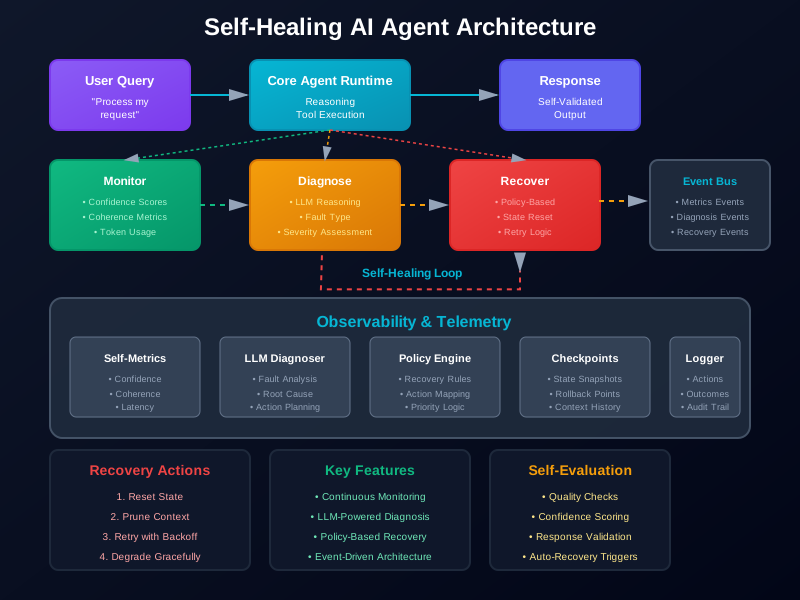
The self-healing loop has three phases: Monitor, Diagnose, and Recover. These phases work together continuously.
The 3-Phase Architecture
Monitor captures everything. It logs reasoning steps, tool calls, and responses. It measures performance metrics. It tracks state changes. The monitoring layer is always active, collecting data.
Diagnose analyzes the data. It looks for anomalies. It identifies patterns that indicate problems. It determines what went wrong and why. Diagnosis uses both rule-based logic and LLM reasoning.
Recover takes action. It applies fixes based on the diagnosis. It might retry operations, reset state, or degrade functionality gracefully. Recovery aims to restore normal operation.
These phases form a loop. Monitoring feeds diagnosis. Diagnosis triggers recovery. Recovery changes behavior, which monitoring observes. The loop continues, adapting as conditions change.
Implementing Agent Self-Metrics
Self-metrics are measurements the agent takes about its own behavior. They include:
Confidence scores: How certain is the agent about its response? High confidence suggests the agent is working well. Low confidence might indicate uncertainty or confusion.
Coherence scores: Do consecutive reasoning steps make sense together? Low coherence suggests the agent’s train of thought has broken.
Execution latency: How long do operations take? Spikes in latency might indicate problems. But latency needs context. Some operations are naturally slow.
Token usage: How many tokens does the agent use? Sudden increases might indicate inefficiency or context bloat.
Tool success rate: What percentage of tool calls succeed? Low success rates indicate problems with external dependencies.
Similarity scores: How similar are current responses to historical ones? Large deviations might indicate drift.
These metrics need baselines. You can’t tell if a metric is abnormal without knowing what’s normal. Baselines come from historical data. You track metrics over time and establish normal ranges.
Here’s how to implement basic self-metrics:
from datetime import datetime
from typing import List, Dict, Optional
import numpy as np
from collections import deque

class AgentSelfMetrics:
    """Collects and analyzes self-metrics for an AI agent."""

    def __init__(self, window_size: int = 100):
        self.window_size = window_size

        # Metric history (rolling windows)
        self.confidence_scores = deque(maxlen=window_size)
        self.coherence_scores = deque(maxlen=window_size)
        self.latency_measurements = deque(maxlen=window_size)
        self.token_counts = deque(maxlen=window_size)
        self.tool_success_rates = deque(maxlen=window_size)

        # Baselines (calculated from history)
        self.baselines = {
            'confidence': 0.7,
            'coherence': 0.6,
            'latency_p95': 2.0,  # seconds
            'tokens_per_query': 1000,
            'tool_success_rate': 0.95
        }

    def record_confidence(self, score: float):
        """Record confidence score for a response."""
        self.confidence_scores.append(score)
        self._update_baseline('confidence', score)

    def record_coherence(self, score: float):
        """Record coherence score between reasoning steps."""
        self.coherence_scores.append(score)
        self._update_baseline('coherence', score)

    def record_latency(self, operation: str, duration: float):
        """Record latency for an operation."""
        self.latency_measurements.append({
            'operation': operation,
            'duration': duration,
            'timestamp': datetime.now()
        })
        self._update_latency_baseline()

    def record_token_usage(self, stage: str, tokens: int):
        """Record token usage for a stage."""
        self.token_counts.append({
            'stage': stage,
            'tokens': tokens,
            'timestamp': datetime.now()
        })
        self._update_token_baseline()

    def record_tool_call(self, tool_name: str, success: bool):
        """Record tool call result."""
        # Calculate success rate over window
        # Simplified: just track recent success
        if success:
            self.tool_success_rates.append(1.0)
        else:
            self.tool_success_rates.append(0.0)

        self._update_tool_baseline()

    def check_anomalies(self) -> Dict[str, bool]:
        """Check if any metrics indicate anomalies."""
        anomalies = {}

        # Check confidence
        if len(self.confidence_scores) > 10:
            recent_avg = np.mean(list(self.confidence_scores)[-10:])
            if recent_avg < self.baselines['confidence'] * 0.8:
                anomalies['low_confidence'] = True

        # Check coherence
        if len(self.coherence_scores) > 10:
            recent_avg = np.mean(list(self.coherence_scores)[-10:])
            if recent_avg < self.baselines['coherence'] * 0.7:
                anomalies['low_coherence'] = True

        # Check latency
        if len(self.latency_measurements) > 10:
            recent_latencies = [m['duration'] for m in list(self.latency_measurements)[-10:]]
            p95 = np.percentile(recent_latencies, 95)
            if p95 > self.baselines['latency_p95'] * 1.5:
                anomalies['high_latency'] = True

        # Check token usage
        if len(self.token_counts) > 10:
            recent_tokens = [t['tokens'] for t in list(self.token_counts)[-10:]]
            avg_tokens = np.mean(recent_tokens)
            if avg_tokens > self.baselines['tokens_per_query'] * 1.3:
                anomalies['high_token_usage'] = True

        # Check tool success rate
        if len(self.tool_success_rates) > 10:
            recent_rate = np.mean(list(self.tool_success_rates)[-10:])
            if recent_rate < self.baselines['tool_success_rate'] * 0.9:
                anomalies['low_tool_success'] = True

        return anomalies

    def _update_baseline(self, metric: str, value: float):
        """Update baseline for a metric (exponential moving average)."""
        alpha = 0.1  # Smoothing factor
        self.baselines[metric] = alpha * value + (1 - alpha) * self.baselines[metric]

    def _update_latency_baseline(self):
        """Update latency baseline (P95)."""
        if len(self.latency_measurements) >= 20:
            latencies = [m['duration'] for m in self.latency_measurements]
            p95 = np.percentile(latencies, 95)
            self.baselines['latency_p95'] = 0.9 * self.baselines['latency_p95'] + 0.1 * p95

    def _update_token_baseline(self):
        """Update token usage baseline."""
        if len(self.token_counts) >= 20:
            tokens = [t['tokens'] for t in self.token_counts]
            avg = np.mean(tokens)
            self.baselines['tokens_per_query'] = 0.9 * self.baselines['tokens_per_query'] + 0.1 * avg

    def _update_tool_baseline(self):
        """Update tool success rate baseline."""
        if len(self.tool_success_rates) >= 20:
            rate = np.mean(self.tool_success_rates)
            self.baselines['tool_success_rate'] = 0.9 * self.baselines['tool_success_rate'] + 0.1 * rate
Integrating LLM Reasoning for Fault Interpretation
LLMs are good at understanding context and reasoning about problems. You can use them to interpret faults. Instead of just matching error patterns, you ask the LLM to analyze what went wrong.
This works because LLMs can understand nuanced failures. They can connect multiple symptoms. They can reason about cause and effect. They can suggest appropriate fixes.
Here’s how to integrate LLM reasoning into diagnosis:
import openai
from typing import Dict, List, Optional
import json

class LLMFaultDiagnoser:
    """Uses LLM reasoning to diagnose agent faults."""

    def __init__(self, client: openai.AsyncOpenAI):
        self.client = client

    async def diagnose(self, symptoms: Dict, context: Dict) -> Dict:
        """Diagnose faults using LLM reasoning.

        Args:
            symptoms: Observed anomalies (from metrics)
            context: Additional context (recent logs, state, etc.)

        Returns:
            Diagnosis with fault type, severity, and recommended action
        """

        diagnosis_prompt = f"""You are diagnosing issues with an AI agent. Analyze these symptoms and determine what's wrong.

Symptoms:
{json.dumps(symptoms, indent=2)}

Context:
- Recent confidence scores: {context.get('confidence_history', [])}
- Recent tool calls: {context.get('tool_calls', [])}
- Error messages: {context.get('errors', [])}
- State information: {context.get('state', {})}

Analyze the symptoms and provide:
1. Fault type (state_drift, tool_failure, quality_degradation, etc.)
2. Severity (low, medium, high, critical)
3. Root cause (what likely caused this)
4. Recommended recovery action (retry, reset_state, degrade_gracefully, etc.)
5. Confidence in diagnosis (0-1)

Return as JSON."""

        try:
            response = await self.client.chat.completions.create(
                model="gpt-4",
                messages=[
                    {"role": "system", "content": "You are an expert at diagnosing AI agent failures. Be precise and actionable."},
                    {"role": "user", "content": diagnosis_prompt}
                ],
                response_format={"type": "json_object"},
                temperature=0.3  # Lower temperature for more consistent diagnoses
            )

            diagnosis = json.loads(response.choices[0].message.content)
            return diagnosis

        except Exception as e:
            # Fallback to rule-based diagnosis if LLM fails
            return self._fallback_diagnosis(symptoms)

    def _fallback_diagnosis(self, symptoms: Dict) -> Dict:
        """Fallback rule-based diagnosis if LLM fails."""
        if 'low_confidence' in symptoms and symptoms['low_confidence']:
            return {
                "fault_type": "quality_degradation",
                "severity": "medium",
                "root_cause": "Agent uncertainty increasing",
                "recommended_action": "reset_state",
                "confidence": 0.6
            }

        if 'low_tool_success' in symptoms and symptoms['low_tool_success']:
            return {
                "fault_type": "tool_failure",
                "severity": "high",
                "root_cause": "External tool failures",
                "recommended_action": "retry_with_backoff",
                "confidence": 0.7
            }

        return {
            "fault_type": "unknown",
            "severity": "low",
            "root_cause": "Unknown",
            "recommended_action": "monitor",
            "confidence": 0.3
        }
The LLM can see patterns that rule-based systems miss. It can connect low confidence with recent tool failures. It can understand that state corruption might cause coherence issues. It reasons about the system holistically.
But LLM reasoning has costs. Each diagnosis uses tokens and takes time. For critical paths, you might want rule-based diagnosis first, then LLM for complex cases. Or you might cache common diagnoses to avoid repeated LLM calls.
Architecture Blueprint
The architecture needs to support continuous monitoring, intelligent diagnosis, and flexible recovery. Let’s look at the key components.
Event-Driven Recovery Workflows
Event-driven architecture works well for self-healing. Each component emits events. Other components subscribe and react. This makes the system flexible. You can add new recovery strategies without changing core logic.
Events flow like this:
- Agent executes operation
- Monitoring layer emits metric events
- Anomaly detector subscribes to metrics
- When anomaly detected, emits diagnosis event
- Recovery planner subscribes to diagnosis events
- Recovery planner emits recovery action events
- Recovery executors subscribe and apply fixes
This decouples components. The monitoring layer doesn’t need to know about recovery strategies. The recovery planner doesn’t need to know about specific metrics. Changes in one area don’t break others.
Here’s an event-driven implementation:
from typing import Callable, Dict, List
from enum import Enum
from dataclasses import dataclass
from datetime import datetime
import asyncio

class EventType(Enum):
    METRIC_RECORDED = "metric_recorded"
    ANOMALY_DETECTED = "anomaly_detected"
    DIAGNOSIS_COMPLETE = "diagnosis_complete"
    RECOVERY_ACTION = "recovery_action"
    RECOVERY_COMPLETE = "recovery_complete"

@dataclass
class Event:
    event_type: EventType
    timestamp: datetime
    data: Dict
    source: str

class EventBus:
    """Simple event bus for agent events."""

    def __init__(self):
        self.subscribers: Dict[EventType, List[Callable]] = {}

    def subscribe(self, event_type: EventType, handler: Callable):
        """Subscribe to an event type."""
        if event_type not in self.subscribers:
            self.subscribers[event_type] = []
        self.subscribers[event_type].append(handler)

    async def publish(self, event: Event):
        """Publish an event to all subscribers."""
        handlers = self.subscribers.get(event.event_type, [])
        await asyncio.gather(*[handler(event) for handler in handlers])

class EventDrivenAgent:
    """Agent with event-driven self-healing."""

    def __init__(self, event_bus: EventBus):
        self.event_bus = event_bus
        self.metrics = AgentSelfMetrics()
        self.diagnoser = None  # Will be set
        self.recovery_planner = RecoveryPlanner()

        # Subscribe to events
        self.event_bus.subscribe(EventType.METRIC_RECORDED, self._handle_metric)
        self.event_bus.subscribe(EventType.ANOMALY_DETECTED, self._handle_anomaly)
        self.event_bus.subscribe(EventType.DIAGNOSIS_COMPLETE, self._handle_diagnosis)

    async def _handle_metric(self, event: Event):
        """Handle metric events - check for anomalies."""
        metric_data = event.data

        # Update metrics
        if metric_data.get('type') == 'confidence':
            self.metrics.record_confidence(metric_data['value'])
        elif metric_data.get('type') == 'coherence':
            self.metrics.record_coherence(metric_data['value'])

        # Check for anomalies
        anomalies = self.metrics.check_anomalies()
        if anomalies:
            await self.event_bus.publish(Event(
                event_type=EventType.ANOMALY_DETECTED,
                timestamp=datetime.now(),
                data={'anomalies': anomalies, 'metrics': metric_data},
                source='anomaly_detector'
            ))

    async def _handle_anomaly(self, event: Event):
        """Handle anomaly events - trigger diagnosis."""
        if not self.diagnoser:
            return

        anomalies = event.data['anomalies']
        context = event.data.get('context', {})

        # Diagnose using LLM
        diagnosis = await self.diagnoser.diagnose(anomalies, context)

        await self.event_bus.publish(Event(
            event_type=EventType.DIAGNOSIS_COMPLETE,
            timestamp=datetime.now(),
            data=diagnosis,
            source='diagnoser'
        ))

    async def _handle_diagnosis(self, event: Event):
        """Handle diagnosis events - plan recovery."""
        diagnosis = event.data

        # Plan recovery action
        recovery_action = self.recovery_planner.plan_recovery(
            diagnosis['fault_type'],
            diagnosis
        )

        await self.event_bus.publish(Event(
            event_type=EventType.RECOVERY_ACTION,
            timestamp=datetime.now(),
            data=recovery_action,
            source='recovery_planner'
        ))
Policy-Based Recovery Strategies
Recovery strategies should be configurable. Different situations need different approaches. A policy engine lets you define rules for when to use which strategy.
Policies map conditions to actions. For example:
- If confidence drops below 0.5 AND it’s recoverable → reset state
- If tool failures exceed 50% AND it’s temporary → retry with backoff
- If latency exceeds baseline AND resources available → scale up
- If quality degradation AND severity high → degrade gracefully
Here’s a policy-based recovery system:
from typing import Dict, List, Optional
from dataclasses import dataclass
from enum import Enum

class RecoveryAction(Enum):
    RETRY = "retry"
    RETRY_WITH_BACKOFF = "retry_with_backoff"
    RESET_STATE = "reset_state"
    PRUNE_CONTEXT = "prune_context"
    DEGRADE_GRACEFULLY = "degrade_gracefully"
    CIRCUIT_BREAKER = "circuit_breaker"
    NOTIFY_HUMAN = "notify_human"

@dataclass
class RecoveryPolicy:
    """Policy for recovery actions."""
    name: str
    conditions: Dict  # Conditions that must be met
    action: RecoveryAction
    parameters: Dict  # Action-specific parameters
    priority: int  # Higher priority policies checked first

class RecoveryPlanner:
    """Plans recovery actions based on policies."""

    def __init__(self):
        self.policies = self._load_default_policies()

    def _load_default_policies(self) -> List[RecoveryPolicy]:
        """Load default recovery policies."""
        return [
            RecoveryPolicy(
                name="high_confidence_drop",
                conditions={
                    "fault_type": "quality_degradation",
                    "severity": ["high", "critical"],
                    "confidence_drop": ">0.3"
                },
                action=RecoveryAction.RESET_STATE,
                parameters={"checkpoint": "last_known_good"},
                priority=10
            ),
            RecoveryPolicy(
                name="temporary_tool_failure",
                conditions={
                    "fault_type": "tool_failure",
                    "severity": ["low", "medium"],
                    "recoverable": True
                },
                action=RecoveryAction.RETRY_WITH_BACKOFF,
                parameters={
                    "max_retries": 3,
                    "initial_delay": 5,
                    "backoff_multiplier": 2
                },
                priority=8
            ),
            RecoveryPolicy(
                name="context_overflow",
                conditions={
                    "fault_type": "state_drift",
                    "symptom": "high_token_usage",
                    "context_size": ">threshold"
                },
                action=RecoveryAction.PRUNE_CONTEXT,
                parameters={"keep_last_n": 10},
                priority=7
            ),
            RecoveryPolicy(
                name="severe_degradation",
                conditions={
                    "fault_type": "quality_degradation",
                    "severity": "critical",
                    "recoverable": False
                },
                action=RecoveryAction.DEGRADE_GRACEFULLY,
                parameters={
                    "fallback_mode": "simple_responses",
                    "disable_tools": True
                },
                priority=9
            ),
            RecoveryPolicy(
                name="cascading_failures",
                conditions={
                    "consecutive_failures": ">3",
                    "fault_type": "tool_failure"
                },
                action=RecoveryAction.CIRCUIT_BREAKER,
                parameters={
                    "duration": 300,  # 5 minutes
                    "half_open_after": 60
                },
                priority=10
            ),
        ]

    def plan_recovery(self, fault_type: str, diagnosis: Dict) -> Dict:
        """Plan recovery action based on policies and diagnosis."""

        # Sort policies by priority (highest first)
        sorted_policies = sorted(self.policies, key=lambda p: p.priority, reverse=True)

        # Check each policy
        for policy in sorted_policies:
            if self._check_conditions(policy.conditions, diagnosis):
                return {
                    "action": policy.action.value,
                    "parameters": policy.parameters,
                    "policy": policy.name,
                    "confidence": diagnosis.get("confidence", 0.5)
                }

        # Default: notify human if no policy matches
        return {
            "action": RecoveryAction.NOTIFY_HUMAN.value,
            "parameters": {"reason": "No matching policy"},
            "policy": "default",
            "confidence": 0.3
        }

    def _check_conditions(self, conditions: Dict, diagnosis: Dict) -> bool:
        """Check if conditions match diagnosis."""
        for key, value in conditions.items():
            diagnosis_value = diagnosis.get(key)

            if isinstance(value, list):
                # Check if diagnosis value is in list
                if diagnosis_value not in value:
                    return False
            elif isinstance(value, str) and value.startswith(">"):
                # Numeric comparison
                threshold = float(value[1:])
                if not isinstance(diagnosis_value, (int, float)) or diagnosis_value <= threshold:
                    return False
            else:
                # Exact match
                if diagnosis_value != value:
                    return False

        return True
Policies give you flexibility. You can adjust recovery behavior without changing code. Add new policies for new failure modes. Tune existing policies based on what works.
Logging, Observability, and Telemetry
Self-healing systems need extensive logging. You need to understand why recovery triggered, what it did, and whether it worked.
Logging should capture:
- Metric values when anomalies detected
- Diagnosis reasoning and confidence
- Recovery actions taken and parameters
- Recovery outcomes (success/failure)
- State before and after recovery
This creates an audit trail. When something goes wrong, you can trace what happened. You can see what the agent observed, what it decided, and what it did.
Here’s how to instrument recovery with observability:
import logging
from typing import Dict, Optional
from datetime import datetime
import json

class RecoveryLogger:
    """Logs recovery actions for observability."""

    def __init__(self):
        self.logger = logging.getLogger("agent.recovery")
        self.recovery_history: List[Dict] = []

    def log_anomaly_detected(self, anomalies: Dict, metrics: Dict):
        """Log when anomalies are detected."""
        self.logger.info(
            "Anomaly detected",
            extra={
                "event": "anomaly_detected",
                "anomalies": anomalies,
                "metrics": metrics,
                "timestamp": datetime.now().isoformat()
            }
        )

    def log_diagnosis(self, diagnosis: Dict, symptoms: Dict):
        """Log diagnosis results."""
        self.logger.info(
            "Diagnosis complete",
            extra={
                "event": "diagnosis",
                "fault_type": diagnosis.get("fault_type"),
                "severity": diagnosis.get("severity"),
                "root_cause": diagnosis.get("root_cause"),
                "recommended_action": diagnosis.get("recommended_action"),
                "confidence": diagnosis.get("confidence"),
                "symptoms": symptoms,
                "timestamp": datetime.now().isoformat()
            }
        )

    def log_recovery_action(self, action: Dict, diagnosis: Dict):
        """Log recovery action taken."""
        recovery_record = {
            "event": "recovery_action",
            "action": action.get("action"),
            "parameters": action.get("parameters"),
            "policy": action.get("policy"),
            "fault_type": diagnosis.get("fault_type"),
            "severity": diagnosis.get("severity"),
            "timestamp": datetime.now().isoformat(),
            "state_before": self._capture_state()
        }

        self.recovery_history.append(recovery_record)
        self.logger.info(
            "Recovery action taken",
            extra=recovery_record
        )

    def log_recovery_outcome(self, action: Dict, success: bool, metrics_after: Dict):
        """Log recovery outcome."""
        outcome_record = {
            "event": "recovery_outcome",
            "action": action.get("action"),
            "success": success,
            "metrics_after": metrics_after,
            "timestamp": datetime.now().isoformat(),
            "state_after": self._capture_state()
        }

        # Update last recovery record
        if self.recovery_history:
            self.recovery_history[-1].update(outcome_record)

        self.logger.info(
            f"Recovery {'succeeded' if success else 'failed'}",
            extra=outcome_record
        )

    def _capture_state(self) -> Dict:
        """Capture current agent state (simplified)."""
        return {
            "timestamp": datetime.now().isoformat(),
            # Add actual state capture here
        }

    def get_recovery_history(self, limit: int = 100) -> List[Dict]:
        """Get recent recovery history."""
        return self.recovery_history[-limit:]
Telemetry should also expose metrics to monitoring systems like Prometheus. This lets operations teams set up alerts and dashboards.
from prometheus_client import Counter, Histogram, Gauge

# Metrics
anomalies_detected = Counter(
    'agent_anomalies_detected_total',
    'Total anomalies detected',
    ['anomaly_type']
)

diagnoses_completed = Counter(
    'agent_diagnoses_completed_total',
    'Total diagnoses completed',
    ['fault_type', 'severity']
)

recovery_actions = Counter(
    'agent_recovery_actions_total',
    'Total recovery actions taken',
    ['action_type', 'policy']
)

recovery_duration = Histogram(
    'agent_recovery_duration_seconds',
    'Time taken for recovery actions',
    ['action_type']
)

recovery_success_rate = Gauge(
    'agent_recovery_success_rate',
    'Success rate of recovery actions',
    ['action_type']
)

# Use in recovery code
with recovery_duration.labels(action_type=action).time():
    result = execute_recovery(action)
    recovery_actions.labels(action_type=action, policy=policy).inc()
    if result['success']:
        # Update success rate
        pass
Code Sample: Minimal Self-Healing Agent
Here’s a complete example that ties everything together:
import openai
import asyncio
from typing import Dict, List, Optional
from datetime import datetime
import numpy as np
from sklearn.metrics.pairwise import cosine_similarity
import logging

logging.basicConfig(level=logging.INFO)
logger = logging.getLogger(__name__)

class SelfHealingAgent:
    """Minimal self-healing AI agent implementation."""

    def __init__(self, api_key: str):
        self.client = openai.AsyncOpenAI(api_key=api_key)
        self.metrics = AgentSelfMetrics()
        self.diagnoser = LLMFaultDiagnoser(self.client)
        self.recovery_planner = RecoveryPlanner()
        self.recovery_logger = RecoveryLogger()

        # Agent state
        self.conversation_history: List[Dict] = []
        self.state_checkpoints: List[Dict] = []
        self.tools_enabled = True
        self.degraded_mode = False

    async def process_query(self, user_query: str) -> str:
        """Process a user query with self-healing capabilities."""
        try:
            # Create checkpoint before processing
            checkpoint = self._create_checkpoint()

            # Health check before processing
            health_status = await self._health_check()
            if not health_status['healthy']:
                logger.warning(f"Health check failed: {health_status['issues']}")
                recovery_action = await self._attempt_recovery(health_status)
                if not recovery_action['success']:
                    return await self._degraded_response(user_query)

            # Process query
            response = await self._generate_response(user_query)

            # Evaluate response quality
            evaluation = await self._evaluate_response(user_query, response)
            self.metrics.record_confidence(evaluation['confidence'])

            # Check if quality is acceptable
            if evaluation['confidence'] < 0.5:
                logger.warning(f"Low confidence response: {evaluation['confidence']}")
                # Trigger recovery
                await self._handle_low_confidence(evaluation, user_query)
                # Retry with recovered state
                response = await self._generate_response(user_query)

            return response

        except Exception as e:
            logger.error(f"Error processing query: {e}")
            # Attempt recovery on error
            recovery = await self._attempt_recovery({
                'healthy': False,
                'issues': [str(e)],
                'fault_type': 'error'
            })

            if recovery['success']:
                # Retry once after recovery
                try:
                    return await self._generate_response(user_query)
                except:
                    return await self._degraded_response(user_query)
            else:
                return await self._degraded_response(user_query)

    async def _generate_response(self, query: str) -> str:
        """Generate response using LLM."""
        start_time = datetime.now()

        # Build messages
        messages = [
            {"role": "system", "content": self._get_system_prompt()},
            *self.conversation_history[-5:],  # Last 5 messages for context
            {"role": "user", "content": query}
        ]

        # Call LLM
        response = await self.client.chat.completions.create(
            model="gpt-4",
            messages=messages,
            max_tokens=500
        )

        # Record metrics
        latency = (datetime.now() - start_time).total_seconds()
        self.metrics.record_latency("generation", latency)

        tokens_used = response.usage.total_tokens
        self.metrics.record_token_usage("generation", tokens_used)

        content = response.choices[0].message.content

        # Add to conversation history
        self.conversation_history.append({"role": "user", "content": query})
        self.conversation_history.append({"role": "assistant", "content": content})

        return content

    async def _evaluate_response(self, query: str, response: str) -> Dict:
        """Self-evaluate response quality."""
        eval_prompt = f"""Evaluate this response to the query: "{query}"

Response: {response}

Rate on a scale of 0-1:
1. Relevance: Does it answer the query?
2. Accuracy: Is it factually correct?
3. Completeness: Is it complete?
4. Clarity: Is it clear?

Return JSON with scores and overall confidence."""

        try:
            eval_response = await self.client.chat.completions.create(
                model="gpt-4",
                messages=[{"role": "user", "content": eval_prompt}],
                response_format={"type": "json_object"},
                max_tokens=200
            )

            import json
            scores = json.loads(eval_response.choices[0].message.content)
            confidence = np.mean([
                scores.get('relevance', 0),
                scores.get('accuracy', 0),
                scores.get('completeness', 0),
                scores.get('clarity', 0)
            ])

            return {
                'confidence': confidence,
                'scores': scores
            }
        except:
            # Fallback if evaluation fails
            return {'confidence': 0.5, 'scores': {}}

    async def _health_check(self) -> Dict:
        """Perform health check on agent."""
        issues = []

        # Check metrics for anomalies
        anomalies = self.metrics.check_anomalies()
        if anomalies:
            issues.extend(anomalies.keys())

        # Check conversation history size
        if len(self.conversation_history) > 20:
            issues.append("context_overflow")

        return {
            'healthy': len(issues) == 0,
            'issues': issues,
            'anomalies': anomalies
        }

    async def _attempt_recovery(self, health_status: Dict) -> Dict:
        """Attempt to recover from health issues."""
        # Diagnose the issue
        symptoms = health_status.get('anomalies', {})
        context = {
            'conversation_length': len(self.conversation_history),
            'state': 'degraded' if self.degraded_mode else 'normal'
        }

        diagnosis = await self.diagnoser.diagnose(symptoms, context)
        self.recovery_logger.log_diagnosis(diagnosis, symptoms)

        # Plan recovery
        recovery_action = self.recovery_planner.plan_recovery(
            diagnosis.get('fault_type', 'unknown'),
            diagnosis
        )
        self.recovery_logger.log_recovery_action(recovery_action, diagnosis)

        # Execute recovery
        success = await self._execute_recovery(recovery_action)

        # Log outcome
        metrics_after = {
            'confidence': self.metrics.baselines['confidence'],
            'coherence': self.metrics.baselines['coherence']
        }
        self.recovery_logger.log_recovery_outcome(recovery_action, success, metrics_after)

        return {
            'success': success,
            'action': recovery_action,
            'diagnosis': diagnosis
        }

    async def _execute_recovery(self, action: Dict) -> bool:
        """Execute a recovery action."""
        action_type = action.get('action')
        params = action.get('parameters', {})

        try:
            if action_type == 'reset_state':
                # Reset to last checkpoint
                if self.state_checkpoints:
                    checkpoint = self.state_checkpoints[-1]
                    self.conversation_history = checkpoint.get('conversation_history', [])
                    self.degraded_mode = False
                    return True

            elif action_type == 'prune_context':
                # Keep only last N messages
                keep_n = params.get('keep_last_n', 5)
                self.conversation_history = self.conversation_history[-keep_n:]
                return True

            elif action_type == 'retry_with_backoff':
                # This would be handled at a higher level
                return True

            elif action_type == 'degrade_gracefully':
                # Enable degraded mode
                self.degraded_mode = True
                self.tools_enabled = False
                return True

            return False
        except Exception as e:
            logger.error(f"Recovery execution failed: {e}")
            return False

    async def _handle_low_confidence(self, evaluation: Dict, query: str):
        """Handle low confidence response."""
        # Reset state and retry
        recovery_action = {
            'action': 'reset_state',
            'parameters': {},
            'policy': 'low_confidence'
        }
        await self._execute_recovery(recovery_action)

    async def _degraded_response(self, query: str) -> str:
        """Generate response in degraded mode."""
        # Simple fallback response
        return f"I'm experiencing technical difficulties. I received your query: '{query}'. Please try again in a moment, or contact support if the issue persists."

    def _get_system_prompt(self) -> str:
        """Get system prompt (may vary in degraded mode)."""
        if self.degraded_mode:
            return "You are a helpful assistant operating in degraded mode. Provide simple, direct responses."
        return "You are a helpful assistant."

    def _create_checkpoint(self) -> Dict:
        """Create a state checkpoint."""
        checkpoint = {
            'timestamp': datetime.now(),
            'conversation_history': self.conversation_history.copy(),
            'state': 'normal'
        }
        self.state_checkpoints.append(checkpoint)
        # Keep only last 3 checkpoints
        if len(self.state_checkpoints) > 3:
            self.state_checkpoints.pop(0)
        return checkpoint

# Example usage with error injection
async def main():
    agent = SelfHealingAgent(api_key="your-api-key")

    # Normal operation
    response = await agent.process_query("What is the weather today?")
    print(f"Response: {response}")

    # Simulate error by corrupting state
    agent.conversation_history = [{"role": "user", "content": "garbage"}] * 25

    # Agent should detect and recover
    response = await agent.process_query("What is the weather today?")
    print(f"Response after recovery: {response}")

if __name__ == "__main__":
    asyncio.run(main())
This implementation includes:
- Health checks before processing
- Self-evaluation of responses
- Automatic diagnosis using LLM reasoning
- Policy-based recovery planning
- State checkpoints for rollback
- Degraded mode fallback
- Comprehensive logging
Case Study: Customer Support AI Agent
A customer support team deployed an AI agent to handle common questions. The agent worked well initially. It answered questions accurately and resolved tickets quickly.
After a few weeks, problems started. The agent began escalating tickets incorrectly. It would tell customers their issues required “urgent escalation” when they were simple questions. The escalation rate jumped from 5% to 25%. Support managers noticed the spike.
The team investigated. They found that the agent’s confidence scores were dropping. Its responses were becoming less coherent. But the agent wasn’t crashing. It was still returning responses, just bad ones.
The team implemented self-healing. They added:
- Confidence monitoring after each response
- Self-evaluation using a secondary LLM call
- Automatic state reset when confidence dropped below 0.5
- Degraded mode that provided simple responses instead of escalating
The monitoring layer detected the confidence drops. The diagnosis engine identified that the agent’s internal state had become corrupted. It was maintaining escalation flags incorrectly. The recovery system reset the state to a known-good checkpoint.
After deployment, the system caught and fixed issues automatically. When confidence dropped, the agent reset its state and retried. If that didn’t work, it switched to degraded mode, providing simple responses instead of incorrect escalations.
Results:
- Escalation rate dropped back to 6%
- False escalation rate decreased from 20% to 2%
- Average response quality improved
- System automatically recovered from 15% of problematic queries
The key was catching the problem early. The agent detected low confidence before users complained. It fixed itself automatically, maintaining service quality without human intervention.
Best Practices & Anti-Patterns
Anti-Patterns to Avoid
Recovery loops that cascade: If recovery triggers another recovery, which triggers another, you get infinite loops. Always set limits. Track recovery attempts. Stop after a threshold.
Hidden auto-restarts without state clarity: If the agent restarts automatically, make sure the state is clear. Don’t restart with corrupted state. Either reset to a checkpoint or start fresh.
Masking real problems: If recovery always succeeds, you might never notice underlying issues. Some failures should surface to humans. Don’t auto-heal everything.
Over-aggressive recovery: Not every anomaly needs recovery. Low confidence might be acceptable for some queries. Set thresholds appropriately. Don’t trigger recovery for minor issues.
No feedback loop: If recovery doesn’t work, the system should learn. Track recovery success rates. Adjust strategies based on what works.
Best Practices
Start with simple rules: Begin with rule-based recovery. Add LLM reasoning later. Rules are easier to understand and debug.
Set confidence thresholds: Don’t act on low-confidence diagnoses. Require high confidence for critical actions. Err on the side of caution.
Maintain human oversight: Critical decisions should notify humans even when recovery succeeds. Use automation for routine issues, humans for edge cases.
Test recovery logic: Recovery is code. Test it like any other code. Use chaos engineering to verify it works under failure.
Monitor recovery effectiveness: Track how often recovery triggers and whether it succeeds. Use this data to improve logic.
Document recovery policies: When recovery triggers, log why. This helps debug issues and understand system behavior.
Gradual rollout: Don’t enable full automation immediately. Start with detection and recommendations. Move to automatic recovery for non-critical paths first.
Conclusion
Self-healing AI agents represent the next step in autonomous systems. They move from reactive to proactive, from manual debugging to automatic recovery.
The architecture is clear: Monitor continuously, diagnose intelligently, recover automatically. The three-phase loop adapts as conditions change. The agent gets smarter over time, learning which recovery strategies work.
The technology exists today. LLMs can reason about faults. Embedding models can detect drift. Policy engines can coordinate recovery. The patterns are established. The code samples above show how to implement them.
The question isn’t whether self-healing is possible. It’s when teams will start building it. Early adopters are already deploying self-healing agents. They’re seeing reduced incident rates and improved reliability.
The journey starts with detection. Add monitoring to your agents. Measure confidence, coherence, and performance. Then add diagnosis. Use LLM reasoning to understand failures. Finally, add recovery. Implement policy-based strategies that fix problems automatically.
Start simple. Add health checks first. Then add self-evaluation. Then add basic recovery like state resets. Build complexity gradually as you learn what works.
The future of AI agents is autonomous resilience. Agents that detect their own problems, diagnose the causes, and fix themselves automatically. The systems that succeed will be the ones that handle real-world failures gracefully, learning and adapting with each cycle.
Discussion
Loading comments...