Designing Multi-Region Consistency Layers: Beyond Active-Active Replication
Multi-region deployments aren’t optional anymore. Users expect fast responses. Services need to survive region failures. Compliance requires data in specific locations. But making it all consistent? That’s where things get messy.
Most teams start with active-active replication. They copy data everywhere and hope it works. Then they hit split-brain scenarios. Conflicting writes. Eventual consistency delays. Data loss during partitions. The simple approach breaks under real-world conditions.
This article covers how to build a consistency layer that handles these problems. We’ll look at patterns used by Netflix, Uber, and Stripe. We’ll cover the theory, but focus on practical implementation. How to make trade-offs. How to test it. How to evolve your system.
Why Global-Scale Systems Are Hard
Building systems that span multiple regions introduces problems that don’t exist in single-region setups.
Network latency varies. A request from New York to Tokyo takes 150ms. That’s unavoidable. Cross-region writes need to wait for confirmation, or accept inconsistency. Reads can hit stale data. Synchronous replication kills latency. Asynchronous replication risks data loss.
Failures happen independently. A region can go offline while others keep running. During that time, writes in the remaining regions need a policy. Do you accept them? Do you reject them? Both choices have consequences.
Consistency models get complicated. Strong consistency across regions means accepting high latency. Eventual consistency means accepting temporary inconsistency. Between those extremes, you need careful design.
Real examples show how teams handle this. Netflix uses a combination of regional replication and conflict resolution for their streaming metadata. They accept some inconsistency in exchange for availability. Uber uses version vectors and last-write-wins with timestamps for ride state. Stripe uses CRDTs for their payment orchestration to merge conflicting operations.
Each of these systems made different trade-offs based on their needs. The key is designing for conflict, not avoiding it.
Revisiting CAP and PACELC in 2025
CAP theorem says you can only guarantee two of three properties: Consistency, Availability, and Partition tolerance. The theorem itself hasn’t changed. But how we interpret it has evolved.
Modern infrastructure changes the equation. Edge computing brings compute closer to users. Global caches like Cloudflare and Fastly reduce latency. Databases like DynamoDB and CockroachDB offer built-in multi-region capabilities. These tools don’t eliminate the trade-offs. They change where you make them.
PACELC extends CAP. If there’s a Partition, choose between Availability and Consistency. Else, choose between Latency and Consistency. This captures the reality that even without partitions, you still have trade-offs.
In 2025, the focus shifted toward optimizing for common cases. Most of the time, there’s no partition. So optimize for low latency and eventual consistency. When a partition happens, degrade gracefully. Accept writes with conflict markers. Reconcile when the partition heals.
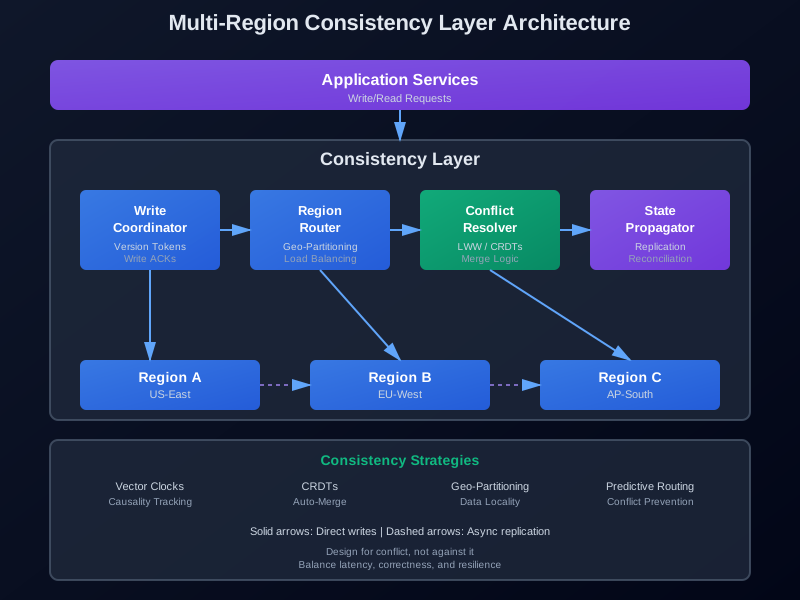
The consistency layer sits between your application and data stores. It abstracts away the complexity of multi-region coordination. Your services write to the layer. The layer handles routing, versioning, and conflict resolution.
Designing the Consistency Layer
A consistency layer is a logical abstraction that sits between application services and underlying data stores. It doesn’t store data itself. It coordinates how data moves and how conflicts get resolved.
Core Components
Write Coordinator
Handles all write requests. It assigns version tokens, routes writes to appropriate regions, and tracks write acknowledgments. The coordinator needs to be fast. It’s in the hot path.
Region Router
Decides which region handles a request. Routes can be based on user location, data ownership, or load. The router needs low latency. It might make routing decisions based on cached metadata.
Conflict Resolver
Detects and resolves conflicts when they occur. Different strategies for different data types. For some data, last-write-wins works. For others, you need semantic merging. The resolver needs to be deterministic. Same conflict should always resolve the same way.
State Propagator
Moves state between regions. Handles replication lag, retries on failures, and applies updates in order. The propagator needs to be reliable. It should survive transient failures and resume from checkpoints.
These components work together. A write comes in. The coordinator assigns a version. The router picks a region. The write goes to that region. The propagator replicates to other regions. If conflicts occur, the resolver handles them.
Architecture Pattern
┌─────────────────┐
│  Application    │
│    Services     │
└────────┬────────┘
         │
┌────────▼─────────────────────────┐
│      Consistency Layer           │
│  ┌──────────┐  ┌──────────────┐ │
│  │  Write   │  │    Region    │ │
│  │Coordinator│  │   Router    │ │
│  └────┬─────┘  └──────┬───────┘ │
│       │               │          │
│  ┌────▼───────────────▼───────┐ │
│  │   Conflict Resolver        │ │
│  └───────────┬───────────────┘ │
│              │                  │
│  ┌───────────▼───────────────┐ │
│  │   State Propagator        │ │
│  └───────────┬───────────────┘ │
└──────────────┼─────────────────┘
               │
    ┌──────────┼──────────┐
    │          │          │
┌───▼───┐ ┌───▼───┐ ┌───▼───┐
│Region │ │Region │ │Region │
│   A   │ │   B   │ │   C   │
└───────┘ └───────┘ └───────┘
The layer is stateless where possible. It can scale horizontally. Stateful components use consensus for coordination. Redis, etcd, or DynamoDB can store coordination metadata.
Techniques and Patterns
Vector Clocks
Vector clocks track causality. Each write gets a vector timestamp. The timestamp shows which regions have seen which versions. When conflicts occur, you can see if one write happened before another, or if they’re concurrent.
type VectorClock struct {
    RegionID string
    Timestamps map[string]int64 // region -> logical time
}

func (vc *VectorClock) Increment() {
    vc.Timestamps[vc.RegionID]++
}

func (vc *VectorClock) HappensBefore(other *VectorClock) bool {
    allBefore := true
    for region, time := range vc.Timestamps {
        if time > other.Timestamps[region] {
            return false
        }
        if time < other.Timestamps[region] {
            allBefore = false
        }
    }
    return !allBefore && !vc.Equals(other)
}

func (vc *VectorClock) Merge(other *VectorClock) {
    for region, time := range other.Timestamps {
        if time > vc.Timestamps[region] {
            vc.Timestamps[region] = time
        }
    }
}
Vector clocks help with conflict detection. If one clock happens before another, no conflict. If they’re concurrent, you have a conflict to resolve.
The downside is storage overhead. Each version needs a vector timestamp. For high-volume systems, this adds up. Also, vector clocks don’t automatically resolve conflicts. They just tell you conflicts exist.
CRDTs
Conflict-free Replicated Data Types merge concurrent updates automatically. They’re commutative and associative. Order doesn’t matter. You can apply updates in any order and get the same result.
CRDTs work well for certain data types:
- Counters: Use a separate counter per region, merge by summing
- Sets: Use add-wins or remove-wins semantics
- Maps: Merge nested CRDTs recursively
- Registers: Use last-write-wins with timestamps
type AddWinsSet struct {
    Adds  map[string]int64 // element -> timestamp
    Removes map[string]int64
}

func (s *AddWinsSet) Add(element string, timestamp int64) {
    if timestamp > s.Removes[element] {
        s.Adds[element] = timestamp
    }
}

func (s *AddWinsSet) Remove(element string, timestamp int64) {
    s.Removes[element] = timestamp
    delete(s.Adds, element)
}

func (s *AddWinsSet) Contains(element string) bool {
    return s.Adds[element] > s.Removes[element]
}

func (s *AddWinsSet) Merge(other *AddWinsSet) {
    for element, timestamp := range other.Adds {
        if timestamp > s.Removes[element] {
            s.Adds[element] = timestamp
        }
    }
    for element, timestamp := range other.Removes {
        if timestamp > s.Removes[element] {
            s.Removes[element] = timestamp
        }
    }
}
CRDTs are powerful, but they have limits. Not all data types have a good CRDT representation. Some operations require application-specific logic. And CRDTs can grow large if you keep all metadata.
Version Tokens
Version tokens are simpler than vector clocks. Each write gets a unique token. Tokens include region ID and a sequence number. When replicating, tokens help detect conflicts.
class VersionToken {
    constructor(regionId, sequence, timestamp) {
        this.regionId = regionId;
        this.sequence = sequence;
        this.timestamp = timestamp;
    }

    static generate(regionId) {
        return new VersionToken(
            regionId,
            Date.now(),
            process.hrtime.bigint()
        );
    }

    compare(other) {
        if (this.timestamp < other.timestamp) return -1;
        if (this.timestamp > other.timestamp) return 1;
        if (this.regionId < other.regionId) return -1;
        if (this.regionId > other.regionId) return 1;
        return 0;
    }
}
Version tokens are lightweight. They’re easy to implement. But they don’t capture causality like vector clocks. For many use cases, that’s fine. You trade precision for simplicity.
Geo-Partitioning
Geo-partitioning assigns data to regions based on location. User data goes to the region closest to the user. This reduces latency and keeps related data together.
Two main approaches:
User-Based Partitioning
Route users to their home region. All their data lives there. Reads are fast. Writes stay local. Replicate to other regions for disaster recovery.
func GetUserRegion(userID string) string {
    // Hash user ID to determine region
    hash := hashFunction(userID)
    regions := []string{"us-east", "eu-west", "ap-south"}
    return regions[hash % len(regions)]
}

func RouteRequest(userID string, operation string) string {
    homeRegion := GetUserRegion(userID)
    if operation == "read" {
        return homeRegion
    }
    // Writes might go to home region with async replication
    return homeRegion
}
Domain-Based Partitioning
Partition by data domain. Customer data in one region. Order data in another. This works when domains are independent. When they’re not, you pay cross-region costs.
Geo-partitioning works best when access patterns align with partitions. If users frequently access data from other partitions, you lose the benefits. Monitor cross-partition access and adjust.
Predictive Routing
Predictive routing avoids split-brain scenarios. Before accepting a write, check if other regions are reachable. If they’re not, enter degraded mode. Accept writes with conflict markers. Reconcile when connectivity returns.
class PredictiveRouter {
    constructor(regions, healthChecker) {
        this.regions = regions;
        this.healthChecker = healthChecker;
        this.quorumSize = Math.floor(regions.length / 2) + 1;
    }

    async shouldAcceptWrite(key, value) {
        const healthyRegions = await this.healthChecker.getHealthy();

        if (healthyRegions.length < this.quorumSize) {
            // Not enough healthy regions - accept write but mark for reconciliation
            return {
                accept: true,
                degraded: true,
                conflictMarker: true
            };
        }

        // Normal operation - route to primary region
        return {
            accept: true,
            degraded: false,
            primaryRegion: this.getPrimaryRegion(key)
        };
    }

    getPrimaryRegion(key) {
        const hash = this.hashKey(key);
        return this.regions[hash % this.regions.length];
    }
}
Predictive routing requires health checking. You need to know which regions are reachable. Network partitions are tricky. Sometimes a region appears healthy but can’t reach others. Use multiple signals: network probes, application health, and coordination service status.
Implementation Example
Let’s build a simple consistency layer using Go and Redis Enterprise (which supports multi-region replication). This example shows versioned writes and basic conflict resolution.
package consistency
import (
"context"
"fmt"
"time"
"github.com/redis/go-redis/v9"
)
type ConsistencyLayer struct {
client *redis.Client
regionID string
coordinator *WriteCoordinator
resolver *ConflictResolver
}
type VersionedValue struct {
Value string
Version int64
RegionID string
Timestamp time.Time
}
type WriteCoordinator struct {
client *redis.Client
regionID string
}
func NewWriteCoordinator(client *redis.Client, regionID string) *WriteCoordinator {
return &WriteCoordinator{
client: client,
regionID: regionID,
}
}
func (wc *WriteCoordinator) Write(ctx context.Context, key string, value string) (*VersionedValue, error) {
// Get current version
currentVersion, err := wc.getCurrentVersion(ctx, key)
if err != nil {
return nil, err
}
newVersion := currentVersion + 1
// Create versioned value
vv := &VersionedValue{
Value: value,
Version: newVersion,
RegionID: wc.regionID,
Timestamp: time.Now(),
}
// Write with version check (optimistic locking)
script := `
local current = redis.call('HGET', KEYS[1], 'version')
if current == false or tonumber(current) == tonumber(ARGV[1]) then
redis.call('HSET', KEYS[1], 'value', ARGV[2])
redis.call('HSET', KEYS[1], 'version', ARGV[3])
redis.call('HSET', KEYS[1], 'region', ARGV[4])
redis.call('HSET', KEYS[1], 'timestamp', ARGV[5])
return 'OK'
else
return 'CONFLICT'
end
`
result, err := wc.client.Eval(ctx, script, []string{key},
currentVersion, value, newVersion, wc.regionID, vv.Timestamp.Unix()).Result()
if err != nil {
return nil, err
}
if result == "CONFLICT" {
// Handle conflict
return nil, fmt.Errorf("write conflict detected for key %s", key)
}
return vv, nil
}
func (wc *WriteCoordinator) getCurrentVersion(ctx context.Context, key string) (int64, error) {
versionStr, err := wc.client.HGet(ctx, key, "version").Result()
if err == redis.Nil {
return 0, nil
}
if err != nil {
return 0, err
}
var version int64
fmt.Sscanf(versionStr, "%d", &version)
return version, nil
}
type ConflictResolver struct {
strategy string // "last-write-wins", "merge", "reject"
}
func NewConflictResolver(strategy string) *ConflictResolver {
return &ConflictResolver{strategy: strategy}
}
func (cr *ConflictResolver) Resolve(conflicts []*VersionedValue) *VersionedValue {
if len(conflicts) == 0 {
return nil
}
if len(conflicts) == 1 {
return conflicts[0]
}
switch cr.strategy {
case "last-write-wins":
return cr.lastWriteWins(conflicts)
case "merge":
return cr.merge(conflicts)
case "reject":
return nil
default:
return cr.lastWriteWins(conflicts)
}
}
func (cr *ConflictResolver) lastWriteWins(conflicts []*VersionedValue) *VersionedValue {
latest := conflicts[0]
for _, vv := range conflicts[1:] {
if vv.Timestamp.After(latest.Timestamp) {
latest = vv
}
}
return latest
}
func (cr *ConflictResolver) merge(conflicts []*VersionedValue) *VersionedValue {
// Simplified merge - in practice, this would be application-specific
// For example, if values are JSON, merge JSON objects
// For strings, might concatenate with delimiters
merged := conflicts[0].Value
for i := 1; i < len(conflicts); i++ {
merged += " | " + conflicts[i].Value
}
latest := cr.lastWriteWins(conflicts)
return &VersionedValue{
Value: merged,
Version: latest.Version,
RegionID: latest.RegionID,
Timestamp: latest.Timestamp,
}
}
func NewConsistencyLayer(client *redis.Client, regionID string) *ConsistencyLayer {
coordinator := NewWriteCoordinator(client, regionID)
resolver := NewConflictResolver("last-write-wins")
return &ConsistencyLayer{
client: client,
regionID: regionID,
coordinator: coordinator,
resolver: resolver,
}
}
func (cl *ConsistencyLayer) Write(ctx context.Context, key string, value string) error {
_, err := cl.coordinator.Write(ctx, key, value)
if err != nil {
// Check if it's a conflict
if err.Error() == fmt.Sprintf("write conflict detected for key %s", key) {
// Fetch conflicting versions
conflicts, fetchErr := cl.fetchConflicts(ctx, key)
if fetchErr != nil {
return fetchErr
}
// Resolve conflict
resolved := cl.resolver.Resolve(conflicts)
if resolved == nil {
return fmt.Errorf("conflict could not be resolved")
}
// Write resolved value
_, writeErr := cl.coordinator.Write(ctx, key, resolved.Value)
return writeErr
}
return err
}
return nil
}
func (cl *ConsistencyLayer) fetchConflicts(ctx context.Context, key string) ([]*VersionedValue, error) {
// In a real implementation, this would fetch from multiple regions
// For this example, we'll simulate by checking Redis
value, err := cl.client.HGetAll(ctx, key).Result()
if err != nil {
return nil, err
}
vv := &VersionedValue{
Value: value["value"],
RegionID: value["region"],
}
fmt.Sscanf(value["version"], "%d", &vv.Version)
timestampInt := int64(0)
fmt.Sscanf(value["timestamp"], "%d", ×tampInt)
vv.Timestamp = time.Unix(timestampInt, 0)
return []*VersionedValue{vv}, nil
}
func (cl *ConsistencyLayer) Read(ctx context.Context, key string) (string, error) {
value, err := cl.client.HGet(ctx, key, "value").Result()
if err == redis.Nil {
return "", fmt.Errorf("key not found")
}
if err != nil {
return "", err
}
return value, nil
}This implementation shows the basics:
- Versioned writes: Each write gets a version number. Optimistic locking prevents lost updates.
- Conflict detection: When a write conflicts, we detect it and fetch conflicting versions.
- Conflict resolution: The resolver picks a strategy. Last-write-wins is simple but not always correct.
- Region awareness: The layer knows which region it’s in. This helps with routing and reconciliation.
In production, you’d add:
- Replication to other regions
- Vector clocks or CRDTs for better conflict handling
- Health checking for predictive routing
- Monitoring and alerting
- More sophisticated merge strategies
Testing Consistency
Testing consistency is hard. You need to simulate failures, network partitions, and concurrent writes. Chaos engineering helps.
Simulating Region Failures
Use chaos tools to kill regions. Stop replication. Introduce network delays. Observe how your system behaves.
// Example using a chaos testing framework
const chaos = require('chaos-framework');

async function testRegionFailure() {
    // Start with all regions healthy
    await ensureAllRegionsHealthy();

    // Accept writes from multiple regions
    const writes = await performConcurrentWrites(['region-a', 'region-b']);

    // Kill one region
    await chaos.killRegion('region-a');

    // Continue writes to remaining regions
    await performWritesToRegion('region-b');

    // Restore region
    await chaos.restoreRegion('region-a');

    // Wait for reconciliation
    await waitForReconciliation();

    // Verify consistency
    const allRegionsConsistent = await verifyAllRegionsHaveSameData();
    assert(allRegionsConsistent, 'Regions should be consistent after reconciliation');
}
Measuring Convergence Latency
Convergence latency is how long it takes for all regions to agree after a partition heals. Measure this under different conditions.
func MeasureConvergenceLatency(regions []string, testDuration time.Duration) time.Duration {
    start := time.Now()

    // Create partition
    partition := createPartition(regions)

    // Perform writes during partition
    performWritesDuringPartition(partition)

    // Heal partition
    healPartition(partition)

    // Measure time until all regions converge
    converged := false
    for !converged && time.Since(start) < testDuration {
        converged = checkAllRegionsConverged(regions)
        time.Sleep(100 * time.Millisecond)
    }

    return time.Since(start)
}
Observing Reconciliation Behavior
Watch how conflicts resolve. Log conflict types. Track resolution strategies. Measure resolution latency.
type ConflictMetrics struct {
    TotalConflicts    int64
    ResolvedByLWW     int64
    ResolvedByMerge   int64
    ResolvedByReject  int64
    AverageLatency    time.Duration
}

func ObserveReconciliation(ctx context.Context, layer *ConsistencyLayer) *ConflictMetrics {
    metrics := &ConflictMetrics{}

    // Hook into conflict resolution
    originalResolve := layer.resolver.Resolve
    layer.resolver.Resolve = func(conflicts []*VersionedValue) *VersionedValue {
        start := time.Now()
        metrics.TotalConflicts++

        result := originalResolve(conflicts)

        latency := time.Since(start)
        metrics.AverageLatency = (metrics.AverageLatency + latency) / 2

        if result != nil {
            if layer.resolver.strategy == "last-write-wins" {
                metrics.ResolvedByLWW++
            } else if layer.resolver.strategy == "merge" {
                metrics.ResolvedByMerge++
            }
        } else {
            metrics.ResolvedByReject++
        }

        return result
    }

    return metrics
}
Testing reveals problems before production. Run chaos tests regularly. Monitor metrics. Adjust your design based on what you learn.
Best Practices and Takeaways
Design for Conflict
Don’t try to avoid conflicts entirely. They will happen. Design your system to handle them gracefully.
Accept that some inconsistency is okay. Define what “eventual” means for your use case. Is 10 seconds acceptable? One minute? One hour? The answer depends on your application.
Choose conflict resolution strategies that match your data semantics. Last-write-wins works for some data. Semantic merging works for others. Sometimes you need to reject conflicts and ask the user.
Start Simple, Evolve Gradually
Begin with basic patterns. Last-write-wins with timestamps. Simple version tokens. Async replication. These work for many use cases.
Add complexity when you need it. If you see conflicts frequently, add vector clocks. If you need automatic merging, add CRDTs. If you need stronger guarantees, add synchronous replication for critical paths.
Don’t over-engineer. Most systems don’t need the most sophisticated consistency mechanisms. Simple solutions are easier to understand, debug, and maintain.
Monitor Everything
You can’t fix what you don’t measure. Track:
- Cross-region latency
- Replication lag
- Conflict rates
- Resolution latency
- Convergence time after partitions
Set alerts on anomalies. If replication lag spikes, investigate. If conflict rates increase, understand why. If convergence takes too long, optimize.
Hybrid Models
Many systems use hybrid approaches. Critical data gets strong consistency. Less critical data gets eventual consistency. Hot paths use in-memory stores. Cold paths use persistent storage.
type HybridConsistencyLayer struct {
    criticalStore   *StrongConsistencyStore  // For user accounts, payments
    normalStore     *EventualConsistencyStore // For user preferences, analytics
    cacheStore      *InMemoryStore            // For hot data
}

func (h *HybridConsistencyLayer) Write(ctx context.Context, key string, value string, priority string) error {
    switch priority {
    case "critical":
        return h.criticalStore.Write(ctx, key, value)
    case "normal":
        return h.normalStore.Write(ctx, key, value)
    case "hot":
        return h.cacheStore.Write(ctx, key, value)
    default:
        return h.normalStore.Write(ctx, key, value)
    }
}
Hybrid models let you optimize for different use cases. Use the right consistency model for each data type.
Document Your Trade-offs
Document why you made each decision. What consistency model did you choose? Why? What conflicts can occur? How are they resolved? What happens during partitions?
This documentation helps future engineers understand the system. It helps when debugging issues. It helps when evolving the design.
Conclusion
Multi-region consistency layers are complex. There’s no one-size-fits-all solution. You need to understand your requirements, choose appropriate techniques, and test thoroughly.
The key is starting with simple patterns and evolving based on real needs. Don’t over-engineer. Measure everything. Design for conflict, not against it.
The examples in this article are starting points. Adapt them to your context. Your data semantics are unique. Your latency requirements are unique. Your consistency needs are unique.
Build the simplest system that meets your requirements. Then measure. Then improve. Repeat.
Discussion
Loading comments...