Adaptive Control Planes: Building Self-Regulating System Architectures
Your system was fine yesterday. Today it’s slow. Traffic patterns changed. A new service started hammering the database. The load balancer is sending requests to the wrong servers. You’re stuck manually adjusting weights and scaling pods.
This is what happens with static configurations. You set rules once. They don’t change. Your system can’t adapt to new conditions.
Adaptive control planes fix this. They watch what’s happening. They make decisions based on real conditions. They adjust routing, scale workloads, shift traffic. All automatically. No manual intervention.
This article explains how adaptive control planes work. We’ll cover the components, feedback loops, and patterns. We’ll build a simple adaptive router. We’ll look at what can go wrong and how to avoid it.
Introduction: From Static to Adaptive
Systems used to be static. You configured them once. They ran the same way until you changed the config. That worked when workloads were predictable. Traffic patterns were steady. Failures were rare.
That’s not the world we live in anymore. Traffic spikes happen randomly. Services fail unpredictably. Load patterns shift throughout the day. Static configurations can’t keep up.
The shift started with auto-scaling. Systems that could add or remove resources based on load. Then came auto-remediation. Systems that could restart failed services. Now we’re moving toward adaptive control planes. Systems that can reconfigure themselves based on feedback.
A control plane is the part of your system that makes decisions. It decides how traffic routes. It decides which services to scale. It decides what policies to enforce. In static systems, these decisions are baked into configuration files.
In adaptive systems, the control plane makes decisions dynamically. It watches metrics. It evaluates conditions. It takes actions. It measures results. Then it adjusts.
This is becoming the “brain” of distributed systems. It’s the layer that makes everything else work together. Without it, you’re stuck manually tuning everything. With it, your system can optimize itself.
The evolution is clear. First, we automated deployment. Then we automated scaling. Now we’re automating optimization. The next step is systems that adapt continuously.
Understanding Adaptive Control Planes
An adaptive control plane is a decision-making layer that changes system behavior based on feedback. It’s not just monitoring. It’s not just alerting. It’s actively adjusting the system.
The key difference from static configuration management is feedback. Static systems use manifests and config files. You update them manually. Changes are discrete. Adaptive systems use continuous feedback loops. They measure, decide, act, and validate.
Think about Kubernetes. Static configuration means writing YAML manifests. You define replica counts, resource limits, service selectors. You apply them. They stay that way until you change them.
Adaptive control planes add a layer on top. They watch metrics from your pods. They see latency increasing. They decide to scale up. They update the replica count. They verify the latency improved. If it didn’t, they try something else.
This requires three things: observability, decision-making, and actuation.
Observability and Telemetry
You can’t adapt to what you can’t see. Adaptive control planes need rich telemetry. Metrics, traces, logs. They need to understand current state and trends.
Latency metrics tell you if requests are slow. Error rates tell you if services are failing. Resource utilization tells you if you’re running out of capacity. Throughput tells you if you’re handling load.
The telemetry needs to be real-time. Historical data helps, but adaptation needs current conditions. You can’t wait for hourly reports. You need metrics updated every few seconds.
It also needs context. Not just “latency is high.” But “latency is high for this service, from this region, at this time of day.” That context helps make better decisions.
Policy-Based Reconfiguration
Adaptive systems don’t make random changes. They follow policies. Policies define goals and constraints.
A policy might say: “Keep latency under 200ms. If it exceeds that, scale up. But don’t exceed 100 replicas. And prefer scaling horizontally over vertically.”
Another policy: “Route traffic to the region with lowest latency. But if a region has more than 5% error rate, stop sending traffic there.”
Policies give the system boundaries. They prevent it from making bad decisions. They encode your business rules and operational constraints.
The control plane evaluates policies against current metrics. It decides what actions to take. It checks if actions are allowed. Then it executes.
Contrast with Static Configuration
Static configuration management tools like Ansible, Terraform, and Kubernetes controllers work differently. They apply desired state. They converge toward that state. But they don’t change the desired state based on feedback.
Adaptive control planes change the desired state. They continuously adjust what “desired” means based on conditions. They’re not just converging. They’re optimizing.
This is a fundamental shift. Instead of “here’s what I want,” it’s “here’s what I want, and here’s how to adjust it based on what’s happening.”
Core Components
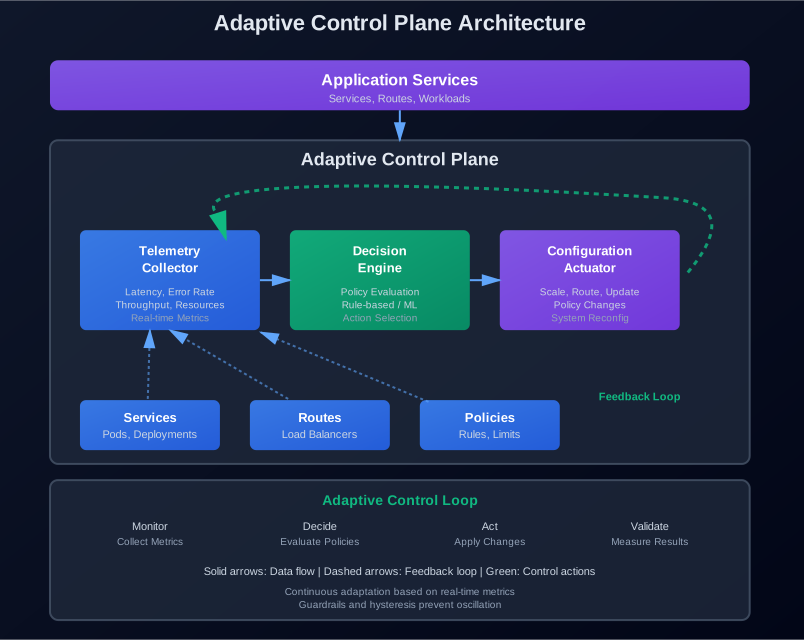
Adaptive control planes have three main components: telemetry collectors, decision engines, and configuration actuators. They work together in a feedback loop.
Telemetry Collector
The telemetry collector gathers metrics and events from your system. It pulls data from services, infrastructure, and networks. It normalizes formats. It aggregates over time windows.
Collectors might pull from Prometheus, scrape logs, listen to event streams, or query databases. They transform raw data into a format the decision engine can use.
type TelemetryCollector struct {
    metricsClient *prometheus.Client
    logClient     *log.Client
    eventStream   chan Event
}

type Metric struct {
    Name      string
    Value     float64
    Labels    map[string]string
    Timestamp time.Time
}

func (tc *TelemetryCollector) CollectMetrics(service string, duration time.Duration) ([]Metric, error) {
    ctx, cancel := context.WithTimeout(context.Background(), duration)
    defer cancel()

    query := fmt.Sprintf("rate(http_request_duration_seconds{service=\"%s\"}[%s])", service, duration)
    result, err := tc.metricsClient.Query(ctx, query)
    if err != nil {
        return nil, err
    }

    metrics := []Metric{}
    for _, sample := range result {
        metrics = append(metrics, Metric{
            Name:      "request_latency",
            Value:     sample.Value,
            Labels:    sample.Metric,
            Timestamp: time.Now(),
        })
    }

    return metrics, nil
}

func (tc *TelemetryCollector) CollectErrorRate(service string, window time.Duration) (float64, error) {
    ctx, cancel := context.WithTimeout(context.Background(), window)
    defer cancel()

    totalQuery := fmt.Sprintf("sum(rate(http_requests_total{service=\"%s\"}[%s]))", service, window)
    errorQuery := fmt.Sprintf("sum(rate(http_requests_total{service=\"%s\",status=~\"5..\"}[%s]))", service, window)

    total, err := tc.metricsClient.Query(ctx, totalQuery)
    if err != nil {
        return 0, err
    }

    errors, err := tc.metricsClient.Query(ctx, errorQuery)
    if err != nil {
        return 0, err
    }

    if len(total) == 0 || total[0].Value == 0 {
        return 0, nil
    }

    errorCount := 0.0
    if len(errors) > 0 {
        errorCount = errors[0].Value
    }

    return errorCount / total[0].Value, nil
}
Collectors need to be efficient. They run continuously. They shouldn’t add significant overhead to your system.
Decision Engine
The decision engine evaluates conditions and decides what actions to take. It uses rules, machine learning, or both.
Rule-based engines use if-then logic. “If latency > 200ms, then scale up.” They’re simple and predictable. Easy to debug. But they can’t handle complex patterns.
ML-based engines learn from historical data. They predict what actions will improve metrics. They can find patterns humans miss. But they’re harder to understand and debug.
Many systems use hybrid approaches. Rules for safety. ML for optimization.
class DecisionEngine:
    def __init__(self, policies):
        self.policies = policies
        self.history = []

    def evaluate(self, metrics):
        """Evaluate current metrics against policies and decide on actions"""
        actions = []

        for policy in self.policies:
            condition_met = self._check_condition(policy.condition, metrics)

            if condition_met:
                action = self._determine_action(policy, metrics)
                if action:
                    actions.append(action)

        return actions

    def _check_condition(self, condition, metrics):
        """Check if a condition is met based on metrics"""
        metric_value = metrics.get(condition.metric_name)

        if metric_value is None:
            return False

        if condition.operator == "gt":
            return metric_value > condition.threshold
        elif condition.operator == "lt":
            return metric_value < condition.threshold
        elif condition.operator == "eq":
            return abs(metric_value - condition.threshold) < 0.001
        else:
            return False

    def _determine_action(self, policy, metrics):
        """Determine what action to take based on policy"""
        action_type = policy.action_type

        if action_type == "scale_up":
            current_replicas = metrics.get("replicas", 1)
            new_replicas = min(current_replicas + policy.step_size, policy.max_replicas)

            if new_replicas > current_replicas:
                return {
                    "type": "scale",
                    "service": policy.service,
                    "replicas": new_replicas,
                    "reason": f"{policy.condition.metric_name} exceeded threshold"
                }

        elif action_type == "reroute":
            # Find alternative route with better metrics
            alternatives = self._find_alternatives(policy.service, metrics)
            if alternatives:
                best = min(alternatives, key=lambda x: x["latency"])
                return {
                    "type": "reroute",
                    "service": policy.service,
                    "target": best["target"],
                    "reason": f"Lower latency: {best['latency']}ms"
                }

        return None

    def _find_alternatives(self, service, metrics):
        """Find alternative routes for a service"""
        # Simplified - in practice, this would query routing table
        return [
            {"target": "region-a", "latency": metrics.get("latency_region_a", 100)},
            {"target": "region-b", "latency": metrics.get("latency_region_b", 150)},
            {"target": "region-c", "latency": metrics.get("latency_region_c", 200)},
        ]
Decision engines need to be fast. They run in the control loop. Slow decisions mean slow adaptation.
Configuration Actuator
The configuration actuator applies changes to the system. It updates routing rules, scales services, adjusts policies.
Actuators need to be reliable. They’re making real changes. If they fail, the system might get stuck in a bad state.
They also need to be idempotent. Applying the same action twice should be safe. This prevents issues if the control loop runs multiple times.
type ConfigurationActuator struct {
    kubernetesClient kubernetes.Interface
    istioClient      istio.Interface
}

type Action struct {
    Type    string
    Service string
    Config  map[string]interface{}
}

func (ca *ConfigurationActuator) Apply(action Action) error {
    switch action.Type {
    case "scale":
        return ca.scaleService(action.Service, action.Config)
    case "reroute":
        return ca.updateRouting(action.Service, action.Config)
    case "policy":
        return ca.updatePolicy(action.Service, action.Config)
    default:
        return fmt.Errorf("unknown action type: %s", action.Type)
    }
}

func (ca *ConfigurationActuator) scaleService(service string, config map[string]interface{}) error {
    replicas, ok := config["replicas"].(int)
    if !ok {
        return fmt.Errorf("invalid replicas value")
    }

    deployment, err := ca.kubernetesClient.AppsV1().Deployments("default").Get(
        context.Background(),
        service,
        metav1.GetOptions{},
    )
    if err != nil {
        return err
    }

    *deployment.Spec.Replicas = int32(replicas)

    _, err = ca.kubernetesClient.AppsV1().Deployments("default").Update(
        context.Background(),
        deployment,
        metav1.UpdateOptions{},
    )

    return err
}

func (ca *ConfigurationActuator) updateRouting(service string, config map[string]interface{}) error {
    target, ok := config["target"].(string)
    if !ok {
        return fmt.Errorf("invalid target value")
    }

    // Update Istio VirtualService to route traffic
    vs, err := ca.istioClient.NetworkingV1beta1().VirtualServices("default").Get(
        context.Background(),
        service,
        metav1.GetOptions{},
    )
    if err != nil {
        return err
    }

    // Update routing weights
    for i := range vs.Spec.Http {
        for j := range vs.Spec.Http[i].Route {
            if vs.Spec.Http[i].Route[j].Destination.Host == target {
                weight := int32(100)
                vs.Spec.Http[i].Route[j].Weight = &weight
            } else {
                weight := int32(0)
                vs.Spec.Http[i].Route[j].Weight = &weight
            }
        }
    }

    _, err = ca.istioClient.NetworkingV1beta1().VirtualServices("default").Update(
        context.Background(),
        vs,
        metav1.UpdateOptions{},
    )

    return err
}
Actuators should validate changes before applying them. Check if the action is safe. Verify it won’t violate constraints. Log what changed.
Feedback Loop Design
Adaptive control planes work through feedback loops. They monitor, decide, act, and validate. Then repeat.
The loop looks like this:
- Monitor: Collect current metrics
- Decide: Evaluate conditions and choose actions
- Act: Apply configuration changes
- Validate: Check if metrics improved
- Repeat
This seems simple, but there are pitfalls. Feedback loops can oscillate. They can overreact. They can make things worse.
Continuous Monitoring
Monitoring should be continuous, not periodic. You need to see changes as they happen. But you also need to smooth data to avoid noise.
Time windows matter. Too short, and you react to temporary spikes. Too long, and you’re slow to adapt. Most systems use 1-5 minute windows.
class FeedbackLoop:
    def __init__(self, collector, engine, actuator):
        self.collector = collector
        self.engine = engine
        self.actuator = actuator
        self.metrics_window = timedelta(minutes=5)
        self.cooldown = timedelta(minutes=2)
        self.last_action_time = None

    def run(self):
        """Main control loop"""
        while True:
            # Collect metrics over time window
            metrics = self.collector.collect(self.metrics_window)

            # Smooth metrics to reduce noise
            smoothed = self._smooth_metrics(metrics)

            # Check if we should act (cooldown period)
            if self._should_act():
                # Decide on actions
                actions = self.engine.evaluate(smoothed)

                # Apply actions
                for action in actions:
                    try:
                        self.actuator.apply(action)
                        self.last_action_time = time.now()
                        self._log_action(action, smoothed)
                    except Exception as e:
                        self._log_error(action, e)

            # Validate previous actions
            if self.last_action_time:
                self._validate_actions()

            # Sleep before next iteration
            time.sleep(30)  # Check every 30 seconds

    def _smooth_metrics(self, metrics):
        """Apply smoothing to reduce noise"""
        smoothed = {}

        for metric_name, values in metrics.items():
            # Use exponential moving average
            if len(values) > 0:
                alpha = 0.3  # Smoothing factor
                smoothed_value = values[0]
                for value in values[1:]:
                    smoothed_value = alpha * value + (1 - alpha) * smoothed_value
                smoothed[metric_name] = smoothed_value

        return smoothed

    def _should_act(self):
        """Check if we should take action (cooldown period)"""
        if self.last_action_time is None:
            return True

        time_since_last = time.now() - self.last_action_time
        return time_since_last >= self.cooldown

    def _validate_actions(self):
        """Check if previous actions improved metrics"""
        current_metrics = self.collector.collect(self.metrics_window)
        # Compare with metrics before action
        # Log if metrics improved or degraded
        pass
Avoiding Oscillation
Oscillation happens when the system overcorrects. Latency goes up, so it scales up. That reduces latency. But now it’s over-provisioned, so it scales down. Latency goes up again. The cycle repeats.
You prevent oscillation with hysteresis and cooldown periods. Hysteresis means different thresholds for scaling up vs down. Cooldown periods prevent rapid back-and-forth changes.
class AntiOscillationController:
    def __init__(self):
        self.scale_up_threshold = 200  # ms
        self.scale_down_threshold = 100  # ms (lower than scale up)
        self.cooldown = timedelta(minutes=5)
        self.last_scale_time = None
        self.last_scale_direction = None

    def should_scale(self, current_latency, current_replicas):
        """Determine if scaling is needed with hysteresis"""
        # Check cooldown
        if self.last_scale_time:
            time_since = time.now() - self.last_scale_time
            if time_since < self.cooldown:
                return None

        # Use different thresholds for up vs down
        if current_latency > self.scale_up_threshold:
            # Only scale up if we haven't just scaled down
            if self.last_scale_direction != "down":
                return "up"

        elif current_latency < self.scale_down_threshold:
            # Only scale down if we haven't just scaled up
            if self.last_scale_direction != "up":
                return "down"

        return None
Preventing Overreaction
Overreaction happens when small changes trigger large actions. A 5% latency increase shouldn’t double your replicas. Use gradual adjustments.
def calculate_scale_adjustment(current_replicas, target_latency, current_latency):
    """Calculate how much to scale based on how far off we are"""
    ratio = current_latency / target_latency

    # Don't scale if we're close (within 10%)
    if 0.9 <= ratio <= 1.1:
        return 0

    # Scale proportionally, but cap at reasonable limits
    if ratio > 1.5:
        # Latency is way too high, scale more aggressively
        adjustment = int(current_replicas * 0.5)  # Scale up 50%
    elif ratio > 1.2:
        # Latency is moderately high
        adjustment = int(current_replicas * 0.2)  # Scale up 20%
    elif ratio > 1.0:
        # Latency is slightly high
        adjustment = int(current_replicas * 0.1)  # Scale up 10%
    else:
        # Latency is low, scale down gradually
        adjustment = -int(current_replicas * 0.1)  # Scale down 10%

    # Ensure minimum replicas
    new_replicas = max(1, current_replicas + adjustment)

    return new_replicas - current_replicas
Code Sample: Adaptive Routing Based on Latency
Here’s a complete example of an adaptive routing system that adjusts traffic weights based on latency metrics.
import time
import threading
from collections import deque
from dataclasses import dataclass
from typing import Dict, List
from datetime import datetime, timedelta

@dataclass
class RouteMetrics:
    """Metrics for a single route"""
    route_name: str
    latency_p50: float  # 50th percentile latency in ms
    latency_p95: float  # 95th percentile latency in ms
    error_rate: float   # Percentage of requests that errored
    request_count: int  # Total requests in window
    last_updated: datetime

@dataclass
class RoutingDecision:
    """Decision about how to route traffic"""
    route_weights: Dict[str, float]  # Route name -> weight (0-100)
    reason: str
    timestamp: datetime

class MockTelemetryFeed:
    """Mock telemetry source that simulates latency metrics"""
    def __init__(self):
        self.routes = {
            "route-a": deque(maxlen=100),
            "route-b": deque(maxlen=100),
            "route-c": deque(maxlen=100),
        }
        self.base_latencies = {
            "route-a": 50.0,
            "route-b": 80.0,
            "route-c": 120.0,
        }
        self.noise_factor = 0.2  # 20% random noise

    def generate_metrics(self) -> Dict[str, RouteMetrics]:
        """Generate mock metrics with some variation"""
        import random

        metrics = {}
        for route_name in self.routes.keys():
            # Add some variation to base latency
            base = self.base_latencies[route_name]
            noise = random.uniform(-self.noise_factor, self.noise_factor)
            latency = base * (1 + noise)

            # Add random spikes occasionally
            if random.random() < 0.1:  # 10% chance
                latency *= random.uniform(1.5, 3.0)

            self.routes[route_name].append(latency)

            # Calculate percentiles
            sorted_latencies = sorted(self.routes[route_name])
            p50_idx = len(sorted_latencies) // 2
            p95_idx = int(len(sorted_latencies) * 0.95)

            metrics[route_name] = RouteMetrics(
                route_name=route_name,
                latency_p50=sorted_latencies[p50_idx] if sorted_latencies else latency,
                latency_p95=sorted_latencies[p95_idx] if sorted_latencies else latency,
                error_rate=random.uniform(0, 0.02),  # 0-2% error rate
                request_count=random.randint(100, 1000),
                last_updated=datetime.now()
            )

        return metrics

    def simulate_route_degradation(self, route_name: str, multiplier: float):
        """Simulate a route experiencing issues"""
        if route_name in self.base_latencies:
            self.base_latencies[route_name] *= multiplier

class AdaptiveRouter:
    """Adaptive router that adjusts traffic weights based on latency"""
    def __init__(self, telemetry_feed: MockTelemetryFeed):
        self.telemetry = telemetry_feed
        self.current_weights = {
            "route-a": 33.3,
            "route-b": 33.3,
            "route-c": 33.4,
        }
        self.target_latency_p95 = 100.0  # Target 95th percentile latency in ms
        self.min_weight = 5.0   # Minimum weight for any route (5%)
        self.max_weight = 80.0  # Maximum weight for any route (80%)
        self.adjustment_rate = 0.1  # How aggressively to adjust (10% per iteration)
        self.cooldown = timedelta(seconds=30)
        self.last_adjustment = None

    def get_routing_decision(self) -> RoutingDecision:
        """Get current routing decision based on latest metrics"""
        metrics = self.telemetry.generate_metrics()

        # Check if we should adjust (cooldown period)
        if self.last_adjustment:
            time_since = datetime.now() - self.last_adjustment
            if time_since < self.cooldown:
                return RoutingDecision(
                    route_weights=self.current_weights.copy(),
                    reason="In cooldown period",
                    timestamp=datetime.now()
                )

        # Calculate new weights based on latency
        new_weights = self._calculate_weights(metrics)

        # Update weights gradually to avoid oscillation
        adjusted_weights = self._gradual_adjustment(new_weights)

        # Normalize to ensure weights sum to 100
        normalized_weights = self._normalize_weights(adjusted_weights)

        self.current_weights = normalized_weights
        self.last_adjustment = datetime.now()

        # Generate reason for decision
        reason = self._generate_reason(metrics, normalized_weights)

        return RoutingDecision(
            route_weights=normalized_weights,
            reason=reason,
            timestamp=datetime.now()
        )

    def _calculate_weights(self, metrics: Dict[str, RouteMetrics]) -> Dict[str, float]:
        """Calculate target weights based on latency metrics"""
        # Inverse latency weighting: lower latency = higher weight
        inverse_latencies = {}
        total_inverse = 0.0

        for route_name, route_metrics in metrics.items():
            # Use p95 latency as primary metric
            latency = route_metrics.latency_p95

            # Penalize routes with high error rates
            if route_metrics.error_rate > 0.05:  # More than 5% errors
                latency *= 2.0  # Double effective latency

            # Avoid routes that are way over target
            if latency > self.target_latency_p95 * 2:
                latency = self.target_latency_p95 * 2  # Cap penalty

            # Calculate inverse (lower latency = higher weight)
            inverse = 1.0 / max(latency, 1.0)  # Avoid division by zero
            inverse_latencies[route_name] = inverse
            total_inverse += inverse

        # Convert to percentages
        weights = {}
        for route_name, inverse in inverse_latencies.items():
            if total_inverse > 0:
                weight = (inverse / total_inverse) * 100.0
            else:
                weight = 100.0 / len(inverse_latencies)  # Equal distribution if all zero

            # Apply min/max constraints
            weight = max(self.min_weight, min(self.max_weight, weight))
            weights[route_name] = weight

        return weights

    def _gradual_adjustment(self, target_weights: Dict[str, float]) -> Dict[str, float]:
        """Gradually adjust weights to avoid sudden changes"""
        adjusted = {}

        for route_name in self.current_weights.keys():
            current = self.current_weights[route_name]
            target = target_weights.get(route_name, current)

            # Move gradually toward target
            diff = target - current
            adjustment = diff * self.adjustment_rate
            adjusted[route_name] = current + adjustment

        return adjusted

    def _normalize_weights(self, weights: Dict[str, float]) -> Dict[str, float]:
        """Ensure weights sum to 100"""
        total = sum(weights.values())

        if total == 0:
            # Equal distribution if all zero
            equal_weight = 100.0 / len(weights)
            return {route: equal_weight for route in weights.keys()}

        normalized = {}
        for route_name, weight in weights.items():
            normalized[route_name] = (weight / total) * 100.0

        return normalized

    def _generate_reason(self, metrics: Dict[str, RouteMetrics], weights: Dict[str, float]) -> str:
        """Generate human-readable reason for routing decision"""
        reasons = []

        for route_name, route_metrics in metrics.items():
            weight = weights[route_name]
            latency = route_metrics.latency_p95

            if latency > self.target_latency_p95:
                reasons.append(f"{route_name}: {latency:.1f}ms (high latency, weight: {weight:.1f}%)")
            elif weight > 40:
                reasons.append(f"{route_name}: {latency:.1f}ms (low latency, weight: {weight:.1f}%)")

        if not reasons:
            return "All routes within target latency"

        return "; ".join(reasons)

def main():
    """Example usage of adaptive router"""
    telemetry = MockTelemetryFeed()
    router = AdaptiveRouter(telemetry)

    print("Starting adaptive routing system...")
    print(f"Target latency (p95): {router.target_latency_p95}ms")
    print(f"Initial weights: {router.current_weights}\n")

    # Run for 10 iterations
    for i in range(10):
        decision = router.get_routing_decision()

        print(f"--- Iteration {i+1} ---")
        print(f"Routing weights: {decision.route_weights}")
        print(f"Reason: {decision.reason}")
        print()

        # Simulate route degradation after a few iterations
        if i == 5:
            print("⚠️  Simulating route-a degradation...")
            telemetry.simulate_route_degradation("route-a", 3.0)

        time.sleep(2)

    print("\nFinal routing weights:", router.current_weights)

if __name__ == "__main__":
    main()
This router:
- Collects latency metrics from routes
- Calculates weights inversely proportional to latency
- Adjusts gradually to avoid oscillation
- Enforces min/max constraints
- Handles error rates as penalties
- Uses cooldown periods
Run it and watch how it adapts when route-a degrades. Traffic shifts away from the slow route automatically.
Design Patterns
Several patterns show up in adaptive control planes. Here are the most common ones.
Self-Healing Mesh Services
Service meshes like Istio and Linkerd already provide some adaptive behavior. They can retry failed requests, circuit break on errors, and load balance traffic. Adaptive control planes enhance this by adjusting policies dynamically.
Instead of static retry policies, you adjust based on error rates. Instead of fixed timeouts, you adjust based on latency percentiles. The mesh handles the mechanics. The control plane optimizes the parameters.
# Static Istio configuration
apiVersion: networking.istio.io/v1beta1
kind: VirtualService
metadata:
  name: reviews
spec:
  hosts:
  - reviews
  http:
  - match:
    - headers:
        end-user:
          exact: jason
    route:
    - destination:
        host: reviews
        subset: v2
  - route:
    - destination:
        host: reviews
        subset: v1
      weight: 50
    - destination:
        host: reviews
        subset: v3
      weight: 50
An adaptive control plane would adjust those weights based on metrics. It would watch error rates and latency for v1 and v3. It would shift more traffic to the better-performing version.
Policy-Driven Orchestration
Kubernetes operators can be made adaptive. Instead of just reconciling to desired state, they can adjust desired state based on feedback.
The pattern: operator watches metrics, evaluates policies, updates desired state, Kubernetes reconciles. The operator becomes the decision engine. Kubernetes becomes the actuator.
// Simplified adaptive operator pattern
type AdaptiveOperator struct {
    k8sClient    kubernetes.Interface
    metricsClient *metrics.Client
    policies     []Policy
}

func (ao *AdaptiveOperator) Reconcile(ctx context.Context, deployment *appsv1.Deployment) error {
    // Get current metrics
    metrics, err := ao.metricsClient.GetDeploymentMetrics(deployment.Name)
    if err != nil {
        return err
    }

    // Evaluate policies
    for _, policy := range ao.policies {
        if policy.Matches(deployment) {
            actions := policy.Evaluate(metrics)

            // Apply actions by updating desired state
            for _, action := range actions {
                ao.applyAction(deployment, action)
            }
        }
    }

    // Let Kubernetes reconcile
    return nil
}
Multi-Objective Optimization
Real systems have multiple goals. Low latency, low cost, high availability. These can conflict. Adaptive control planes need to balance them.
You can use weighted scoring. Each objective gets a weight. You optimize the weighted sum. Or you can use Pareto optimization. Find solutions that aren’t dominated by others.
class MultiObjectiveOptimizer:
    def __init__(self, objectives):
        self.objectives = objectives  # List of (name, weight, function)

    def optimize(self, current_state, options):
        """Find best option considering all objectives"""
        scores = []

        for option in options:
            total_score = 0.0

            for obj_name, weight, obj_func in self.objectives:
                score = obj_func(current_state, option)
                total_score += weight * score

            scores.append((option, total_score))

        # Return option with highest score
        return max(scores, key=lambda x: x[1])[0]

# Example usage
optimizer = MultiObjectiveOptimizer([
    ("latency", 0.4, lambda state, opt: -opt.latency),  # Lower is better
    ("cost", 0.3, lambda state, opt: -opt.cost),        # Lower is better
    ("availability", 0.3, lambda state, opt: opt.availability),  # Higher is better
])
Best Practices and Pitfalls
Adaptive control planes are powerful but risky. Here’s how to use them safely.
Observability Before Automation
You can’t automate what you can’t observe. Make sure you have good metrics before you start adapting. If your metrics are wrong, your decisions will be wrong.
Start with manual monitoring. Understand your system’s behavior. Identify what metrics matter. Then automate decisions based on those metrics.
Don’t skip the observability step. It’s tempting to jump straight to automation. But you’ll regret it when the system makes bad decisions based on bad data.
Guardrails and Limits
Always set limits. Maximum scale, minimum scale, rate limits. Prevent the system from making catastrophic mistakes.
Guardrails should be hard limits. Not suggestions. The control plane should not be able to exceed them, even if metrics suggest it should.
class Guardrails:
    def __init__(self):
        self.max_replicas = 100
        self.min_replicas = 1
        self.max_scale_rate = 10  # Can't scale more than 10 at once
        self.min_scale_interval = timedelta(minutes=2)

    def validate_action(self, action):
        """Validate that action is within guardrails"""
        if action.type == "scale":
            if action.replicas > self.max_replicas:
                return False, f"Exceeds max replicas: {self.max_replicas}"
            if action.replicas < self.min_replicas:
                return False, f"Below min replicas: {self.min_replicas}"

            # Check scale rate
            current = action.current_replicas
            change = abs(action.replicas - current)
            if change > self.max_scale_rate:
                return False, f"Scale change too large: {change}"

        return True, None
Control Hysteresis
Hysteresis prevents oscillation. Use different thresholds for increasing vs decreasing. Scale up when latency > 200ms. Scale down when latency < 100ms. The gap prevents back-and-forth.
class HysteresisController:
    def __init__(self):
        self.scale_up_threshold = 200.0
        self.scale_down_threshold = 100.0  # Lower threshold

    def should_scale(self, current_latency, current_direction):
        """Determine if scaling is needed with hysteresis"""
        # Don't reverse direction immediately
        if current_latency > self.scale_up_threshold:
            if current_direction != "down":  # Not scaling down
                return "up"
        elif current_latency < self.scale_down_threshold:
            if current_direction != "up":  # Not scaling up
                return "down"

        return None
Gradual Changes
Make changes gradually. Don’t jump from 10 replicas to 100. Move in steps. 10 → 15 → 25 → 40. This gives the system time to stabilize.
Gradual changes also make it easier to roll back. If something goes wrong, you can stop before it gets too bad.
Validation and Rollback
Always validate that changes improved things. If metrics got worse, roll back. Or try a different action.
def validate_and_rollback(self, action, metrics_before, metrics_after):
    """Check if action improved metrics, rollback if not"""
    improvement = self._calculate_improvement(metrics_before, metrics_after)

    if improvement < 0:  # Metrics got worse
        self._rollback(action)
        self._log_rollback(action, improvement)
        return False

    return True
Testing in Staging
Test adaptive behavior in staging first. Use production-like traffic. Watch how it adapts. Fix issues before production.
Chaos engineering helps. Introduce failures. See how the system adapts. Does it oscillate? Does it overreact? Does it recover?
Monitoring the Control Plane
Monitor the control plane itself. How often is it making decisions? What actions is it taking? Are those actions improving metrics?
If the control plane is making constant changes, something’s wrong. It might be oscillating. Or metrics might be too noisy.
Log all decisions. Keep history. Review periodically. Learn from mistakes.
Conclusion
Adaptive control planes are the next step in system automation. They move beyond static configuration to dynamic optimization. They make systems that can adapt to changing conditions.
But they’re not magic. They require good observability. They need careful design. They need guardrails and testing.
Start simple. Pick one thing to adapt. Maybe routing weights. Or replica counts. Get that working. Then expand.
The key is feedback. Monitor continuously. Decide based on data. Act carefully. Validate results. Repeat.
Your system will never be perfect. But it can get better over time. Adaptive control planes make that happen automatically.
Discussion
Loading comments...