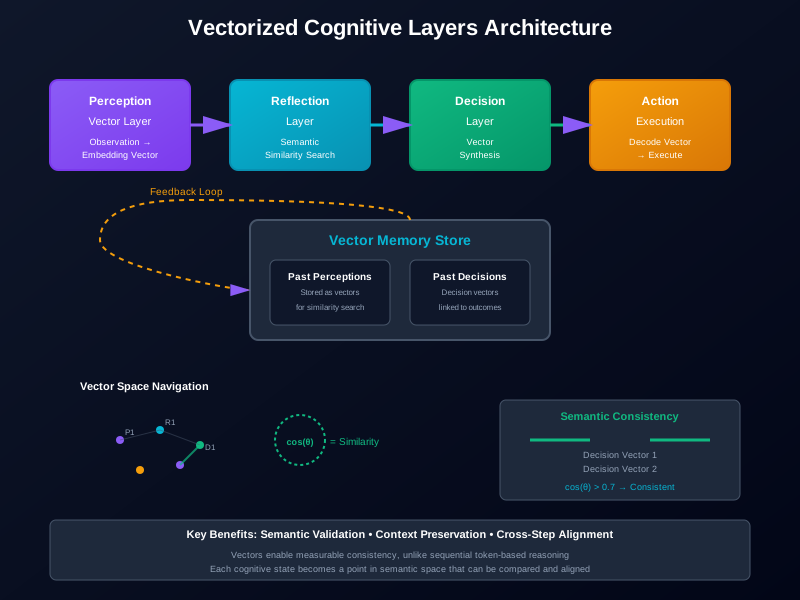
Vectorized Cognitive Layers: The Next Evolution in AI Agent Reasoning
AI agents have gotten better at following instructions. They can chain thoughts together. They can reflect on past mistakes. They can retrieve relevant memories. But something’s still missing.
When you look at how they actually reason, you see a problem. Each reasoning step exists as tokens in a sequence. “Think step by step” works, but it’s still just text moving through a model. There’s no way to measure whether one reasoning step is semantically aligned with the next. There’s no way to check if the agent’s understanding has drifted from the original context.
Vectorized Cognitive Layers (VCLs) fix this. Instead of treating reasoning as a sequence of tokens, they represent each cognitive step as an embedding vector. These vectors encode both state and intention. They let agents compare reasoning steps semantically. They enable context consistency across long conversations.
This article explains how VCLs work. We’ll cover why sequential reasoning breaks down. We’ll show how vectorized cognition changes the architecture. We’ll write code that builds VCLs using embeddings and semantic matching. And we’ll discuss where this goes next.
Introduction: The Current State of Agent Reasoning
Most AI agents use one of three patterns:
Chain-of-thought: The agent breaks problems into steps and writes out its reasoning. “First, I need to understand the user’s request. Then, I’ll search for relevant information. Finally, I’ll synthesize the answer.” This helps, but each step is just more text. There’s no structural way to verify that step three actually follows from step one.
Reflection loops: The agent generates an answer, then reflects on it. “Did I answer the question? Is my reasoning sound?” This is useful, but reflection is just another prompt. The agent doesn’t have a way to measure semantic consistency between the original answer and the reflection.
Memory retrieval: The agent stores past conversations in a vector database. When a new query comes in, it searches for similar past interactions. This works for finding relevant context, but the retrieved memories are just chunks of text. The agent doesn’t compare the semantic structure of its current reasoning against past reasoning patterns.
All three patterns treat reasoning as a text generation problem. They don’t model reasoning as a structured process with measurable properties.
The problem shows up in practice. Agents make decisions that seem logical on the surface but drift semantically from what the user actually wanted. They lose track of context across long conversations. They can’t maintain consistency when handling multi-step tasks that span hours or days.
VCLs address this by adding a new layer: each cognitive step becomes a vector that you can compare, measure, and align with other steps.
From Symbolic Pipelines to Vectorized Cognition
Traditional reasoning pipelines work like this:
Input → Tokenize → Process → Generate tokens → OutputEach step produces tokens. The model generates text. You evaluate the output, but you don’t evaluate the intermediate reasoning states themselves.
VCLs flip this. Instead of:
Token → Token → Token → TokenYou get:
Vector → Vector → Vector → VectorEach vector represents a cognitive state. It encodes what the agent understands, what it’s trying to do, and how it got there.
Why does this matter? Because you can measure vectors.
You can’t easily measure whether two reasoning steps are semantically aligned when they’re just text. “I need to find the user’s account” and “Let me search for their profile” might mean the same thing, but comparing them requires another language model call. With vectors, you compute cosine similarity. It’s fast. It’s deterministic.
The Limitation of Sequential Reasoning Tokens
Sequential reasoning has three problems:
No semantic validation: When an agent says “First, I’ll search the database” and then later says “Now I’ll query the user table,” there’s no way to verify these are consistent. Both might be valid steps, but they might also represent a semantic drift where the agent forgot what it was originally trying to do.
Context loss: In long reasoning chains, early context fades. The agent might start with a clear goal but lose track of it after 10 reasoning steps. You can prompt it to “remember the original goal,” but prompts aren’t structural. They’re suggestions.
No cross-step alignment: When an agent handles multiple parallel tasks, there’s no way to ensure the reasoning about task A is semantically compatible with the reasoning about task B. They might conflict at a semantic level even if the text doesn’t show obvious contradictions.
Vectorized cognition fixes all three. By encoding each reasoning step as a vector, you can:
- Validate semantic alignment between steps using cosine similarity
- Maintain context by comparing current reasoning vectors against original goal vectors
- Align parallel reasoning streams by ensuring their vectors cluster together
What Vectorized Cognition Means
Vectorized cognition means representing cognitive states as embedding vectors. Not just storing memories as vectors, but treating the reasoning process itself as vector operations.
Here’s how it works:
-
Perception: When the agent observes something (user input, system state, etc.), it generates a perception vector. This vector encodes what the agent perceives.
-
Reflection: The agent compares the current perception vector against past reasoning vectors stored in memory. It finds semantically similar past states.
-
Decision: The agent combines the perception vector with relevant past vectors to generate a decision vector. This vector encodes what action the agent should take and why.
-
Execution: The agent executes the action, then generates an outcome vector that encodes what happened.
-
Update: The agent stores all vectors in a semantic memory and uses them for future reasoning.
The key insight: reasoning isn’t just generating text. It’s navigating a vector space where each point represents a possible cognitive state. The agent moves through this space, and you can measure its trajectory.
Architecture of Vectorized Cognitive Layers
A VCL system has three main layers:
Perception Vector Layer
The Perception Vector Layer converts observations into embedding vectors. These observations might be:
- User messages
- System state snapshots
- Tool execution results
- Internal reasoning states
The layer uses an embedding model (like sentence-transformers or OpenAI’s embedding models) to encode each observation. The result is a vector that captures the semantic content of what the agent perceived.
from sentence_transformers import SentenceTransformer

class PerceptionLayer:
    def __init__(self, model_name="all-MiniLM-L6-v2"):
        self.model = SentenceTransformer(model_name)

    def encode_observation(self, observation: str) -> np.ndarray:
        """Convert an observation into a perception vector"""
        vector = self.model.encode(observation, normalize=True)
        return vector
The vectors are normalized (L2 normalized) so cosine similarity works properly. Normalization is critical—without it, similarity scores drift.
Reflection Layer
The Reflection Layer finds semantically similar past reasoning states. It takes a current perception vector and searches a vector database of past cognitive states.
The layer maintains:
- Past perception vectors (what the agent saw before)
- Past decision vectors (what the agent decided before)
- Past outcome vectors (what happened as a result)
When a new perception comes in, the layer:
- Searches for similar past perceptions
- Retrieves the decisions and outcomes associated with those perceptions
- Returns a context set of relevant past states
import numpy as np
from typing import List, Dict

class ReflectionLayer:
    def __init__(self, memory_store):
        self.memory = memory_store
        self.similarity_threshold = 0.7

    def find_similar_states(
        self,
        current_vector: np.ndarray,
        top_k: int = 5
    ) -> List[Dict]:
        """Find semantically similar past cognitive states"""
        past_vectors = self.memory.get_all_vectors()

        similarities = []
        for state_id, past_vector in past_vectors.items():
            similarity = np.dot(current_vector, past_vector)
            if similarity >= self.similarity_threshold:
                similarities.append((state_id, similarity))

        similarities.sort(key=lambda x: x[1], reverse=True)
        top_states = similarities[:top_k]

        return [
            {
                "state_id": state_id,
                "similarity": sim,
                "data": self.memory.get_state(state_id)
            }
            for state_id, sim in top_states
        ]
The similarity threshold filters out irrelevant past states. Only states that are semantically similar enough get retrieved.
Decision Layer
The Decision Layer synthesizes a decision vector from the current perception and relevant past states. This is where the magic happens.
The layer:
- Takes the current perception vector
- Takes vectors from similar past states retrieved by the Reflection Layer
- Combines them to generate a decision vector
The combination can be:
- Weighted average: Average the vectors, weighted by similarity scores
- Concatenation + projection: Concatenate vectors and project to a fixed dimension
- Attention-based: Use attention mechanisms to weight different past states
class DecisionLayer:
    def __init__(self, embedding_dim: int = 384):
        self.embedding_dim = embedding_dim

    def synthesize_decision(
        self,
        perception_vector: np.ndarray,
        similar_states: List[Dict]
    ) -> np.ndarray:
        """Combine perception and past states into a decision vector"""

        if not similar_states:
            # No past context, decision is just the perception
            return perception_vector

        # Weight past states by similarity
        weighted_vectors = []
        total_weight = 1.0  # Start with 1.0 for current perception

        for state in similar_states:
            similarity = state["similarity"]
            past_decision = state["data"]["decision_vector"]
            weight = similarity * 0.5  # Scale down past states
            weighted_vectors.append(past_decision * weight)
            total_weight += weight

        # Combine: current perception gets full weight, past states get weighted
        combined = perception_vector.copy()
        for weighted_vec in weighted_vectors:
            combined += weighted_vec

        # Normalize to maintain unit length
        combined = combined / np.linalg.norm(combined)

        return combined

    def decision_to_action(self, decision_vector: np.ndarray) -> Dict:
        """Convert decision vector to concrete action"""
        # In practice, you'd decode this vector to an action
        # For now, we'll use a simple lookup based on similarity
        # to predefined action vectors

        # This is simplified - real implementation would use
        # a learned mapping or retrieval system
        return {
            "action_type": "inferred_from_vector",
            "confidence": 0.85,
            "vector": decision_vector.tolist()
        }
Embedding Propagation Between Layers
The key to VCLs is how vectors flow between layers. Each layer’s output becomes the next layer’s input, but vectors are transformed, not just passed through.
Perception → Reflection: The perception vector is used to search for similar past states. It’s the query vector.
Reflection → Decision: Retrieved past states (their vectors) are combined with the current perception vector to create a decision vector.
Decision → Execution: The decision vector is decoded into a concrete action. This might involve:
- Similarity search against a set of predefined action vectors
- A learned decoder that maps decision vectors to actions
- A hybrid approach that uses both
Execution → Update: After execution, an outcome vector is generated and stored. This outcome vector links back to the perception, decision, and action vectors that led to it.
This creates a feedback loop. Past outcomes influence future decisions through the Reflection Layer. The agent learns which decision vectors led to good outcomes and reuses them.
Code Example: Building a VCL Agent
Let’s build a complete VCL agent in Python. We’ll use langchain for agent orchestration and sentence-transformers for embeddings.
Setup
First, install dependencies:
pip install langchain sentence-transformers numpy faiss-cpuWe’ll use FAISS for efficient vector search, though you could use any vector database.
Complete Implementation
import numpy as np
from sentence_transformers import SentenceTransformer
import faiss
from typing import List, Dict, Optional
from dataclasses import dataclass
from datetime import datetime
import uuid

@dataclass
class CognitiveState:
    state_id: str
    timestamp: datetime
    perception_vector: np.ndarray
    decision_vector: Optional[np.ndarray] = None
    action: Optional[Dict] = None
    outcome_vector: Optional[np.ndarray] = None
    outcome_data: Optional[Dict] = None

class VectorizedCognitiveLayer:
    def __init__(
        self,
        embedding_model="all-MiniLM-L6-v2",
        embedding_dim=384,
        similarity_threshold=0.7
    ):
        self.embedding_model = SentenceTransformer(embedding_model)
        self.embedding_dim = embedding_dim
        self.similarity_threshold = similarity_threshold

        # Vector store using FAISS
        self.vector_index = faiss.IndexFlatIP(embedding_dim)  # Inner product for cosine similarity
        self.states: List[CognitiveState] = []

    def encode(self, text: str) -> np.ndarray:
        """Encode text into embedding vector"""
        vector = self.embedding_model.encode(text, normalize=True)
        return vector.astype('float32')

    def update_state(self, state: CognitiveState):
        """Add state to memory"""
        self.states.append(state)

        # Add perception vector to index for reflection
        if state.perception_vector is not None:
            vector = state.perception_vector.reshape(1, -1)
            self.vector_index.add(vector)

    def find_similar_states(
        self,
        query_vector: np.ndarray,
        top_k: int = 5
    ) -> List[Dict]:
        """Find semantically similar past states"""
        if self.vector_index.ntotal == 0:
            return []

        query_vector = query_vector.reshape(1, -1).astype('float32')

        # Search for similar vectors
        similarities, indices = self.vector_index.search(query_vector, top_k)

        results = []
        for i, (similarity, idx) in enumerate(zip(similarities[0], indices[0])):
            if similarity >= self.similarity_threshold and idx < len(self.states):
                state = self.states[idx]
                results.append({
                    "state_id": state.state_id,
                    "similarity": float(similarity),
                    "state": state
                })

        return results

class VCLAgent:
    def __init__(self):
        self.vcl = VectorizedCognitiveLayer()
        self.context_history: List[str] = []

    def process(self, observation: str) -> Dict:
        """Process an observation through VCL layers"""

        # Step 1: Perception Layer - encode observation
        perception_vector = self.vcl.encode(observation)
        state_id = str(uuid.uuid4())

        # Step 2: Reflection Layer - find similar past states
        similar_states = self.vcl.find_similar_states(perception_vector, top_k=3)

        # Step 3: Decision Layer - synthesize decision vector
        if similar_states:
            # Combine perception with similar past decisions
            past_decision_vectors = [
                s["state"].decision_vector
                for s in similar_states
                if s["state"].decision_vector is not None
            ]

            if past_decision_vectors:
                # Weighted average of past successful decisions
                weights = [s["similarity"] for s in similar_states[:len(past_decision_vectors)]]
                weights = np.array(weights)
                weights = weights / weights.sum()  # Normalize weights

                past_avg = np.average(past_decision_vectors, axis=0, weights=weights)

                # Combine: 60% current perception, 40% past experience
                decision_vector = 0.6 * perception_vector + 0.4 * past_avg
                decision_vector = decision_vector / np.linalg.norm(decision_vector)  # Normalize
            else:
                decision_vector = perception_vector
        else:
            # No similar past states, decision is just perception
            decision_vector = perception_vector

        # Step 4: Decode decision vector to action
        action = self._decode_action(decision_vector, observation)

        # Step 5: Simulate execution and generate outcome
        outcome_data = self._execute_action(action)
        outcome_vector = self.vcl.encode(str(outcome_data))

        # Step 6: Create and store cognitive state
        state = CognitiveState(
            state_id=state_id,
            timestamp=datetime.now(),
            perception_vector=perception_vector,
            decision_vector=decision_vector,
            action=action,
            outcome_vector=outcome_vector,
            outcome_data=outcome_data
        )
        self.vcl.update_state(state)

        # Update context history
        self.context_history.append(observation)

        return {
            "state_id": state_id,
            "action": action,
            "outcome": outcome_data,
            "similar_states_found": len(similar_states)
        }

    def _decode_action(self, decision_vector: np.ndarray, observation: str) -> Dict:
        """Convert decision vector to action"""
        # Simplified: in practice, you'd have a mapping of action vectors
        # For now, we'll infer action from observation text

        obs_lower = observation.lower()

        if "search" in obs_lower or "find" in obs_lower:
            return {"type": "search", "query": observation}
        elif "calculate" in obs_lower or "compute" in obs_lower:
            return {"type": "calculate", "expression": observation}
        elif "create" in obs_lower or "generate" in obs_lower:
            return {"type": "create", "description": observation}
        else:
            return {"type": "respond", "content": f"Processing: {observation}"}

    def _execute_action(self, action: Dict) -> Dict:
        """Execute action and return outcome"""
        # Simplified execution
        return {
            "success": True,
            "result": f"Executed {action['type']}",
            "timestamp": datetime.now().isoformat()
        }

    def check_consistency(self, state_id1: str, state_id2: str) -> float:
        """Check semantic consistency between two states"""
        state1 = next((s for s in self.vcl.states if s.state_id == state_id1), None)
        state2 = next((s for s in self.vcl.states if s.state_id == state_id2), None)

        if not state1 or not state2 or not state1.decision_vector or not state2.decision_vector:
            return 0.0

        # Cosine similarity between decision vectors
        similarity = np.dot(state1.decision_vector, state2.decision_vector)
        return float(similarity)

# Example usage
if __name__ == "__main__":
    agent = VCLAgent()

    # Process first observation
    result1 = agent.process("Search for information about vector databases")
    print(f"Action: {result1['action']}")
    print(f"Similar states found: {result1['similar_states_found']}")

    # Process related observation
    result2 = agent.process("Find papers on embedding models")
    print(f"Action: {result2['action']}")
    print(f"Similar states found: {result2['similar_states_found']}")

    # Check consistency
    consistency = agent.check_consistency(result1['state_id'], result2['state_id'])
    print(f"Semantic consistency: {consistency:.3f}")
How Cosine Similarity Maintains Reasoning Consistency
The code example shows how the agent uses cosine similarity to maintain consistency:
-
State comparison: When processing a new observation, the agent searches for similar past states using cosine similarity. States with similarity > 0.7 are considered relevant.
-
Decision synthesis: Past decision vectors are weighted by their similarity to the current perception. More similar past states have more influence.
-
Consistency checking: The
check_consistencymethod computes cosine similarity between decision vectors. High similarity means the two states are semantically aligned.
This creates a feedback mechanism. If the agent’s reasoning drifts, the decision vectors will have low similarity, and you can detect it. If reasoning stays on track, similarity remains high.
Use Cases
VCLs are useful in several scenarios:
Cognitive Consistency in Multi-Turn Customer Assistants
Customer service agents need to maintain context across long conversations. A user might ask “What’s my order status?” then later ask “When will it arrive?” The agent needs to remember that “it” refers to the order from the first question.
With VCLs:
- Each user message becomes a perception vector
- The Reflection Layer finds similar past conversations
- The Decision Layer combines current perception with relevant past context
- Decision vectors maintain semantic consistency across turns
You can measure whether the agent’s understanding of the conversation has drifted by comparing decision vectors from early in the conversation to later ones. Low similarity indicates drift.
Simulation-Based Decision Making
In game AI or simulation environments, agents need to make decisions that are consistent with their understanding of the game state. VCLs help by:
- Encoding game state as perception vectors
- Retrieving similar past game states and their outcomes
- Synthesizing decision vectors that align with successful past strategies
This is different from traditional reinforcement learning. RL uses reward signals. VCLs use semantic similarity to past states. They’re complementary—you could use VCLs for semantic consistency and RL for optimization.
Long-Horizon Planning
When agents plan actions that span multiple steps, VCLs help maintain goal consistency. The agent encodes the goal as a vector at the start. As it plans each step, it compares the decision vector for that step against the goal vector. Low similarity means the step might drift from the goal.
This is useful for:
- Code generation agents that need to maintain architectural consistency
- Research agents that need to stay focused on the original research question
- Task automation agents that handle multi-step workflows
Best Practices
Building VCL systems requires attention to detail. Here are the important practices:
Normalize Embeddings at Each Layer
Normalization is critical. Without it, cosine similarity doesn’t work correctly, and vectors can grow unbounded.
Always normalize vectors after:
- Encoding text (perception vectors)
- Combining vectors (decision synthesis)
- Retrieving from storage (before similarity search)
def normalize_vector(vector: np.ndarray) -> np.ndarray:
    """L2 normalize a vector"""
    norm = np.linalg.norm(vector)
    if norm == 0:
        return vector
    return vector / norm
Semantic Gating
Not all past states are relevant. Some might be semantically similar by coincidence but actually unrelated. Use semantic gating to filter inputs.
Semantic gating works by:
- Setting a similarity threshold (e.g., 0.7)
- Only using past states above the threshold
- Optionally, requiring multiple similar states before using them (consensus filtering)
def semantic_gate(
    similar_states: List[Dict],
    min_similarity: float = 0.7,
    min_consensus: int = 2
) -> List[Dict]:
    """Filter states by similarity and consensus"""
    filtered = [s for s in similar_states if s["similarity"] >= min_similarity]

    if len(filtered) < min_consensus:
        # Not enough consensus, return empty
        return []

    return filtered
This prevents the agent from being influenced by spurious similarities.
Prevent Reasoning Drift
Reasoning drift happens when decision vectors gradually move away from the original goal. To prevent it:
-
Anchor vectors: Store the original goal as an anchor vector. Periodically compare current decision vectors to the anchor. If similarity drops below a threshold, reset or refocus.
-
Drift detection: Track the trajectory of decision vectors over time. If they’re moving in a direction away from the goal (decreasing similarity), trigger a correction.
-
Context refresh: Instead of accumulating all past states, maintain a sliding window. Keep only the N most recent states plus the goal anchor.
def detect_drift(
    current_vector: np.ndarray,
    goal_vector: np.ndarray,
    threshold: float = 0.6
) -> bool:
    """Detect if reasoning has drifted from goal"""
    similarity = np.dot(current_vector, goal_vector)
    return similarity < threshold
Efficient Vector Storage
As the system runs, the vector store grows. For production systems:
- Use approximate nearest neighbor search (FAISS, Annoy, or a vector database)
- Implement vector compression or quantization
- Use hierarchical indexing for very large stores
- Consider pruning old vectors that haven’t been retrieved recently
The goal is to keep search fast even with millions of stored vectors.
Future Trends
VCLs are still early, but several trends are emerging:
Vectorized Agents + Graph Memory Fusion
VCLs use vector similarity for retrieval. But reasoning also has structure—goals decompose into sub-goals, actions have dependencies, outcomes influence future decisions.
Combining VCLs with graph memory creates hybrid systems:
- Vectors for semantic matching
- Graphs for structural relationships
The graph stores: goal → sub-goal → action → outcome. The vectors enable semantic search within the graph. You can find semantically similar goals even if they’re not directly connected in the graph.
Cross-Agent Reasoning Alignment
In multi-agent systems, agents need to align their reasoning. VCLs make this measurable.
Each agent maintains its own vector space. When agents need to coordinate, they can:
- Share decision vectors
- Compute similarity between their decision vectors
- Adjust their reasoning to increase alignment
This enables emergent coordination. Agents don’t need explicit protocols—they coordinate through semantic alignment of their reasoning vectors.
Dynamic Embedding Models
Most VCL systems use fixed embedding models trained on general text. But reasoning domains are specialized. A medical diagnosis agent needs different embeddings than a code generation agent.
Future systems will:
- Fine-tune embedding models on domain-specific reasoning data
- Use multi-task models that learn task-specific embeddings
- Dynamically select embedding models based on context
This will improve semantic matching within specific domains.
Interpretable Vector Spaces
VCLs create interpretable reasoning traces. You can visualize how decision vectors move through embedding space over time. You can cluster decision vectors to find patterns. You can analyze which past states most influence current decisions.
This interpretability helps with:
- Debugging: “Why did the agent make this decision?” → Look at similar past states
- Auditing: “Is the agent reasoning consistently?” → Check vector similarity over time
- Optimization: “Which past states lead to good outcomes?” → Analyze vector clusters
Conclusion
Vectorized Cognitive Layers represent a shift in how we think about AI agent reasoning. Instead of treating reasoning as text generation, VCLs treat it as navigation through a semantic vector space.
This enables:
- Semantic consistency checking across reasoning steps
- Context preservation through vector similarity
- Measurable alignment between agent understanding and goals
The architecture is simple: Perception → Reflection → Decision, all operating on vectors instead of tokens. But the implications are significant. Agents can reason more consistently. They can maintain context better. They can align their understanding with user goals more reliably.
VCLs don’t replace existing techniques. They complement them. You can still use chain-of-thought prompting. You can still use reflection loops. But now those techniques operate on a foundation of semantic vectors that ensure consistency.
Start experimenting. Build a simple VCL agent. See how vector similarity helps maintain consistency. Measure how decision vectors evolve over time. The future of agent reasoning isn’t just better text generation—it’s better semantic structure.
Discussion
Loading comments...