Intent-Oriented AI Agents: Building Context-Aware Autonomy Beyond Prompts
Most AI agents work like task runners. You give them instructions. They follow them step by step. When the steps end, they stop.
This works fine for simple jobs. “Summarize this document.” “Generate a report.” “Translate this text.” But it breaks down when tasks get complex or when the goal isn’t clear from the start.
The problem isn’t the agent’s capability. It’s the architecture. We’re building prompt-driven systems that treat every request as a fresh instruction set. They don’t reason about why they’re doing something. They just do what they’re told.
Intent-Oriented Agent Architecture (IOAA) changes that. Instead of reacting to prompts, agents extract intent from interactions. They build context over time. They generate policies that adapt to changing conditions. They reason about goals before choosing actions.
This article shows how to build intent-oriented agents. We’ll define what intent means in cognitive systems. We’ll draw an architecture that separates intent from execution. We’ll write code that extracts intent from user interactions and aligns policies with those intents. We’ll also discuss how to measure whether agents are actually understanding intent, not just following instructions.
From Prompt-Driven to Intent-Driven Agents
Traditional agents follow a simple pattern: Input → Process → Output.
A user sends a prompt. The agent parses it, calls tools, formats a response. Done.
This pattern has limits. Here’s where it fails:
- Ambiguous requests: “Make the design better.” Better how? Faster? Cleaner? More accessible? The agent needs to infer intent.
- Multi-turn conversations: Each message builds on previous context. The agent needs memory of why earlier actions happened.
- Goal evolution: What the user wants might change as they see results. The agent needs to detect these shifts.
- Error recovery: When actions fail, the agent needs to reason about whether to retry, change approach, or abandon the goal.
Instruction-based design treats each interaction as isolated. It doesn’t model goals. It doesn’t track why decisions were made. It doesn’t adapt when circumstances change.
Intent-driven design fixes this by adding three layers:
- Intent modeling: The agent infers goals from interactions, not just explicit instructions.
- Contextual memory: The agent maintains a graph of past intents, actions, and outcomes.
- Adaptive policies: The agent generates execution strategies that align with current intent and context.
This isn’t just semantics. It changes how agents reason. Instead of “what should I do next?” they ask “why should I do this?” and “does this action match the user’s goal?”
Why Interpretability Matters
Intent-oriented systems are more interpretable because they make goals explicit. You can inspect what intent the agent inferred. You can see how that intent influenced action selection. You can trace why the agent chose one path over another.
This helps with:
- Debugging: When an agent makes a wrong choice, you can check if it misunderstood intent or if the policy was flawed.
- Safety: You can set guardrails on which intents are allowed, which actions are safe for each intent.
- User trust: Users can see what the agent thinks they want and correct misunderstandings.
Traditional agents are black boxes. You see input and output, but not the reasoning. Intent-oriented agents expose their reasoning at the intent level.
Dynamic Goal Modeling
Goals aren’t static. A user might start wanting to “optimize database queries” but realize they actually need “redesign the data model.” The agent needs to detect these shifts.
Intent-oriented architecture tracks goal evolution. It maintains a hierarchy: high-level goals decompose into sub-goals, which decompose into intents, which map to actions. When the user’s behavior suggests a goal change, the agent can restructure this hierarchy.
This is different from prompt engineering tricks like “think step by step.” Those still operate within a single-turn context. Intent modeling spans conversations and adapts over time.
Understanding Intent in Cognitive Systems
Intent exists at multiple levels. A user might have a high-level goal: “build a secure authentication system.” That goal contains sub-goals: “choose an auth protocol,” “implement token management,” “add multi-factor support.” Each sub-goal has intents: “I need to research OAuth vs JWT” or “I want to test token expiration.”
Actions live at the bottom. “Call the OAuth documentation API.” “Generate a test token.” “Validate token expiry.”
The hierarchy looks like this:
Goal: Build secure auth system
  ├─ Sub-goal: Choose protocol
  │   └─ Intent: Research options
  │       └─ Action: Search documentation
  ├─ Sub-goal: Implement tokens
  │   └─ Intent: Create token generator
  │       └─ Action: Write code
  └─ Sub-goal: Add MFA
      └─ Intent: Integrate 2FA library
          └─ Action: Install package
Most agents skip the hierarchy and jump straight to actions. Intent-oriented agents maintain it explicitly.
Extracting Latent Intent
Users rarely state intent directly. They might say “the app is slow” when they mean “I want to optimize database queries” or “I need better caching.” The agent must infer the real intent from behavior and context.
This is where embeddings and semantic analysis help. By comparing user messages to historical patterns, the agent can cluster similar intents. “App is slow” might map to intent clusters like “performance optimization,” “scaling issues,” or “bottleneck identification.”
The extraction process works like this:
- Parse the user message for explicit instructions.
- Search context memory for similar past interactions.
- Use embeddings to find latent patterns in user behavior.
- Infer likely intent based on context and patterns.
- Update the intent hierarchy if goals have shifted.
This isn’t perfect. The agent can misread intent. That’s why it’s important to make inferred intent visible and allow user correction.
Comparison with Reinforcement Learning
Reinforcement learning (RL) uses reward signals to shape behavior. The agent tries actions, receives rewards or penalties, and updates its policy. Reward structures are like intent hierarchies—they define what the agent should optimize for.
But RL rewards are usually fixed. They don’t adapt to changing user needs. Intent-oriented architecture makes rewards (intents) dynamic. The agent can update its understanding of what matters based on user feedback and context.
Also, RL often operates in simulation or controlled environments. Real user interactions are messier. Intent extraction handles the mess by inferring what users actually want, even when they don’t express it clearly.
Architectural Overview: The Intent Loop
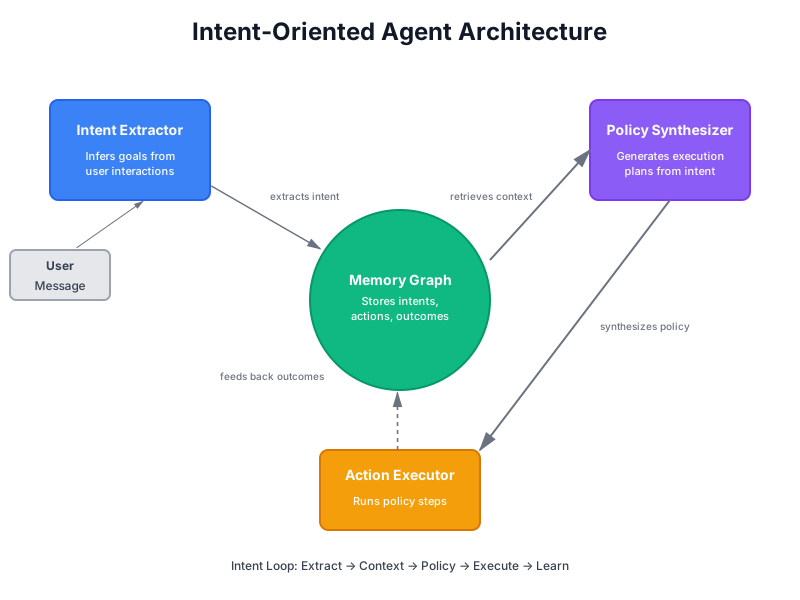
Intent-oriented architecture has three main components that form a loop:
Intent Extractor → Contextual Memory Graph → Policy Synthesizer → Action Executor → (feedback loops back)
Intent Extractor
The Intent Extractor infers goals from user interactions. It takes raw messages, extracts explicit instructions, searches context for similar patterns, and outputs structured intent objects.
Each intent has:
- Goal hierarchy position (which high-level goal it serves)
- Confidence score (how certain the agent is about this intent)
- Constraints (what the intent requires or forbids)
- Context links (connections to related past intents)
Contextual Memory Graph
The Contextual Memory Graph stores past intents, actions, and outcomes in a graph structure. Nodes are intents, actions, or outcomes. Edges connect related items—an intent led to actions, actions produced outcomes, outcomes influenced future intents.
This graph enables:
- Pattern recognition: “When users ask about performance, they usually want query optimization.”
- Goal tracking: “This user has been working toward building an auth system for three sessions.”
- Outcome learning: “The last time we tried approach X, it failed because of Y.”
The graph is queryable. The agent can ask “what intents are similar to this one?” or “what actions worked for this intent before?”
Policy Synthesizer
The Policy Synthesizer generates execution plans that align with current intent and leverage historical patterns. It doesn’t just map intent to a fixed action sequence. It creates policies—rules about which actions to take under which conditions.
Policies include:
- Action sequences (do X, then Y, then Z)
- Conditionals (if X happens, do Y; otherwise do Z)
- Fallbacks (if primary path fails, try alternatives)
- Constraints (never do X when intent requires Y)
The synthesizer uses the memory graph to find effective past patterns. If a similar intent succeeded with a specific approach before, it favors that approach. If it failed, it avoids it.
The Loop
Here’s how they work together:
- User sends a message.
- Intent Extractor infers intent.
- Memory Graph retrieves related intents and outcomes.
- Policy Synthesizer generates a policy based on intent + memory.
- Action Executor runs the policy.
- Outcomes feed back into Memory Graph.
- Next user message triggers the loop again.
This creates autonomous decision cycles. The agent reasons about why actions are needed, remembers what worked before, and adapts its approach over time.
Implementation Guide
Let’s build a minimal intent-oriented agent in Python. We’ll use OpenAI’s function-calling API for intent extraction, semantic embeddings for pattern matching, and a simple policy generator.
Setting Up
First, install dependencies:
pip install openai langchain transformers scikit-learn networkxIntent Extraction Module
Here’s an intent extractor that uses embeddings and function calling:
import openai
from typing import List, Dict, Any
from dataclasses import dataclass
import json

@dataclass
class Intent:
    goal: str
    sub_goal: str
    action_type: str
    confidence: float
    constraints: Dict[str, Any]
    context_links: List[str]

class IntentExtractor:
    def __init__(self, openai_client, embedding_model="text-embedding-3-small"):
        self.client = openai_client
        self.embedding_model = embedding_model
        self.intent_functions = [
            {
                "type": "function",
                "function": {
                    "name": "extract_intent",
                    "description": "Extract user intent from a message",
                    "parameters": {
                        "type": "object",
                        "properties": {
                            "goal": {
                                "type": "string",
                                "description": "High-level goal (e.g., 'optimize performance', 'build feature')"
                            },
                            "sub_goal": {
                                "type": "string",
                                "description": "Specific sub-goal within the high-level goal"
                            },
                            "action_type": {
                                "type": "string",
                                "enum": ["research", "implement", "debug", "test", "refactor", "deploy"]
                            },
                            "confidence": {
                                "type": "number",
                                "description": "Confidence score 0-1"
                            },
                            "constraints": {
                                "type": "object",
                                "description": "Any constraints or requirements"
                            }
                        },
                        "required": ["goal", "sub_goal", "action_type", "confidence"]
                    }
                }
            }
        ]

    def get_embedding(self, text: str) -> List[float]:
        response = self.client.embeddings.create(
            model=self.embedding_model,
            input=text
        )
        return response.data[0].embedding

    def find_similar_intents(self, current_intent: str, memory_graph, top_k: int = 3) -> List[str]:
        """Find similar past intents using embeddings"""
        current_embedding = self.get_embedding(current_intent)

        # Get embeddings for past intents from memory graph
        past_intents = memory_graph.get_intent_history()
        if not past_intents:
            return []

        # Simple cosine similarity (in production, use a vector DB)
        similarities = []
        for past_intent in past_intents:
            past_embedding = memory_graph.get_intent_embedding(past_intent["id"])
            if past_embedding:
                similarity = self._cosine_similarity(current_embedding, past_embedding)
                similarities.append((past_intent["id"], similarity))

        # Return top K most similar
        similarities.sort(key=lambda x: x[1], reverse=True)
        return [intent_id for intent_id, _ in similarities[:top_k]]

    def _cosine_similarity(self, a: List[float], b: List[float]) -> float:
        import numpy as np
        return np.dot(a, b) / (np.linalg.norm(a) * np.linalg.norm(b))

    def extract(self, user_message: str, conversation_history: List[Dict] = None) -> Intent:
        messages = conversation_history or []
        messages.append({"role": "user", "content": user_message})

        response = self.client.chat.completions.create(
            model="gpt-4",
            messages=messages,
            tools=self.intent_functions,
            tool_choice={"type": "function", "function": {"name": "extract_intent"}}
        )

        tool_call = response.choices[0].message.tool_calls[0]
        params = json.loads(tool_call.function.arguments)

        return Intent(
            goal=params["goal"],
            sub_goal=params["sub_goal"],
            action_type=params["action_type"],
            confidence=params["confidence"],
            constraints=params.get("constraints", {}),
            context_links=[]  # Will be populated by memory graph
        )
Implementing the Contextual Memory Graph
A simple memory graph implementation:
import networkx as nx
from datetime import datetime
from typing import Optional

class MemoryGraph:
    def __init__(self):
        self.graph = nx.DiGraph()
        self.intent_embeddings = {}  # intent_id -> embedding

    def add_intent(self, intent_id: str, intent: Intent, embedding: List[float]):
        self.graph.add_node(intent_id, type="intent", data=intent, timestamp=datetime.now())
        self.intent_embeddings[intent_id] = embedding

    def add_action(self, action_id: str, intent_id: str, action_data: Dict):
        self.graph.add_node(action_id, type="action", data=action_data, timestamp=datetime.now())
        self.graph.add_edge(intent_id, action_id, relation="triggers")

    def add_outcome(self, outcome_id: str, action_id: str, outcome_data: Dict):
        self.graph.add_node(outcome_id, type="outcome", data=outcome_data, timestamp=datetime.now())
        self.graph.add_edge(action_id, outcome_id, relation="produces")

    def link_intents(self, intent_id1: str, intent_id2: str, relation: str = "similar"):
        if self.graph.has_node(intent_id1) and self.graph.has_node(intent_id2):
            self.graph.add_edge(intent_id1, intent_id2, relation=relation)

    def get_intent_history(self) -> List[Dict]:
        intents = []
        for node_id, data in self.graph.nodes(data=True):
            if data.get("type") == "intent":
                intents.append({"id": node_id, "data": data["data"], "timestamp": data["timestamp"]})
        return sorted(intents, key=lambda x: x["timestamp"], reverse=True)

    def get_intent_embedding(self, intent_id: str) -> Optional[List[float]]:
        return self.intent_embeddings.get(intent_id)

    def find_related_intents(self, intent_id: str, max_depth: int = 2) -> List[str]:
        """Find intents connected within max_depth hops"""
        if not self.graph.has_node(intent_id):
            return []

        related = []
        for depth in range(1, max_depth + 1):
            successors = list(self.graph.successors(intent_id))
            predecessors = list(self.graph.predecessors(intent_id))
            related.extend(successors + predecessors)

            # Traverse further
            for node in successors + predecessors:
                if self.graph.nodes[node].get("type") == "intent":
                    related.extend(self.graph.successors(node))
                    related.extend(self.graph.predecessors(node))

        return list(set(related))

    def get_actions_for_intent(self, intent_id: str) -> List[Dict]:
        actions = []
        for successor in self.graph.successors(intent_id):
            if self.graph.nodes[successor].get("type") == "action":
                actions.append({
                    "id": successor,
                    "data": self.graph.nodes[successor]["data"]
                })
        return actions
Implementing the Policy Synthesizer
The policy synthesizer generates execution plans:
from typing import List, Dict

class PolicySynthesizer:
    def __init__(self, memory_graph: MemoryGraph):
        self.memory = memory_graph

    def synthesize_policy(self, intent: Intent, intent_id: str) -> Dict:
        """Generate a policy that aligns with the intent and leverages past patterns"""

        # Find similar past intents
        related_intent_ids = self.memory.find_related_intents(intent_id)

        # Analyze what worked before
        successful_patterns = []
        failed_patterns = []

        for related_id in related_intent_ids:
            actions = self.memory.get_actions_for_intent(related_id)
            for action in actions:
                action_id = action["id"]
                # Check outcomes
                outcomes = list(self.memory.graph.successors(action_id))
                for outcome_id in outcomes:
                    outcome_data = self.memory.graph.nodes[outcome_id]["data"]
                    if outcome_data.get("success", False):
                        successful_patterns.append(action["data"])
                    else:
                        failed_patterns.append(action["data"])

        # Generate policy
        policy = {
            "intent_id": intent_id,
            "goal": intent.goal,
            "action_type": intent.action_type,
            "steps": self._generate_steps(intent, successful_patterns, failed_patterns),
            "fallbacks": self._generate_fallbacks(intent, failed_patterns),
            "constraints": intent.constraints
        }

        return policy

    def _generate_steps(self, intent: Intent, successful: List, failed: List) -> List[Dict]:
        """Generate action steps based on intent and patterns"""
        steps = []

        if intent.action_type == "research":
            steps = [
                {"type": "search", "query": f"{intent.sub_goal} best practices"},
                {"type": "analyze", "focus": intent.constraints.get("topics", [])},
                {"type": "summarize", "format": "structured"}
            ]
        elif intent.action_type == "implement":
            steps = [
                {"type": "plan", "scope": intent.sub_goal},
                {"type": "code", "constraints": intent.constraints},
                {"type": "test", "coverage": "critical_path"}
            ]
        else:
            steps = [{"type": intent.action_type, "target": intent.sub_goal}]

        # Adjust based on successful patterns
        if successful:
            # Prefer patterns that worked before
            preferred_approach = successful[0].get("approach")
            if preferred_approach:
                steps.insert(0, {"type": "validate_approach", "approach": preferred_approach})

        return steps

    def _generate_fallbacks(self, intent: Intent, failed: List) -> List[Dict]:
        """Generate fallback strategies based on what failed before"""
        fallbacks = []

        for failed_pattern in failed[:3]:  # Top 3 failures to avoid
            fallbacks.append({
                "condition": f"If {failed_pattern.get('error_type')} occurs",
                "action": "try_alternative",
                "avoid": failed_pattern.get("approach")
            })

        return fallbacks
Intent-Policy Alignment with Reinforcement Learning
Here’s a lightweight RL component that refines policies based on feedback:
import numpy as np
from typing import Dict, List

class PolicyRefiner:
    """Lightweight policy refiner using contextual bandits"""

    def __init__(self):
        self.action_rewards = {}  # action_pattern -> reward_history
        self.intent_action_map = {}  # intent_id -> attempted_actions

    def record_outcome(self, intent_id: str, action_pattern: str, reward: float):
        """Record reward for an action pattern"""
        if action_pattern not in self.action_rewards:
            self.action_rewards[action_pattern] = []

        self.action_rewards[action_pattern].append(reward)

        # Keep only recent history (last 100)
        if len(self.action_rewards[action_pattern]) > 100:
            self.action_rewards[action_pattern] = self.action_rewards[action_pattern][-100:]

    def get_expected_reward(self, action_pattern: str) -> float:
        """Get expected reward for an action pattern"""
        if action_pattern not in self.action_rewards:
            return 0.5  # Default neutral reward

        rewards = self.action_rewards[action_pattern]
        return np.mean(rewards) if rewards else 0.5

    def select_best_action(self, candidate_actions: List[Dict], intent_context: Dict) -> Dict:
        """Select action with highest expected reward, with exploration"""

        if not candidate_actions:
            return None

        # Calculate expected rewards
        action_scores = []
        for action in candidate_actions:
            pattern = self._extract_pattern(action)
            expected_reward = self.get_expected_reward(pattern)

            # Add exploration bonus for less-tried actions
            trial_count = len(self.action_rewards.get(pattern, []))
            exploration_bonus = 0.1 / (1 + trial_count)

            action_scores.append((action, expected_reward + exploration_bonus))

        # Select best (with some randomness for exploration)
        action_scores.sort(key=lambda x: x[1], reverse=True)

        # 80% exploit, 20% explore
        if np.random.random() < 0.8:
            return action_scores[0][0]
        else:
            return np.random.choice([a[0] for a in action_scores[:3]])

    def _extract_pattern(self, action: Dict) -> str:
        """Extract a pattern string from action for matching"""
        return f"{action.get('type')}:{action.get('target', '')}"
Putting It Together
Here’s a complete agent that uses all components:
import uuid

class IntentOrientedAgent:
    def __init__(self, openai_client):
        self.intent_extractor = IntentExtractor(openai_client)
        self.memory = MemoryGraph()
        self.policy_synthesizer = PolicySynthesizer(self.memory)
        self.policy_refiner = PolicyRefiner()
        self.conversation_history = []

    def process_message(self, user_message: str) -> Dict:
        # Extract intent
        intent = self.intent_extractor.extract(user_message, self.conversation_history)
        intent_id = str(uuid.uuid4())

        # Find similar intents in memory
        similar_ids = self.intent_extractor.find_similar_intents(
            f"{intent.goal} {intent.sub_goal}",
            self.memory
        )

        # Link to similar intents
        for similar_id in similar_ids:
            self.memory.link_intents(intent_id, similar_id, "similar")

        # Store intent in memory
        intent_embedding = self.intent_extractor.get_embedding(
            f"{intent.goal} {intent.sub_goal}"
        )
        self.memory.add_intent(intent_id, intent, intent_embedding)

        # Synthesize policy
        policy = self.policy_synthesizer.synthesize_policy(intent, intent_id)

        # Refine action selection using RL
        if policy["steps"]:
            best_action = self.policy_refiner.select_best_action(
                policy["steps"],
                {"intent_id": intent_id, "goal": intent.goal}
            )
        else:
            best_action = policy["steps"][0] if policy["steps"] else None

        # Execute action (simplified)
        action_id = str(uuid.uuid4())
        self.memory.add_action(action_id, intent_id, best_action)

        # Simulate outcome (in real use, this would be actual execution)
        outcome = self._execute_action(best_action)
        outcome_id = str(uuid.uuid4())
        self.memory.add_outcome(outcome_id, action_id, outcome)

        # Update policy refiner
        reward = 1.0 if outcome.get("success") else 0.0
        action_pattern = self.policy_refiner._extract_pattern(best_action)
        self.policy_refiner.record_outcome(intent_id, action_pattern, reward)

        # Update conversation history
        self.conversation_history.append({"role": "user", "content": user_message})
        self.conversation_history.append({
            "role": "assistant",
            "content": outcome.get("response", "Action completed")
        })

        return {
            "intent": intent,
            "policy": policy,
            "action": best_action,
            "outcome": outcome
        }

    def _execute_action(self, action: Dict) -> Dict:
        """Simplified action executor"""
        # In production, this would call actual tools/APIs
        return {
            "success": True,
            "response": f"Executed {action.get('type')} for {action.get('target', 'target')}"
        }
Example Usage
import os
import openai

# Initialize
client = openai.OpenAI(api_key=os.getenv("OPENAI_API_KEY"))
agent = IntentOrientedAgent(client)

# Process messages
result1 = agent.process_message("The app is slow. I need to optimize database queries.")
print(f"Intent: {result1['intent'].goal} - {result1['intent'].sub_goal}")
print(f"Action: {result1['action']}")

result2 = agent.process_message("Show me the best practices for query optimization.")
print(f"Intent: {result2['intent'].goal} - {result2['intent'].sub_goal}")
# Agent recognizes this is related to the previous intent

result3 = agent.process_message("Actually, I think the problem is the API rate limiting, not the database.")
print(f"Intent: {result3['intent'].goal} - {result3['intent'].sub_goal}")
# Agent detects intent shift and updates goal hierarchy
Evaluation and Metrics
How do you know if an intent-oriented agent is working? Traditional metrics like accuracy or latency don’t capture intent understanding. You need new measures.
Intent Fidelity
Intent fidelity measures how well extracted intent matches what the user actually wanted. You can measure this by:
- User confirmation: After the agent infers intent, ask the user to confirm. Track confirmation rate over time.
- Outcome correlation: If the agent’s actions lead to user satisfaction (measured by follow-up feedback), intent was likely correct.
- Intent drift detection: Track when users correct inferred intent. High correction rate means low fidelity.
Here’s code to track intent fidelity:
class IntentFidelityTracker:
    def __init__(self):
        self.intent_confirmations = {}  # intent_id -> confirmed (bool)
        self.user_corrections = []  # List of corrected intents
        self.outcome_satisfaction = {}  # intent_id -> satisfaction_score

    def record_confirmation(self, intent_id: str, confirmed: bool):
        self.intent_confirmations[intent_id] = confirmed
        if not confirmed:
            self.user_corrections.append(intent_id)

    def record_satisfaction(self, intent_id: str, score: float):
        self.outcome_satisfaction[intent_id] = score

    def calculate_fidelity(self) -> Dict:
        total = len(self.intent_confirmations)
        if total == 0:
            return {"fidelity": 0.0, "correction_rate": 0.0}

        confirmed_count = sum(1 for c in self.intent_confirmations.values() if c)
        correction_rate = len(self.user_corrections) / total if total > 0 else 0.0

        avg_satisfaction = np.mean(list(self.outcome_satisfaction.values())) if self.outcome_satisfaction else 0.5

        return {
            "fidelity": confirmed_count / total,
            "correction_rate": correction_rate,
            "avg_satisfaction": avg_satisfaction
        }
Contextual Alignment
Contextual alignment measures how well policies match context. A policy that ignores past failures has low alignment. A policy that adapts based on memory has high alignment.
Metrics:
- Pattern reuse rate: How often does the agent reuse successful patterns from memory?
- Failure avoidance: How often does it avoid actions that failed before?
- Context relevance: When retrieving related intents, are they actually relevant?
class ContextualAlignmentTracker:
    def __init__(self, memory: MemoryGraph):
        self.memory = memory
        self.policy_decisions = []  # List of (policy, context_used)

    def record_policy_decision(self, policy: Dict, context_intent_ids: List[str]):
        self.policy_decisions.append({
            "policy": policy,
            "context_used": context_intent_ids,
            "timestamp": datetime.now()
        })

    def calculate_alignment(self) -> Dict:
        if not self.policy_decisions:
            return {"alignment": 0.0}

        pattern_reuse_count = 0
        context_usage_count = 0

        for decision in self.policy_decisions:
            # Check if policy uses patterns from context
            context_intents = decision["context_used"]
            if context_intents:
                context_usage_count += 1
                # Check if policy steps reference successful patterns
                policy_steps = decision["policy"].get("steps", [])
                if any("validate_approach" in str(step) for step in policy_steps):
                    pattern_reuse_count += 1

        return {
            "alignment": pattern_reuse_count / len(self.policy_decisions) if self.policy_decisions else 0.0,
            "context_usage_rate": context_usage_count / len(self.policy_decisions) if self.policy_decisions else 0.0
        }
Adaptability Testing
To test adaptability, create scenarios where:
- User goals shift mid-conversation
- Past patterns become obsolete
- New patterns emerge
Measure how quickly the agent detects shifts and updates its policies.
def test_adaptability(agent: IntentOrientedAgent):
    """Test agent's ability to adapt to goal shifts"""

    # Phase 1: Establish initial intent
    result1 = agent.process_message("I want to optimize database performance.")
    initial_intent = result1["intent"].goal

    # Phase 2: Shift goal
    result2 = agent.process_message("Actually, the real issue is API rate limiting, not the database.")
    shifted_intent = result2["intent"].goal

    # Phase 3: Check if agent detected shift
    shift_detected = initial_intent != shifted_intent

    # Phase 4: Check if policy updated
    policy_updated = result2["policy"]["goal"] != result1["policy"]["goal"]

    return {
        "shift_detected": shift_detected,
        "policy_updated": policy_updated,
        "adaptability_score": 1.0 if (shift_detected and policy_updated) else 0.5
    }
Conclusion: Future of Intent-Centric Architectures
Intent-oriented architecture isn’t just a different way to build agents. It’s a shift toward systems that reason about goals, maintain context, and adapt policies dynamically.
This matters because AI agents are moving beyond single-turn tasks. They’re becoming long-running assistants that collaborate with users over days or weeks. They need memory. They need to understand why they’re doing things, not just what to do.
Integration with RAG Pipelines
Intent-oriented agents pair well with RAG (Retrieval-Augmented Generation). The memory graph can store document chunks alongside intents. When inferring intent, the agent can retrieve relevant documents. When generating policies, it can reference both past actions and document knowledge.
This creates a hybrid: intent-driven reasoning plus knowledge retrieval. The agent knows why it’s doing something and what knowledge it needs.
Multi-Agent Networks
In multi-agent systems, intents can span agents. One agent might extract intent, another might execute actions, a third might monitor outcomes. The memory graph becomes shared context. Agents coordinate through intent alignment—ensuring their actions serve the same goal.
This enables emergent collaboration. Agents don’t need explicit coordination protocols. They coordinate through shared intent understanding.
Security and Bias Considerations
Intent-oriented systems introduce new security concerns:
- Intent injection: Malicious users might try to manipulate inferred intent to trigger unsafe actions. Mitigation: validate intents against allowed goal sets, require confirmation for sensitive intents.
- Memory poisoning: Attackers might try to corrupt the memory graph with false patterns. Mitigation: validate outcomes before adding to memory, use reputation scores for pattern reliability.
- Bias amplification: If historical patterns contain bias, the agent might perpetuate it. Mitigation: audit patterns for bias, diversify training data, allow users to flag problematic patterns.
Also, making intent explicit helps with bias detection. You can inspect what goals the agent infers for different user groups. If the agent consistently misreads intent for certain groups, that’s a bias signal.
Where This Goes Next
Intent-oriented architecture is still early. But the pieces are falling into place:
- Better intent extraction through fine-tuned models
- More sophisticated memory graphs with vector databases
- Policy synthesis through reinforcement learning
- Integration with existing agent frameworks
The goal isn’t to replace prompt engineering or tool calling. It’s to add a reasoning layer that makes agents more autonomous, more interpretable, and more aligned with what users actually want.
Start small. Build an intent extractor for one use case. Add a memory graph to track patterns. Experiment with policy synthesis. See if intent-oriented design improves your agent’s understanding and adaptability.
The future of AI agents isn’t better prompts. It’s better reasoning about goals, context, and why actions matter.
Discussion
Loading comments...