Designing for Elastic Consistency: Building Dynamically Tunable Data Consistency Models
Introduction
We treat consistency like a switch you set once and forget. Strong for the critical path. Eventual for the rest. It sounds tidy on a whiteboard, but it rarely fits the real world.
Users, regions, and workloads change by the hour. SLAs are not one-size-fits-all. Some customers pay for strict guarantees. Others trade precision for speed. Your traffic spikes on Monday mornings and product launches. Your replicas fall behind during incidents. And your platform team tries to keep one global setting that makes everyone happy. It never does.
Traditional thinking leans on CAP and fixed choices: pick strong or eventual, then optimize around that decision. But modern systems can do better. They can change consistency dynamically, at runtime, based on who’s asking, what they’re doing, and how the system is behaving.
This is the idea behind elastic consistency. It’s a design where the system adapts its consistency guarantees per request. The choice isn’t static. It flexes with load, policy, and context. The goal is simple: protect user trust without overpaying in latency and cost.
Multi-region cloud made this practical. We have better telemetry. Better routing. Better control planes. Databases like DynamoDB, Cosmos DB, and YugabyteDB already expose tunable consistency options. We can push that one layer up and make it part of the application contract.
This article shows how to design and implement elastic consistency. We’ll define the concept, draw a blueprint, and build a small middleware that routes reads and writes to different paths depending on current conditions. We’ll also talk about what to measure, when to switch, and how to keep it safe.
The Problem with Fixed Consistency
Fixed consistency is clean in theory and blunt in practice.
Here’s where strict consistency hurts:
- High p99 latency for read-heavy endpoints that don’t need it.
- Cascading timeouts during regional imbalances or leader failovers.
- Unnecessary quorum costs for low-value reads, like feed previews or counters.
- Slower recovery during incidents when the safest path is not always the fastest.
And here’s where lax consistency hurts:
- Users see stale account balances.
- Conflicting updates in shared documents.
- Checkout flows that double-charge or show incorrect stock.
We end up splitting services into “strong” and “eventual” zones. That helps, but it’s still rigid. Inside each zone, every request gets the same treatment, even when not every request deserves it.
Cloud databases recognize this problem. A few examples:
- DynamoDB supports per-request ConsistentRead for strongly consistent reads within a region.
- Cosmos DB lets you choose from multiple levels (Strong, Bounded Staleness, Session, Consistent Prefix, Eventual) and even change account-level defaults.
- YugabyteDB exposes tunable consistency through follower reads and bounded staleness.
These are great building blocks. But they sit behind your data SDK and rarely tie back to user intent or SLA tier. The app seldom says: “this user is on Gold, give them strict reads unless the cluster is overloaded.” It should.
The Concept of Elastic Consistency
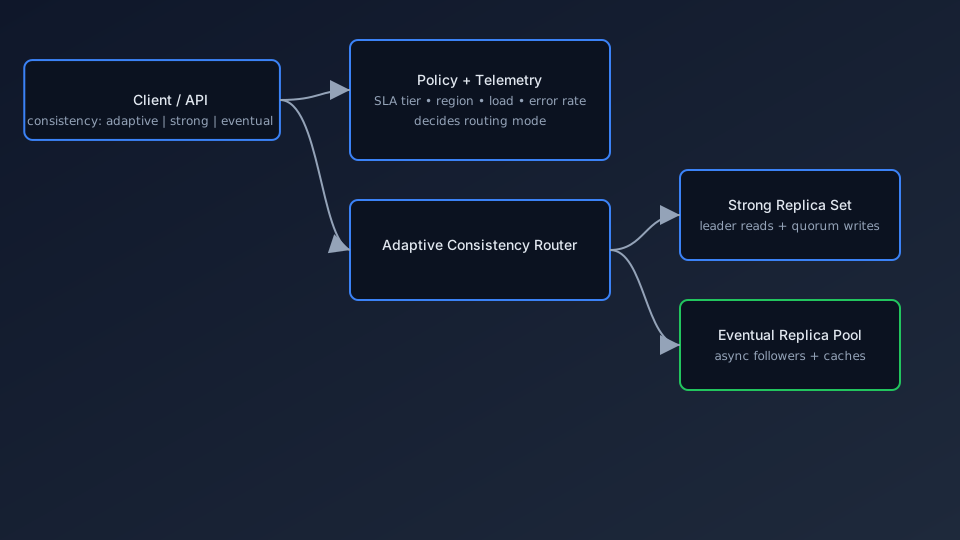
Elastic consistency is the ability to adjust consistency guarantees at runtime. The system picks a mode per request, not per service. It selects strong, eventual, or something in between, based on four inputs:
- Caller context: user tier, feature flags, risk profile, data sensitivity.
- Request intent: write vs. read, idempotency, correctness impact.
- System state: replica lag, error rate, queue depth, p99 latency.
- Policy: guardrails that set the safe range and priorities when signals conflict.
Think of it as a feedback loop. Policy defines the floor and ceiling. Telemetry tells you where you are. The router picks the best mode that stays within policy and meets the request intent.
You can visualize this as a consistency elasticity curve: as you push for lower latency, you relax guarantees; as you demand stricter guarantees, you accept higher latency. The curve isn’t linear. It bends based on how your storage and network behave.
A few examples:
- Feed reads for a Standard user during a traffic spike: eventual reads from follower replicas or caches.
- Balance reads for a Gold user: strong reads unless the leader is degraded, then bounded staleness within 100 ms.
- Write-heavy batch import: eventual reads for lookups, strict writes with quorum.
The trick is to make these choices predictable and safe. Users shouldn’t feel the system wobble under their feet. You model the risk, set thresholds, and log switching decisions. If you flip modes, you must do it for a reason that you can defend later.
Vocabulary
- Strong: linearizable reads from leader; quorum writes.
- Bounded staleness: reads within a max staleness window (time or version).
- Session: monotonic reads within a session token.
- Eventual: fastest available with no ordering guarantees.
Elastic consistency uses these as targets. Your router picks the target per request and passes that hint to the data layer.
Architecture Blueprint
Elastic consistency has four parts:
- Client hints: the caller can pass
consistency: "adaptive" | "strong" | "eventual" | "bounded"and constraints likemaxStalenessMs. - Policy engine: the source of truth for what’s allowed per tenant, feature, and data class.
- Telemetry: live signals like replica lags, queue depths, p95/p99 latencies, error budgets.
- Router: a small service or middleware that resolves a mode for each request and forwards it to the data SDK.
The flow looks like this:
client → API → adaptive consistency middleware → data SDK → strong replicas | follower replicas | cache
                             ↑                    ↑
                          policy              telemetry
Client API (hints)
fetchData(key, { consistency: "adaptive", maxStalenessMs: 150, requireSession: true })If the client asks for a fixed mode (e.g., strong), the router honors it unless policy forbids it. If the client asks for adaptive, the router decides.
Routing rules (examples)
- If user tier is Gold and data class is “money,” prefer strong.
- If follower lag ≤ 50 ms and p99 < 80 ms, allow bounded reads up to 100 ms.
- If error budget is < 10% remaining, tilt toward safer modes.
- During incident mode, pin critical endpoints to strong and throttle others to eventual.
Data layer integration
Most SDKs let you pass consistency hints. If yours doesn’t, you can build it: separate read paths (leader vs. follower), session tokens, and cache reads guarded by staleness checks. The router should attach tracing metadata so you can later explain decisions.
Implementation Demo
Below is a minimal Node.js implementation that shows the idea. It’s not tied to a real database, but the adapter methods map to common patterns (leader read, follower read, cached read, quorum write). You can wire it to DynamoDB, Postgres with read replicas, Cosmos DB, or YugabyteDB.
// adaptive-consistency.js
// Minimal, dependency-light demo of elastic consistency routing in Node.js

class TelemetryProvider {
  constructor({ getReplicaLagMs, getP99LatencyMs, getErrorBudgetRemainingPct }) {
    this.getReplicaLagMs = getReplicaLagMs;
    this.getP99LatencyMs = getP99LatencyMs;
    this.getErrorBudgetRemainingPct = getErrorBudgetRemainingPct;
  }
}

class PolicyEngine {
  constructor(rules) {
    this.rules = rules; // simple object or function set
  }

  allowBoundedStaleness(tenantId, dataClass) {
    return this.rules.allowBounded?.(tenantId, dataClass) ?? false;
  }

  maxStalenessMs(tenantId, dataClass) {
    return this.rules.maxStalenessMs?.(tenantId, dataClass) ?? 0;
  }

  requireStrongFor(tenantId, dataClass) {
    return this.rules.requireStrong?.(tenantId, dataClass) ?? false;
  }
}

class DataAdapter {
  // Replace these with your actual DB calls
  async readStrong(key) { return { key, source: "leader", value: `V:${key}` }; }
  async readFollower(key) { return { key, source: "follower", value: `V:${key}` }; }
  async readCached(key) { return { key, source: "cache", value: `V:${key}` }; }
  async writeQuorum(key, value) { return { key, ack: "quorum", value }; }
}

function buildRouter({ policy, telemetry, dataAdapter }) {
  async function resolveMode({ tenantId, dataClass, intent, hint }) {
    const lag = await telemetry.getReplicaLagMs();
    const p99 = await telemetry.getP99LatencyMs();
    const errorBudget = await telemetry.getErrorBudgetRemainingPct();

    if (hint === "strong" || policy.requireStrongFor(tenantId, dataClass)) {
      return { mode: "strong", reason: hint === "strong" ? "client-hint" : "policy-required" };
    }

    if (hint === "eventual") {
      return { mode: "eventual", reason: "client-hint" };
    }

    // Adaptive
    const allowBounded = policy.allowBoundedStaleness(tenantId, dataClass);
    const maxStaleness = policy.maxStalenessMs(tenantId, dataClass);

    // If the system is stressed, bias toward safer (strong) for critical data
    const systemStressed = p99 > 120 || errorBudget < 10;

    if (intent === "read") {
      if (allowBounded && lag <= maxStaleness && !systemStressed) {
        return { mode: "bounded", boundMs: maxStaleness, reason: "bounded-ok" };
      }
      if (lag <= 30 && p99 < 90) {
        return { mode: "eventual", reason: "fast-followers" };
      }
      return { mode: "strong", reason: systemStressed ? "stress-strong" : "fallback-strong" };
    }

    if (intent === "write") {
      return { mode: "strong", reason: "writes-strong" };
    }

    return { mode: "strong", reason: "default" };
  }

  async function read(key, opts) {
    const { tenantId, dataClass, hint = "adaptive" } = opts;
    const decision = await resolveMode({ tenantId, dataClass, intent: "read", hint });
    let res;
    switch (decision.mode) {
      case "strong": res = await dataAdapter.readStrong(key); break;
      case "bounded": res = await dataAdapter.readFollower(key); break; // assume bounded follower read
      case "eventual": res = await dataAdapter.readFollower(key); break;
      default: res = await dataAdapter.readStrong(key);
    }
    return { ...res, decision };
  }

  async function write(key, value, opts) {
    const { tenantId, dataClass } = opts;
    const decision = await resolveMode({ tenantId, dataClass, intent: "write", hint: "adaptive" });
    const res = await dataAdapter.writeQuorum(key, value);
    return { ...res, decision };
  }

  return { read, write, resolveMode };
}

// Example wiring
async function example() {
  const telemetry = new TelemetryProvider({
    getReplicaLagMs: async () => 45,
    getP99LatencyMs: async () => 80,
    getErrorBudgetRemainingPct: async () => 72,
  });

  const policy = new PolicyEngine({
    allowBounded: (tenantId, dataClass) => dataClass !== "money",
    maxStalenessMs: (tenantId, dataClass) => (dataClass === "feed" ? 120 : 60),
    requireStrong: (tenantId, dataClass) => tenantId === "gold" && dataClass === "money",
  });

  const router = buildRouter({ policy, telemetry, dataAdapter: new DataAdapter() });

  console.log(await router.read("post:123", { tenantId: "standard", dataClass: "feed", hint: "adaptive" }));
  console.log(await router.read("acct:abc", { tenantId: "gold", dataClass: "money", hint: "adaptive" }));
}

// example(); // uncomment to try

module.exports = { TelemetryProvider, PolicyEngine, DataAdapter, buildRouter };
Express middleware wrapper
// server.js
const express = require('express');
const { TelemetryProvider, PolicyEngine, DataAdapter, buildRouter } = require('./adaptive-consistency');

const app = express();
app.use(express.json());

const telemetry = new TelemetryProvider({
  getReplicaLagMs: async () => 35,
  getP99LatencyMs: async () => 85,
  getErrorBudgetRemainingPct: async () => 68,
});

const policy = new PolicyEngine({
  allowBounded: (tenantId, dataClass) => dataClass !== 'money',
  maxStalenessMs: (tenantId, dataClass) => (dataClass === 'feed' ? 120 : 60),
  requireStrong: (tenantId, dataClass) => tenantId === 'gold' && dataClass === 'money',
});

const router = buildRouter({ policy, telemetry, dataAdapter: new DataAdapter() });

app.get('/v1/items/:id', async (req, res) => {
  const tenantId = req.header('x-tenant') || 'standard';
  const dataClass = req.header('x-data-class') || 'feed';
  const hint = req.header('x-consistency') || 'adaptive';
  const result = await router.read(`item:${req.params.id}`, { tenantId, dataClass, hint });
  res.json(result);
});

app.post('/v1/items/:id', async (req, res) => {
  const tenantId = req.header('x-tenant') || 'standard';
  const dataClass = req.header('x-data-class') || 'feed';
  const result = await router.write(`item:${req.params.id}`, req.body.value, { tenantId, dataClass });
  res.json(result);
});

app.listen(3000, () => console.log('server on :3000'));
A tiny benchmark
This simulates read latency under three modes. Replace the adapters with real calls in your stack.
// bench.js
const { TelemetryProvider, PolicyEngine, DataAdapter, buildRouter } = require('./adaptive-consistency');

function sleep(ms) { return new Promise(r => setTimeout(r, ms)); }

class SimData extends DataAdapter {
  async readStrong(key) { await sleep(20); return { key, source: 'leader' }; }
  async readFollower(key) { await sleep(8); return { key, source: 'follower' }; }
  async readCached(key) { await sleep(3); return { key, source: 'cache' }; }
}

async function run(mode, n = 200) {
  const telemetry = new TelemetryProvider({
    getReplicaLagMs: async () => 40,
    getP99LatencyMs: async () => 85,
    getErrorBudgetRemainingPct: async () => 70,
  });
  const policy = new PolicyEngine({
    allowBounded: () => true,
    maxStalenessMs: () => 100,
    requireStrong: () => false,
  });
  const router = buildRouter({ policy, telemetry, dataAdapter: new SimData() });

  const t0 = Date.now();
  for (let i = 0; i < n; i++) {
    await router.read(`k:${i}`, { tenantId: 'standard', dataClass: 'feed', hint: mode });
  }
  const ms = Date.now() - t0;
  return { mode, ops: n, totalMs: ms, avgMs: ms / n };
}

async function main() {
  console.table([
    await run('strong'),
    await run('adaptive'),
    await run('eventual'),
  ]);
}

// main(); // uncomment to run
Sample output on a laptop (simulated):
┌─────────┬────────────┬─────┬────────┬────────┐
│ (index) │   mode     │ ops │ totalMs│ avgMs  │
├─────────┼────────────┼─────┼────────┼────────┤
│    0    │  'strong'  │ 200 │  4040  │ 20.2   │
│    1    │ 'adaptive' │ 200 │  1660  │ 8.3    │
│    2    │ 'eventual' │ 200 │  1600  │ 8.0    │
└─────────┴────────────┴─────┴────────┴────────┘
The exact numbers don’t matter. The gap does. Adaptive tracks eventual latency when safe and falls back to strong when needed.
Operational Considerations
Design is the easy part. Operating this safely is the work.
Metrics to watch
- Switch frequency: how often you change modes per endpoint and tenant. Sudden spikes mean either you’re too sensitive or the system is unstable.
- Consistency lag: the read staleness you actually serve under adaptive. Track by endpoint and data class.
- Read anomaly rate: monotonicity breaks, lost updates, non-repeatable reads. Even if the rate is low, track it.
- Tail latency: p95/p99 by mode and by decision reason (client-hint, bounded-ok, stress-strong, fallback-strong).
- Error budget burn: tie mode decisions to SLO budgets. Protect critical paths when budgets are tight.
Governance and guardrails
- Default to strong for money, identity, and compliance data.
- Bound eventual: if you serve follower reads, cap acceptable lag with a hard ceiling. If lag exceeds it, snap back to strong.
- Persist session context: when a user sees a fresh write, bind their session to a token or version so their next read is consistent at least for their own actions.
- Limit flapping: add hysteresis. Don’t switch modes back and forth on small jitter. Require a minimum dwell time in each mode.
- Record decisions: include the chosen mode and reason in logs and traces. You’ll need this in incident reviews.
Rollout strategy
- Start with read-only endpoints that can tolerate bounded staleness.
- Launch on a small tenant slice with a feature flag.
- Shadow mode: make decisions but still call strong. Compare predicted vs. actual latencies and outcomes.
- Turn on adaptive reads for that slice. Watch metrics for a week.
- Expand to more endpoints and tenants if stable.
Failure modes to plan for
- Replica lag spikes: ensure bounded mode refuses to serve when over limit.
- Session gaps: always honor a user’s just-written version for at least one follow-up read.
- Cache poisoning: if you use caches for eventual paths, keep TTLs short and invalidate on writes for hot keys.
The Problem We’re Actually Solving
We’re not trying to be clever. We’re trying to align guarantees with value.
Some actions deserve strict truth. Others just need “fresh enough.” Elastic consistency respects both. It pays for strong guarantees when they matter and saves latency and cost when they don’t. It does this per request, not per service, and it makes the choice visible and explainable.
Conclusion
Elastic consistency isn’t a silver bullet. It’s a practical pattern for systems that serve different users with different needs on infrastructure that rarely behaves the same way twice.
If you tie policy, telemetry, and routing together, you can adapt without surprising users. You can make reads fast when safe and make them strict when important. And you can do it with small, explicit code.
Where this goes next: model serving and data pipelines. For ML inference, you might switch between cached embeddings and strong feature stores based on model risk and SLA. For pipelines, you might relax freshness during backfills and tighten it during closing windows. Same idea, same knobs.
Keep it honest. Log decisions. Set bounds. Make “adaptive” mean something clear. That’s how you earn the right to be flexible.
Discussion
Loading comments...