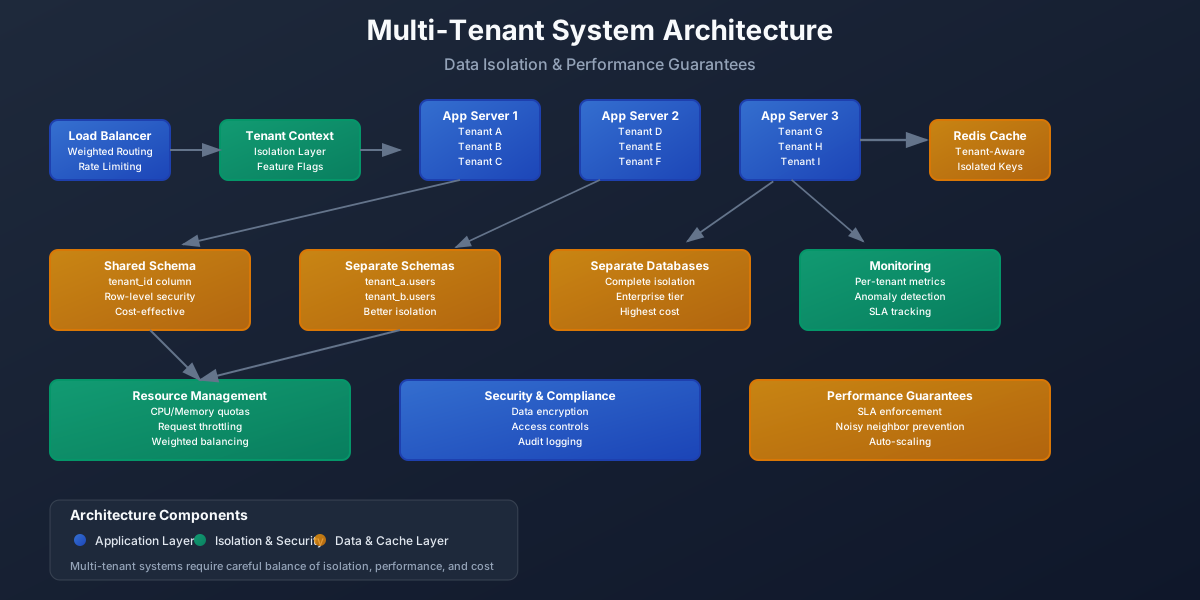
Designing Multi-Tenant Systems with Data Isolation and Performance Guarantees
Multi-tenant systems are everywhere now. Every SaaS platform you use - from Slack to Salesforce - serves thousands of customers from the same infrastructure. But here’s the thing: building these systems right is harder than it looks.
The main challenge isn’t just keeping data separate. It’s making sure one customer’s heavy workload doesn’t slow down everyone else. We call this the “noisy neighbor” problem, and it’s real.
In this article, we’ll look at how to design multi-tenant systems that actually work. We’ll cover different isolation models, show you how to implement them, and explain the trade-offs you’ll face along the way.
Why Multi-Tenancy Matters
Most companies start with single-tenant systems. Each customer gets their own database, their own servers, their own everything. This works fine when you have ten customers. But what happens when you have ten thousand?
The costs explode. You’re managing thousands of databases, thousands of deployments, thousands of monitoring dashboards. Your team can’t keep up.
Multi-tenancy solves this by sharing resources across customers. One database serves many tenants. One application instance handles requests from different customers. The infrastructure costs drop dramatically.
But you can’t just throw everyone into the same database and hope for the best. You need proper isolation. Without it, you get:
- Data leaks between customers
- Performance issues when one tenant hogs resources
- Security vulnerabilities
- Compliance nightmares
Tenant Isolation Models
There are three main ways to isolate tenants: shared schema, shared database, and separate databases. Each has different trade-offs.
Shared Schema
In a shared schema model, all tenants share the same database and the same tables. You add a tenant_id column to every table and filter by it in every query.
-- All tenants share the same users table
CREATE TABLE users (
    id SERIAL PRIMARY KEY,
    tenant_id VARCHAR(50) NOT NULL,
    email VARCHAR(255) NOT NULL,
    name VARCHAR(255) NOT NULL,
    created_at TIMESTAMP DEFAULT NOW()
);

-- Every query needs to filter by tenant
SELECT * FROM users WHERE tenant_id = 'tenant_123';
This is the cheapest option. You use one database for everyone. But it’s also the riskiest. One wrong query and you might expose another tenant’s data.
Shared Database, Separate Schemas
Here, each tenant gets their own schema within the same database. Tenant A’s data lives in schema tenant_a, while Tenant B’s data lives in schema tenant_b.
-- Tenant A's users table
CREATE TABLE tenant_a.users (
    id SERIAL PRIMARY KEY,
    email VARCHAR(255) NOT NULL,
    name VARCHAR(255) NOT NULL
);

-- Tenant B's users table
CREATE TABLE tenant_b.users (
    id SERIAL PRIMARY KEY,
    email VARCHAR(255) NOT NULL,
    name VARCHAR(255) NOT NULL
);
This gives you better isolation than shared schema. Each tenant’s data is completely separate. But you still share the same database resources, so performance can still be an issue.
Separate Databases
Each tenant gets their own database. Complete physical separation.
This is the safest option. No way to accidentally access another tenant’s data. But it’s also the most expensive. You’re back to managing thousands of databases.
Most companies use a hybrid approach. Start with shared schema for small tenants, move to separate schemas for medium tenants, and give large enterprise customers their own databases.
Resource Partitioning Strategies
Isolation isn’t just about data. You also need to partition compute, storage, and network resources.
Compute Partitioning
Your application needs to handle resource limits per tenant. If Tenant A is doing heavy data processing, it shouldn’t slow down Tenant B’s simple queries.
One approach is to use weighted queues. Each tenant gets a certain number of “credits” per minute. Heavy operations cost more credits. When a tenant runs out of credits, their requests wait.
class TenantResourceManager:
    def __init__(self):
        self.tenant_credits = {}
        self.credit_refill_rate = 100  # credits per minute

    def can_process_request(self, tenant_id, operation_cost):
        if tenant_id not in self.tenant_credits:
            self.tenant_credits[tenant_id] = self.credit_refill_rate

        return self.tenant_credits[tenant_id] >= operation_cost

    def consume_credits(self, tenant_id, operation_cost):
        if self.can_process_request(tenant_id, operation_cost):
            self.tenant_credits[tenant_id] -= operation_cost
            return True
        return False
Storage Partitioning
Different tenants might need different storage policies. Some want everything encrypted. Others need data in specific regions for compliance.
You can implement this with storage classes:
class TenantStorageConfig:
    def __init__(self, tenant_id, encryption_required, region):
        self.tenant_id = tenant_id
        self.encryption_required = encryption_required
        self.region = region

    def get_storage_client(self):
        if self.encryption_required:
            return EncryptedStorageClient(self.region)
        return StandardStorageClient(self.region)
Network Partitioning
Network isolation prevents tenants from interfering with each other’s traffic. You can use virtual networks, load balancers with tenant-aware routing, or even separate network segments for high-value customers.
Building an Isolation Layer
The key to good multi-tenancy is building an isolation layer at the application level. This layer handles tenant context, enforces policies, and ensures data never leaks between tenants.
Tenant Context Propagation
Every request needs to know which tenant it belongs to. You can pass this in headers, URL parameters, or JWT tokens.
from functools import wraps

def with_tenant_context(f):
    @wraps(f)
    def wrapper(*args, **kwargs):
        tenant_id = get_tenant_from_request()
        if not tenant_id:
            raise UnauthorizedError("No tenant context")

        # Set tenant context for this request
        set_current_tenant(tenant_id)
        return f(*args, **kwargs)
    return wrapper

@with_tenant_context
def get_user_data(user_id):
    # This function automatically has tenant context
    tenant_id = get_current_tenant()
    return db.query("SELECT * FROM users WHERE id = %s AND tenant_id = %s",
                   user_id, tenant_id)
Feature Flags and Tenant Policies
Different tenants might need different features. Some want advanced analytics. Others just need basic functionality.
class TenantFeatureManager:
    def __init__(self):
        self.tenant_features = {}

    def is_feature_enabled(self, tenant_id, feature_name):
        tenant_config = self.tenant_features.get(tenant_id, {})
        return tenant_config.get(feature_name, False)

    def get_tenant_limits(self, tenant_id):
        return self.tenant_features.get(tenant_id, {}).get('limits', {})

# Usage
if feature_manager.is_feature_enabled(tenant_id, 'advanced_analytics'):
    return generate_advanced_report(data)
else:
    return generate_basic_report(data)
Tenant-Aware Caching
Caching gets tricky in multi-tenant systems. You can’t cache data from one tenant and serve it to another.
class TenantAwareCache:
    def __init__(self, redis_client):
        self.redis = redis_client

    def get(self, key, tenant_id):
        tenant_key = f"{tenant_id}:{key}"
        return self.redis.get(tenant_key)

    def set(self, key, value, tenant_id, ttl=3600):
        tenant_key = f"{tenant_id}:{key}"
        self.redis.setex(tenant_key, ttl, value)

    def delete(self, key, tenant_id):
        tenant_key = f"{tenant_id}:{key}"
        self.redis.delete(tenant_key)

    def clear_tenant_cache(self, tenant_id):
        pattern = f"{tenant_id}:*"
        keys = self.redis.keys(pattern)
        if keys:
            self.redis.delete(*keys)
Performance Guarantees and SLAs
Multi-tenant systems need to deliver consistent performance. This means handling resource quotas, implementing proper load balancing, and setting up monitoring.
Resource Quotas
Each tenant should have limits on how much they can consume. CPU, memory, database connections, API calls - everything needs limits.
class TenantQuotaManager:
    def __init__(self):
        self.quotas = {}
        self.usage = {}

    def set_quota(self, tenant_id, resource, limit):
        if tenant_id not in self.quotas:
            self.quotas[tenant_id] = {}
        self.quotas[tenant_id][resource] = limit

    def check_quota(self, tenant_id, resource, amount=1):
        tenant_quota = self.quotas.get(tenant_id, {})
        tenant_usage = self.usage.get(tenant_id, {})

        limit = tenant_quota.get(resource, 0)
        current_usage = tenant_usage.get(resource, 0)

        return current_usage + amount <= limit

    def consume_quota(self, tenant_id, resource, amount=1):
        if not self.check_quota(tenant_id, resource, amount):
            raise QuotaExceededError(f"Tenant {tenant_id} exceeded {resource} quota")

        if tenant_id not in self.usage:
            self.usage[tenant_id] = {}

        self.usage[tenant_id][resource] = self.usage[tenant_id].get(resource, 0) + amount
Request Throttling
Rate limiting prevents any single tenant from overwhelming the system.
import time
from collections import defaultdict

class TenantRateLimiter:
    def __init__(self):
        self.requests = defaultdict(list)

    def is_allowed(self, tenant_id, max_requests=100, window_seconds=60):
        now = time.time()
        window_start = now - window_seconds

        # Clean old requests
        tenant_requests = self.requests[tenant_id]
        tenant_requests[:] = [req_time for req_time in tenant_requests if req_time > window_start]

        # Check if under limit
        if len(tenant_requests) < max_requests:
            tenant_requests.append(now)
            return True

        return False
Weighted Load Balancing
Not all tenants are equal. Enterprise customers might pay more and expect better performance. You can implement weighted load balancing to give them priority.
class WeightedTenantBalancer:
    def __init__(self):
        self.tenant_weights = {}
        self.current_weights = {}

    def set_tenant_weight(self, tenant_id, weight):
        self.tenant_weights[tenant_id] = weight
        self.current_weights[tenant_id] = weight

    def get_next_tenant(self):
        # Simple weighted round-robin
        if not self.current_weights:
            return None

        # Find tenant with highest current weight
        tenant_id = max(self.current_weights, key=self.current_weights.get)

        # Decrease weight (will be reset when it reaches 0)
        self.current_weights[tenant_id] -= 1

        # Reset weights when all reach 0
        if all(w <= 0 for w in self.current_weights.values()):
            self.current_weights = self.tenant_weights.copy()

        return tenant_id
Observability and Troubleshooting
Multi-tenant systems are complex. When something goes wrong, you need to know which tenant is affected and why.
Request Tracing
Every request should be traceable back to its tenant. Use correlation IDs and structured logging.
import logging
import uuid
from contextvars import ContextVar

# Context variable for tenant tracking
tenant_context: ContextVar[str] = ContextVar('tenant_id')
request_id_context: ContextVar[str] = ContextVar('request_id')

class TenantAwareLogger:
    def __init__(self, name):
        self.logger = logging.getLogger(name)

    def info(self, message, **kwargs):
        tenant_id = tenant_context.get(None)
        request_id = request_id_context.get(None)

        self.logger.info(message, extra={
            'tenant_id': tenant_id,
            'request_id': request_id,
            **kwargs
        })

# Usage
def process_request(tenant_id, request_data):
    request_id = str(uuid.uuid4())
    tenant_context.set(tenant_id)
    request_id_context.set(request_id)

    logger = TenantAwareLogger(__name__)
    logger.info("Processing request", data_size=len(request_data))
Tenant-Level Dashboards
Each tenant should have their own dashboard showing their usage, performance, and any issues.
class TenantDashboard:
    def __init__(self, metrics_client):
        self.metrics = metrics_client

    def get_tenant_metrics(self, tenant_id, time_range='1h'):
        return {
            'request_count': self.metrics.get_metric(
                'requests_total',
                {'tenant_id': tenant_id},
                time_range
            ),
            'response_time_p99': self.metrics.get_metric(
                'response_time_seconds',
                {'tenant_id': tenant_id, 'quantile': '0.99'},
                time_range
            ),
            'error_rate': self.metrics.get_metric(
                'errors_total',
                {'tenant_id': tenant_id},
                time_range
            )
        }

    def detect_anomalies(self, tenant_id):
        metrics = self.get_tenant_metrics(tenant_id)

        anomalies = []
        if metrics['error_rate'] > 0.05:  # 5% error rate
            anomalies.append('High error rate detected')

        if metrics['response_time_p99'] > 2.0:  # 2 seconds
            anomalies.append('Slow response times detected')

        return anomalies
Best Practices and Trade-offs
Building multi-tenant systems involves many trade-offs. Here are the key decisions you’ll face:
Cost vs. Isolation
More isolation costs more money. Separate databases are expensive but safe. Shared schemas are cheap but risky.
Most companies start with shared schemas and move to more isolation as they grow. The key is having a migration path.
Performance vs. Security
Strict isolation can hurt performance. If every query needs to check tenant context, it adds overhead.
You can optimize this with database-level row-level security or application-level query rewriting.
Complexity vs. Features
Multi-tenancy adds complexity everywhere. Caching, logging, monitoring - everything needs to be tenant-aware.
But it also enables features like cross-tenant analytics and shared resources that wouldn’t be possible otherwise.
Future Trends
AI is starting to help with multi-tenant systems. Machine learning can predict which tenants will need more resources and automatically scale them.
Some companies are experimenting with dynamic tenant placement - moving tenants between different infrastructure based on their usage patterns.
Conclusion
Multi-tenant systems are hard to build right. The isolation models, resource partitioning, and observability requirements all add complexity.
But the benefits are real. Lower costs, easier management, and the ability to serve thousands of customers from shared infrastructure.
The key is starting simple and having a clear migration path. Don’t try to solve every problem upfront. Build for your current needs, but design for future growth.
Focus on the isolation layer. Get tenant context right. Make sure data never leaks between tenants. Everything else builds on top of that foundation.
And remember - multi-tenancy is a journey, not a destination. Your system will evolve as you learn more about your tenants’ needs and usage patterns.
Start with shared schemas. Add more isolation as you grow. Use the patterns and code examples in this article as your starting point.
The noisy neighbor problem is solvable. You just need the right architecture and the discipline to stick with it.
Discussion
Loading comments...