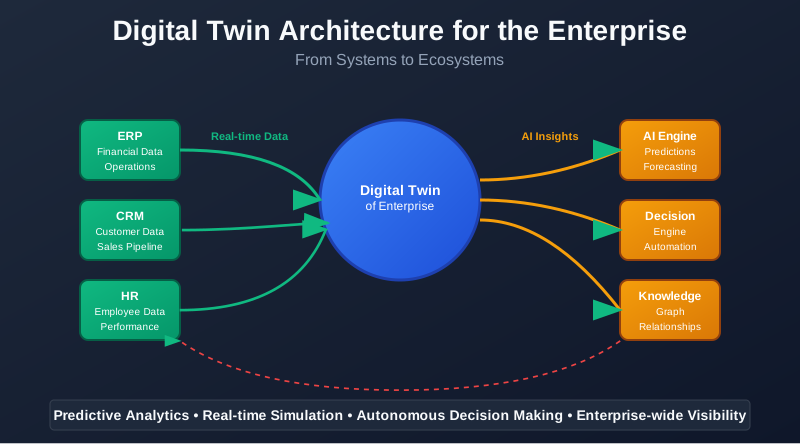
Digital Twin Architecture for the Enterprise: From Systems to Ecosystems
Most people think digital twins belong in factories. They picture sensors on machines, real-time data streams, and predictive maintenance alerts. That’s true, but it’s only part of the story.
What if you could create a digital twin of your entire organization? Not just the machines, but the people, processes, and decisions that make everything work. That’s what we’re talking about here.
Why This Matters Now
Enterprise architecture has always been about understanding how things connect. But traditional modeling stops at documentation. It shows you what exists, not what could happen.
Digital twins change that. They let you simulate scenarios, test decisions, and see outcomes before they happen. For enterprise architects, this means moving from static diagrams to living models that actually help make better choices.
Think about it: if you can model how a supply chain disruption affects your entire business, you can prepare. If you can simulate how a new product launch impacts different departments, you can plan better. That’s the power of enterprise digital twins.
What Makes a Digital Twin of an Enterprise Different
A Digital Twin of an Enterprise (DToE) isn’t just another business process model. It’s different in three key ways:
Real-time data integration: Instead of static snapshots, DToE pulls live data from all your systems. Sales numbers, customer feedback, employee metrics, everything flows in continuously.
Predictive capabilities: Traditional models show current state. DToE shows what happens next. It uses AI to forecast outcomes based on current conditions and historical patterns.
Autonomous decision support: The twin doesn’t just show you what might happen. It can suggest actions and even trigger automated responses when certain conditions are met.
This goes way beyond business process management. BPM tells you how work flows. DToE tells you how work flows, what affects it, and what happens when you change it.
Real-World Use Cases
Here are some ways companies are using enterprise digital twins:
Risk forecasting: A financial services company models market conditions, regulatory changes, and internal operations to predict compliance risks before they become problems.
Demand planning: A retail chain simulates customer behavior, inventory levels, and supply chain disruptions to optimize stock levels across all locations.
AI operations: A tech company uses its digital twin to monitor AI model performance, predict when models need retraining, and automatically adjust parameters based on changing conditions.
Resource optimization: A consulting firm models project assignments, skill availability, and client demands to optimize team allocation and prevent overcommitment.
The common thread? These companies aren’t just tracking what happened. They’re predicting what will happen and taking action before problems occur.
Building the Architecture
Creating a digital twin of your enterprise requires four main layers:
Data Abstraction and Ingestion
This is where everything starts. You need to pull data from every system that matters: ERP, CRM, HR, financial systems, even external sources like market data or weather.
The challenge isn’t just getting the data. It’s making sense of it. Different systems use different formats, update frequencies, and data quality standards. Your ingestion layer needs to normalize everything into a consistent format.
Think of it like a universal translator. It takes data from anywhere and converts it into a common language your twin can understand.
Knowledge Graph Integration
Raw data isn’t enough. You need to understand how different pieces connect. That’s where knowledge graphs come in.
A knowledge graph shows relationships between entities. It knows that “John Smith” works in “Sales Department” which reports to “VP of Sales” who manages “Q4 Revenue Target” which depends on “Customer Acquisition Rate.”
This isn’t just a fancy database. It’s how your twin understands context. When something changes in one area, the graph shows how it affects everything else.
AI and Simulation Layer
This is where the magic happens. The AI layer takes all your data and relationships and builds predictive models.
It might use machine learning to forecast sales based on market conditions and internal metrics. It could use simulation to model how a new process would affect different departments. It might use optimization algorithms to find the best way to allocate resources.
The key is making it practical. The AI needs to work with the data you have, not the data you wish you had. It needs to give you answers you can actually use, not just interesting insights.
Decision Orchestration
The final layer turns insights into actions. It takes predictions from the AI layer and either presents recommendations to humans or triggers automated responses.
This could be as simple as sending an alert when inventory gets too low. Or as complex as automatically adjusting pricing based on demand forecasts and competitor analysis.
The goal is to close the loop between prediction and action. Your twin doesn’t just tell you what might happen. It helps you do something about it.
A Reference Architecture
Here’s how these layers work together in practice:
APIs and Event Streams: All your systems expose APIs or publish events. Your ingestion layer subscribes to these streams and pulls data continuously.
Knowledge Models: A graph database stores relationships between entities. As new data comes in, the graph updates automatically.
Simulation Engine: AI models run continuously, updating predictions as new data arrives. They use the knowledge graph to understand context and relationships.
Decision Engine: Rules and machine learning models determine when to take action. They might send alerts, trigger workflows, or update other systems.
Governance Layer: Everything needs oversight. You need controls for data quality, model accuracy, and decision accountability.
This architecture is modular. You can start with one department or process and expand over time. You can swap out components as your needs change. You can integrate with existing systems without disrupting current operations.
Security and Data Integrity
Enterprise digital twins handle sensitive data. You need strong security from day one.
Data encryption: Everything should be encrypted in transit and at rest. Use industry-standard protocols and key management.
Access controls: Not everyone needs access to everything. Implement role-based permissions and audit all access.
Data lineage: Track where data comes from and how it’s transformed. This helps with compliance and debugging.
Model governance: AI models can drift or become biased. You need processes to monitor performance and retrain when necessary.
Privacy protection: Personal data needs special handling. Follow GDPR, CCPA, and other regulations. Consider techniques like differential privacy for sensitive analysis.
Implementation Example
Let’s look at a practical example. Here’s a Python microservice that publishes digital twin state updates to Kafka:
import json
import time
from datetime import datetime
from kafka import KafkaProducer
from typing import Dict, Any
import logging

class DigitalTwinPublisher:
    def __init__(self, kafka_bootstrap_servers: str, topic: str):
        self.producer = KafkaProducer(
            bootstrap_servers=kafka_bootstrap_servers,
            value_serializer=lambda v: json.dumps(v).encode('utf-8'),
            key_serializer=lambda k: k.encode('utf-8') if k else None
        )
        self.topic = topic
        self.logger = logging.getLogger(__name__)

    def publish_twin_update(self, twin_id: str, update_data: Dict[str, Any]):
        """Publish a digital twin state update to Kafka"""

        # Create the twin update payload
        twin_update = {
            "twin_id": twin_id,
            "timestamp": datetime.utcnow().isoformat(),
            "version": "1.0",
            "state": {
                "asset_state": update_data.get("asset_state", "operational"),
                "business_metric": update_data.get("business_metric", 0),
                "forecast_accuracy": update_data.get("forecast_accuracy", 0.0),
                "prediction_confidence": update_data.get("prediction_confidence", 0.0),
                "last_updated": datetime.utcnow().isoformat()
            },
            "metadata": {
                "source_system": update_data.get("source_system", "unknown"),
                "data_quality_score": update_data.get("data_quality_score", 1.0),
                "processing_time_ms": update_data.get("processing_time_ms", 0)
            }
        }

        try:
            # Publish to Kafka
            future = self.producer.send(
                self.topic,
                value=twin_update,
                key=twin_id
            )

            # Wait for confirmation
            record_metadata = future.get(timeout=10)

            self.logger.info(f"Published twin update for {twin_id} to partition {record_metadata.partition}")

        except Exception as e:
            self.logger.error(f"Failed to publish twin update: {e}")
            raise

    def simulate_enterprise_twin(self, twin_id: str):
        """Simulate a digital twin with realistic enterprise data"""

        # Simulate different business scenarios
        scenarios = [
            {
                "asset_state": "operational",
                "business_metric": 125000,  # Monthly revenue
                "forecast_accuracy": 0.87,
                "prediction_confidence": 0.92,
                "source_system": "crm",
                "data_quality_score": 0.95
            },
            {
                "asset_state": "degraded",
                "business_metric": 98000,
                "forecast_accuracy": 0.73,
                "prediction_confidence": 0.78,
                "source_system": "erp",
                "data_quality_score": 0.88
            },
            {
                "asset_state": "maintenance",
                "business_metric": 45000,
                "forecast_accuracy": 0.91,
                "prediction_confidence": 0.89,
                "source_system": "hr",
                "data_quality_score": 0.92
            }
        ]

        for i, scenario in enumerate(scenarios):
            self.publish_twin_update(twin_id, scenario)
            time.sleep(2)  # Simulate real-time updates

# Example usage
if __name__ == "__main__":
    # Configure logging
    logging.basicConfig(level=logging.INFO)

    # Create publisher
    publisher = DigitalTwinPublisher(
        kafka_bootstrap_servers="localhost:9092",
        topic="digital-twin-updates"
    )

    # Simulate enterprise digital twin
    publisher.simulate_enterprise_twin("enterprise-sales-dept-001")
This example shows the basic structure. In practice, you’d add more sophisticated data validation, error handling, and integration with your actual systems.
Best Practices
Here’s what we’ve learned from implementing enterprise digital twins:
Start small, think big: Begin with one department or process. Get it working well, then expand. Don’t try to model everything at once.
Federated data management: Don’t try to centralize all data. Keep it where it lives, but make it accessible through APIs and event streams.
Real-time synchronization: Your twin needs to stay current. Use event-driven patterns to update the model as soon as new data arrives.
Monitoring and feedback loops: Track how accurate your predictions are. Use that feedback to improve your models over time.
Human oversight: AI can suggest actions, but humans should make final decisions. Build in review processes and override capabilities.
Incremental value: Each component should provide value on its own. Don’t wait for the entire system to be perfect before you start using it.
The Road Ahead
Enterprise digital twins are still evolving. The technology is getting better, the tools are getting easier to use, and the use cases are expanding.
The companies that succeed will be the ones that start now. They’ll learn by doing, improve through iteration, and build capabilities that give them real competitive advantages.
This isn’t about replacing human judgment. It’s about giving humans better information to make better decisions. It’s about understanding your organization in ways that weren’t possible before.
The future belongs to organizations that can see around corners. Digital twins help you do exactly that.
Getting Started
If you want to explore enterprise digital twins, start here:
-
Map your data sources: List all the systems that contain information about your organization. Understand what data they have and how often it updates.
-
Identify key relationships: Figure out how different parts of your organization connect. What affects what? Where are the dependencies?
-
Pick a pilot project: Choose one process or department to model first. Something that’s important but not too complex.
-
Build the foundation: Set up data ingestion, create a basic knowledge graph, and start collecting real-time data.
-
Add intelligence: Implement simple predictive models. Start with basic forecasting and work up to more sophisticated AI.
-
Close the loop: Connect predictions to actions. Make sure insights lead to decisions and decisions lead to results.
The technology exists. The patterns are proven. The question is whether you’ll be ready when the opportunity comes.
Your organization is more complex than any single person can understand. But with the right digital twin, you can see the whole picture. And that changes everything.
Discussion
Loading comments...