Designing Latency-Aware Systems: Adaptive Queues and Dynamic Backpressure Strategies
Modern distributed systems face a tough challenge. They need to handle traffic spikes, service failures, and unpredictable workloads while keeping response times stable. Traditional rate limiting and static queuing just don’t cut it anymore.
The problem is simple: your system works fine under normal load, but when things get busy, everything falls apart. Requests pile up in queues, services start timing out, and users get frustrated. We need smarter approaches.
This article shows you how to build systems that adapt in real-time. We’ll look at dynamic queuing, intelligent backpressure, and feedback loops that keep your services responsive even when the world around them changes.
Why Latency Awareness Matters
Most systems treat latency as an afterthought. They set up basic rate limits and hope for the best. But latency isn’t just a number - it’s a signal about what’s happening inside your system.
When latency spikes, it usually means one of three things:
- Your queues are getting too deep
- A downstream service is struggling
- Your system is hitting resource limits
The old way of handling this was to set static limits. “Never allow more than 100 requests per second” or “Queue can hold 1000 items max.” But this approach breaks down when conditions change.
What if your database is running slow today? Your static limits might be too high. What if you just added more servers? Your limits might be too low. You need systems that can adjust.
Understanding Latency Dynamics
Not all latency is created equal. Average latency tells you one story, but tail latency tells you another. If 95% of your requests complete in 10ms but 5% take 5 seconds, your average looks fine but your users are suffering.
In microservices, this gets worse. One slow service can cascade through your entire system. A payment service that’s having issues doesn’t just affect payments - it affects everything that depends on it.
Queue depth plays a big role here. When queues get deep, requests wait longer. But it’s not just about the number of items in the queue. It’s about how long each item takes to process.
If your service normally takes 1ms per request, a queue of 1000 items means 1 second of delay. But if your service is struggling and now takes 100ms per request, that same queue means 100 seconds of delay.
Adaptive Queuing Concepts
Static queues are like having a fixed-size parking lot. Sometimes it’s half empty, sometimes it’s overflowing. Adaptive queues are like having a parking lot that can expand and contract based on demand.
There are two main approaches: time-based limits and size-based limits.
Time-based limits work like this: “Don’t let requests wait more than 200ms in the queue.” When latency starts climbing, you reduce the queue size. When latency is low, you can allow more items.
Size-based limits are simpler: “Don’t allow more than X items in the queue.” But the magic is in how you choose X. You base it on current conditions, not some fixed number.
Dynamic prioritization adds another layer. Not all requests are equal. A user checking their account balance is different from a user making a large transfer. You can prioritize based on user tiers, request types, or SLA requirements.
Backpressure Strategies in Modern Architectures
Backpressure is how your system tells upstream services to slow down. Traditional systems use simple on/off signals. “I’m busy, stop sending me requests.” But this is crude and can cause oscillations.
Modern approaches use graduated backpressure. Instead of just “stop” or “go,” you send signals like “send 50% of normal rate” or “only send high-priority requests.”
Reactive Streams provide a good foundation for this. They give you built-in backpressure mechanisms that work across service boundaries. You can propagate pressure signals up the chain, letting each service adjust its behavior.
The key is using latency as feedback. When your service starts slowing down, it should signal upstream services before it gets overwhelmed. This prevents the cascade of failures that plague many systems.
Building an Adaptive Queue
Let’s look at a practical example. Here’s a Python implementation of an adaptive queue manager:
import asyncio
import time
from collections import deque
from dataclasses import dataclass
from typing import Optional, Callable
import logging

@dataclass
class QueueMetrics:
    current_depth: int
    avg_processing_time: float
    p95_latency: float
    p99_latency: float
    error_rate: float

class AdaptiveQueue:
    def __init__(self,
                 max_depth: int = 1000,
                 target_latency_ms: float = 100.0,
                 min_depth: int = 10):
        self.max_depth = max_depth
        self.target_latency_ms = target_latency_ms
        self.min_depth = min_depth
        self.current_limit = max_depth

        self.queue = asyncio.Queue(maxsize=max_depth)
        self.processing_times = deque(maxlen=1000)
        self.latencies = deque(maxlen=1000)

        self.metrics_callback: Optional[Callable] = None
        self.logger = logging.getLogger(__name__)

    async def put(self, item, priority: int = 0) -> bool:
        """Add item to queue with backpressure control"""
        if self.queue.qsize() >= self.current_limit:
            self.logger.warning(f"Queue full, rejecting request. Current limit: {self.current_limit}")
            return False

        try:
            await asyncio.wait_for(self.queue.put((priority, time.time(), item)), timeout=0.1)
            return True
        except asyncio.TimeoutError:
            self.logger.warning("Queue put timeout")
            return False

    async def get(self):
        """Get next item from queue"""
        priority, enqueue_time, item = await self.queue.get()

        start_time = time.time()
        processing_time = start_time - enqueue_time
        self.processing_times.append(processing_time)

        return item, start_time

    def record_completion(self, start_time: float, success: bool = True):
        """Record when processing completes"""
        total_latency = time.time() - start_time
        self.latencies.append(total_latency)

        if not success:
            self.logger.error("Request processing failed")

    def adjust_limits(self):
        """Adjust queue limits based on current metrics"""
        if len(self.latencies) < 10:
            return  # Not enough data

        current_p95 = self._calculate_percentile(self.latencies, 0.95)
        current_p99 = self._calculate_percentile(self.latencies, 0.99)

        # If we're exceeding target latency, reduce queue size
        if current_p95 > self.target_latency_ms:
            new_limit = max(self.min_depth, int(self.current_limit * 0.8))
            self.logger.info(f"Reducing queue limit: {self.current_limit} -> {new_limit}")
            self.current_limit = new_limit

        # If we're well under target, we can increase queue size
        elif current_p95 < self.target_latency_ms * 0.5:
            new_limit = min(self.max_depth, int(self.current_limit * 1.2))
            self.logger.info(f"Increasing queue limit: {self.current_limit} -> {new_limit}")
            self.current_limit = new_limit

        # Update queue size
        self.queue._maxsize = self.current_limit

        # Report metrics
        if self.metrics_callback:
            metrics = QueueMetrics(
                current_depth=self.queue.qsize(),
                avg_processing_time=sum(self.processing_times) / len(self.processing_times),
                p95_latency=current_p95,
                p99_latency=current_p99,
                error_rate=0.0  # Would track actual errors
            )
            self.metrics_callback(metrics)

    def _calculate_percentile(self, values, percentile):
        """Calculate percentile of values"""
        sorted_values = sorted(values)
        index = int(len(sorted_values) * percentile)
        return sorted_values[min(index, len(sorted_values) - 1)]

# Usage example
async def process_requests(queue: AdaptiveQueue):
    """Process requests from the adaptive queue"""
    while True:
        try:
            item, start_time = await queue.get()

            # Simulate work
            await asyncio.sleep(0.01)  # 10ms processing

            # Record completion
            queue.record_completion(start_time, success=True)

        except Exception as e:
            queue.record_completion(start_time, success=False)
            logging.error(f"Error processing request: {e}")

async def main():
    queue = AdaptiveQueue()

    # Start background task to adjust limits
    async def adjust_limits_task():
        while True:
            queue.adjust_limits()
            await asyncio.sleep(1)  # Adjust every second

    # Start processing
    asyncio.create_task(process_requests(queue))
    asyncio.create_task(adjust_limits_task())

    # Simulate incoming requests
    for i in range(1000):
        success = await queue.put(f"request-{i}")
        if not success:
            print(f"Request {i} rejected due to backpressure")
        await asyncio.sleep(0.001)  # 1ms between requests

if __name__ == "__main__":
    asyncio.run(main())
This implementation shows the core concepts:
- Dynamic limits: The queue adjusts its size based on current latency
- Latency tracking: It monitors both processing time and total latency
- Gradual adjustment: Changes happen slowly to avoid oscillations
- Metrics reporting: External systems can monitor queue health
End-to-End Architecture
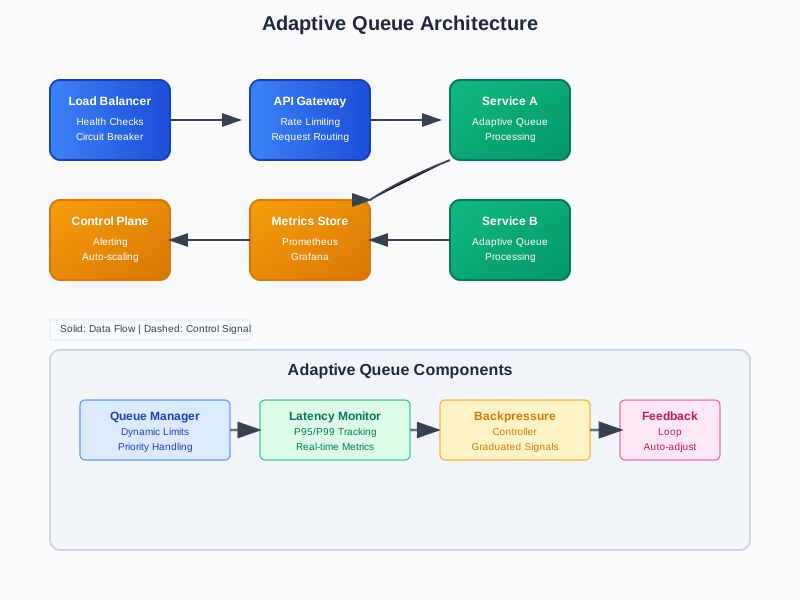
Here’s how this fits into a larger system:
┌─────────────────┐    ┌──────────────────┐    ┌─────────────────┐
│   Load Balancer │    │  API Gateway     │    │  Service A      │
│                 │    │                  │    │                 │
│ - Health checks │◄──►│ - Rate limiting  │◄──►│ - Adaptive queue│
│ - Circuit break │    │ - Request routing│    │ - Processing    │
└─────────────────┘    └──────────────────┘    └─────────────────┘
                                │                        │
                                │                        ▼
                       ┌──────────────────┐    ┌─────────────────┐
                       │  Metrics Store   │    │  Service B      │
                       │                  │    │                 │
                       │ - Prometheus     │◄──►│ - Adaptive queue│
                       │ - Grafana        │    │ - Processing    │
                       └──────────────────┘    └─────────────────┘
                                │
                                ▼
                       ┌──────────────────┐
                       │  Control Plane   │
                       │                  │
                       │ - Alerting       │
                       │ - Auto-scaling   │
                       │ - Config updates │
                       └──────────────────┘
The flow works like this:
- Load balancer distributes requests across API gateways
- API gateway applies initial rate limiting and routes to services
- Services use adaptive queues to manage their own capacity
- Metrics store collects latency and queue depth data
- Control plane uses this data to make scaling decisions
Each service reports its queue depth and current latency. The control plane can see when services are getting overwhelmed and scale them up. It can also adjust rate limits at the gateway level.
Integration with Monitoring
You’ll want to integrate this with your existing monitoring stack. Here’s how to add Prometheus metrics:
from prometheus_client import Counter, Histogram, Gauge, start_http_server

# Metrics
queue_depth = Gauge('adaptive_queue_depth', 'Current queue depth')
queue_limit = Gauge('adaptive_queue_limit', 'Current queue limit')
request_latency = Histogram('request_latency_seconds', 'Request latency')
queue_rejections = Counter('queue_rejections_total', 'Total rejected requests')

class AdaptiveQueueWithMetrics(AdaptiveQueue):
    def __init__(self, *args, **kwargs):
        super().__init__(*args, **kwargs)
        self.rejection_count = 0

    async def put(self, item, priority: int = 0) -> bool:
        success = await super().put(item, priority)
        if not success:
            queue_rejections.inc()
            self.rejection_count += 1
        return success

    def adjust_limits(self):
        super().adjust_limits()

        # Update Prometheus metrics
        queue_depth.set(self.queue.qsize())
        queue_limit.set(self.current_limit)

        if self.latencies:
            for latency in self.latencies:
                request_latency.observe(latency)
Real-World Considerations
Building adaptive systems isn’t just about the code. You need to think about several practical concerns:
Monitoring and Alerting: You need visibility into how your queues are behaving. Set up alerts for when queue depths spike or latency exceeds thresholds.
Testing: Adaptive systems are harder to test because they change behavior. You need to test under various load conditions and verify that adaptations work as expected.
Configuration: Don’t hardcode all the parameters. Make them configurable so you can tune the system without code changes.
Graceful Degradation: What happens when your adaptive system itself fails? Have fallbacks to static limits.
Observability: Log when adaptations happen and why. This helps with debugging and understanding system behavior.
Performance Gains
When done right, adaptive systems provide significant benefits:
- Better resource utilization: You use more capacity when it’s available
- Improved user experience: Fewer timeouts and more consistent response times
- Reduced operational overhead: Less manual tuning of rate limits and queue sizes
- Better fault tolerance: Systems can adapt to partial failures
But there are trade-offs. Adaptive systems are more complex. They require more monitoring and can be harder to debug when things go wrong. The key is finding the right balance for your specific use case.
Future Directions
The next frontier is using machine learning to make these adaptations smarter. Instead of simple rules like “reduce queue size when latency is high,” ML models can learn complex patterns and make more nuanced decisions.
For example, a model might learn that certain types of requests always take longer during business hours, or that database latency spikes predictably during backup windows. It can adjust queue behavior proactively rather than reactively.
We’re also seeing more sophisticated backpressure mechanisms that consider multiple factors simultaneously - not just latency, but also error rates, resource utilization, and business priorities.
Conclusion
Static rate limiting and queuing strategies are becoming obsolete. Modern systems need to adapt to changing conditions in real-time. Adaptive queues and dynamic backpressure provide the foundation for building systems that can handle unpredictable workloads while maintaining stable performance.
The key is starting simple. Begin with basic adaptive queuing, add monitoring, and gradually make your system smarter. Don’t try to solve every problem at once.
Remember: the goal isn’t to eliminate all latency or handle infinite load. It’s to build systems that degrade gracefully and recover quickly when things go wrong. Adaptive systems give you that resilience.
Start with one service. Add adaptive queuing. Monitor the results. Then expand to other services. The patterns we’ve covered here will scale to much larger systems.
The future belongs to systems that can think and adapt. Your users will thank you for building them.
Discussion
Loading comments...