AI-Governed Enterprise Architecture: Building Self-Evolving Operating Models
Most enterprise architecture teams work like this: they create governance frameworks, document standards, and then hope teams follow them. But here’s the thing - they rarely do. Not because teams are rebellious, but because governance models are static while organizations change constantly.
What if your architecture could watch itself? What if it could spot problems before they become disasters? That’s where AI-governed enterprise architecture comes in.
The Problem with Static Governance
Traditional governance works like a checklist. You define rules, check compliance quarterly, and update policies when something breaks. But modern enterprises move too fast for this approach.
Teams deploy new services daily. Dependencies change weekly. Technology stacks evolve monthly. By the time your governance review happens, the architecture has already drifted from your standards.
This creates a gap between what you think your architecture looks like and what it actually is. And that gap costs money, creates security risks, and slows down delivery.
What AI-Governed Architecture Actually Means
AI-governed architecture isn’t about replacing architects with robots. It’s about giving your governance framework a brain that never sleeps.
Think of it as having a continuous architectural auditor that watches everything happening in your systems. It spots violations in real-time, suggests improvements, and even fixes simple problems automatically.
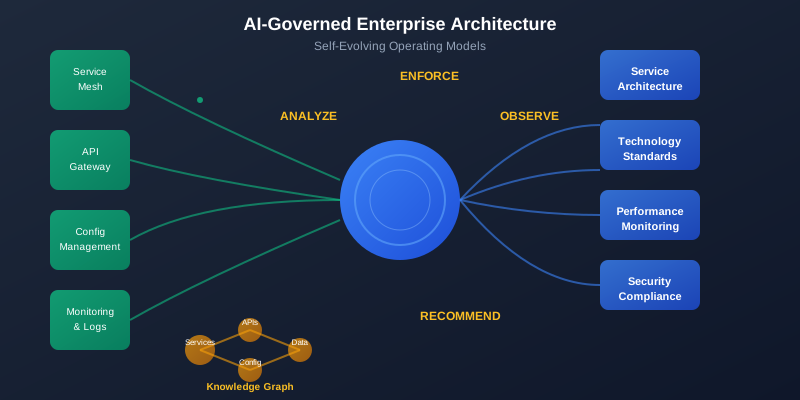
The key is something called “Autonomic Governance Loops.” These are AI agents that continuously observe, analyze, recommend, and enforce architectural decisions across your entire enterprise.
How the AI Governance Loop Works
The AI governance loop has four stages that run continuously:
Observe: The AI watches your systems 24/7. It collects data from service meshes, API gateways, configuration management tools, and deployment pipelines. It tracks what services exist, how they connect, what technologies they use, and how they perform.
Analyze: The AI processes this data using your architectural rules and standards. It looks for violations, identifies patterns, and spots potential problems before they become real issues.
Recommend: When the AI finds something wrong, it suggests specific fixes. These aren’t generic recommendations - they’re tailored to your specific situation and constraints.
Enforce: For simple violations, the AI can fix them automatically. For complex issues, it escalates to human architects with clear explanations of what’s wrong and how to fix it.
This isn’t theoretical. Companies are already doing this with tools like Open Policy Agent, service mesh observability platforms, and custom AI agents built on top of their existing architecture management tools.
Building Your Feedback System
The foundation of AI-governed architecture is telemetry. You need data flowing from every part of your system into a central knowledge graph.
Start with service discovery. Your AI needs to know what services exist, where they run, and how they connect. This comes from your service mesh, API gateway, or service registry.
Add configuration data. What frameworks are teams using? What databases? What security policies? This comes from your configuration management tools and infrastructure as code.
Include performance metrics. How are services performing? What’s the error rate? Where are the bottlenecks? This comes from your monitoring and observability stack.
The AI builds a knowledge graph from all this data. It understands relationships between services, tracks technology usage patterns, and identifies architectural trends over time.
A Practical Example
Let’s look at a Python AI agent that analyzes architecture metadata and flags violations:
import json
import yaml
from typing import Dict, List, Any
from dataclasses import dataclass
from enum import Enum

class ViolationType(Enum):
    CIRCULAR_DEPENDENCY = "circular_dependency"
    NON_COMPLIANT_TECH = "non_compliant_tech"
    MISSING_SECURITY = "missing_security"
    PERFORMANCE_ANTIPATTERN = "performance_antipattern"

@dataclass
class ArchitectureViolation:
    service: str
    violation_type: ViolationType
    severity: str
    description: str
    recommendation: str

class ArchitectureGovernanceAgent:
    def __init__(self, rules_config: Dict[str, Any]):
        self.rules = rules_config
        self.services = {}
        self.dependencies = {}

    def load_architecture_metadata(self, metadata_file: str):
        """Load architecture metadata from JSON or YAML file"""
        with open(metadata_file, 'r') as f:
            if metadata_file.endswith('.json'):
                data = json.load(f)
            else:
                data = yaml.safe_load(f)

        self.services = data.get('services', {})
        self.dependencies = data.get('dependencies', {})

    def detect_circular_dependencies(self) -> List[ArchitectureViolation]:
        """Detect circular dependencies in service architecture"""
        violations = []
        visited = set()
        rec_stack = set()

        def has_cycle(service):
            visited.add(service)
            rec_stack.add(service)

            for dep in self.dependencies.get(service, []):
                if dep not in visited:
                    if has_cycle(dep):
                        return True
                elif dep in rec_stack:
                    return True

            rec_stack.remove(service)
            return False

        for service in self.services:
            if service not in visited:
                if has_cycle(service):
                    violations.append(ArchitectureViolation(
                        service=service,
                        violation_type=ViolationType.CIRCULAR_DEPENDENCY,
                        severity="high",
                        description=f"Circular dependency detected involving {service}",
                        recommendation="Break the circular dependency by introducing an abstraction layer or event-driven communication"
                    ))

        return violations

    def check_technology_compliance(self) -> List[ArchitectureViolation]:
        """Check if services use approved technology stacks"""
        violations = []
        approved_tech = self.rules.get('approved_technologies', [])

        for service, config in self.services.items():
            tech_stack = config.get('technology_stack', [])
            for tech in tech_stack:
                if tech not in approved_tech:
                    violations.append(ArchitectureViolation(
                        service=service,
                        violation_type=ViolationType.NON_COMPLIANT_TECH,
                        severity="medium",
                        description=f"Service {service} uses non-approved technology: {tech}",
                        recommendation=f"Replace {tech} with an approved alternative or add it to the approved technologies list"
                    ))

        return violations

    def check_security_requirements(self) -> List[ArchitectureViolation]:
        """Check if services meet security requirements"""
        violations = []
        security_requirements = self.rules.get('security_requirements', {})

        for service, config in self.services.items():
            security_config = config.get('security', {})

            for requirement, required_value in security_requirements.items():
                if requirement not in security_config or security_config[requirement] != required_value:
                    violations.append(ArchitectureViolation(
                        service=service,
                        violation_type=ViolationType.MISSING_SECURITY,
                        severity="high",
                        description=f"Service {service} missing security requirement: {requirement}",
                        recommendation=f"Configure {requirement} to {required_value}"
                    ))

        return violations

    def analyze_architecture(self) -> List[ArchitectureViolation]:
        """Run all architecture analysis checks"""
        all_violations = []
        all_violations.extend(self.detect_circular_dependencies())
        all_violations.extend(self.check_technology_compliance())
        all_violations.extend(self.check_security_requirements())

        return all_violations

    def generate_governance_report(self) -> Dict[str, Any]:
        """Generate a comprehensive governance report"""
        violations = self.analyze_architecture()

        report = {
            "total_services": len(self.services),
            "total_violations": len(violations),
            "violations_by_type": {},
            "violations_by_severity": {},
            "recommendations": []
        }

        for violation in violations:
            # Count by type
            violation_type = violation.violation_type.value
            if violation_type not in report["violations_by_type"]:
                report["violations_by_type"][violation_type] = 0
            report["violations_by_type"][violation_type] += 1

            # Count by severity
            if violation.severity not in report["violations_by_severity"]:
                report["violations_by_severity"][violation.severity] = 0
            report["violations_by_severity"][violation.severity] += 1

            # Collect recommendations
            report["recommendations"].append({
                "service": violation.service,
                "issue": violation.description,
                "fix": violation.recommendation
            })

        return report

# Example usage
if __name__ == "__main__":
    # Load governance rules
    rules = {
        "approved_technologies": ["Python", "Node.js", "PostgreSQL", "Redis"],
        "security_requirements": {
            "authentication": True,
            "encryption": True,
            "rate_limiting": True
        }
    }

    # Create governance agent
    agent = ArchitectureGovernanceAgent(rules)

    # Load architecture metadata
    agent.load_architecture_metadata("architecture_metadata.yaml")

    # Generate governance report
    report = agent.generate_governance_report()

    print("=== Architecture Governance Report ===")
    print(f"Total Services: {report['total_services']}")
    print(f"Total Violations: {report['total_violations']}")
    print(f"Violations by Type: {report['violations_by_type']}")
    print(f"Violations by Severity: {report['violations_by_severity']}")
    print("\nRecommendations:")
    for rec in report['recommendations']:
        print(f"- {rec['service']}: {rec['issue']}")
        print(f"  Fix: {rec['fix']}\n")
This agent can analyze your architecture metadata and spot common problems. It checks for circular dependencies, ensures teams use approved technologies, and verifies security requirements are met.
The Multi-Agent Approach
Real enterprise architecture governance needs multiple AI agents working together. Each agent specializes in different aspects of your architecture.
Service Architecture Agent: Monitors service boundaries, API contracts, and data flow patterns.
Technology Standards Agent: Tracks technology usage, license compliance, and security posture.
Performance Agent: Identifies bottlenecks, scalability issues, and optimization opportunities.
Security Agent: Monitors for vulnerabilities, compliance violations, and security policy breaches.
These agents work together through a central orchestration layer. They share data, coordinate responses, and escalate issues to human architects when needed.
Integration with Your Existing Tools
You don’t need to replace your current architecture management tools. AI governance works on top of what you already have.
Connect to your service mesh (Istio, Linkerd, Consul Connect) for service discovery and traffic data. Integrate with your API gateway (Kong, Ambassador, AWS API Gateway) for API usage patterns. Pull data from your monitoring stack (Prometheus, DataDog, New Relic) for performance metrics.
Use tools like Open Policy Agent for policy enforcement. Connect to your CI/CD pipeline to block deployments that violate architectural standards. Integrate with your ticketing system to automatically create tasks for architectural improvements.
The Benefits Are Real
Companies using AI-governed architecture see measurable improvements:
Faster compliance cycles: Instead of quarterly reviews, compliance happens continuously. Problems get caught and fixed in days, not months.
Reduced architectural drift: Teams get immediate feedback when they deviate from standards. This prevents small changes from accumulating into big problems.
Better decision making: Architects get data-driven insights about their systems. They can see trends, predict problems, and make informed decisions about technology choices.
Lower costs: Catching problems early saves money. Fixing a circular dependency during development costs much less than fixing it in production.
The Challenges You’ll Face
This isn’t easy to implement. You’ll face several challenges:
Data quality: AI governance is only as good as your data. If your service discovery is incomplete or your monitoring has gaps, the AI will make bad decisions.
False positives: AI agents will flag things that aren’t actually problems. You need processes to handle these and improve the AI’s accuracy over time.
Change management: Teams need to trust the AI’s recommendations. This requires clear communication about what the AI is doing and why.
Complexity: Managing multiple AI agents across a large enterprise is complex. You need good tooling and processes to keep everything working smoothly.
Making It Transparent and Explainable
One of the biggest concerns about AI governance is the “black box” problem. Teams need to understand why the AI made a particular decision.
Your AI agents should provide clear explanations for every recommendation. When they flag a violation, they should explain what rule was violated, why it matters, and how to fix it.
Use techniques like attention mechanisms in neural networks or rule-based explanations in traditional AI systems. The goal is to make the AI’s reasoning process visible and understandable.
Getting Started
Start small. Pick one area of your architecture where governance is already challenging. Maybe it’s API standards, or database usage, or security policies.
Build a simple AI agent that monitors this one area. Give it clear rules and good data. Let it run for a few weeks and see what it finds.
Once you prove the concept works, expand to other areas. Add more sophisticated analysis. Connect more data sources. Build more specialized agents.
The key is to start with something concrete and measurable. Don’t try to solve all of enterprise architecture governance on day one.
The Future of Architecture Governance
We’re moving from reactive governance to self-evolving architecture. Instead of fixing problems after they happen, AI agents prevent them from happening in the first place.
This doesn’t replace human architects. It makes them more effective. They spend less time on routine compliance checking and more time on strategic decisions and complex problem solving.
The organizations that figure this out first will have a significant advantage. They’ll move faster, make fewer mistakes, and build more resilient systems.
Your architecture governance doesn’t have to be static anymore. With AI agents watching and learning, it can evolve and improve continuously. The question isn’t whether this will happen - it’s whether you’ll be ready when it does.
Discussion
Loading comments...